

Newnham is a leafy, affluent residential area on the south‑west side of Cambridge, running along the west bank of the River Cam and within easy reach of the historic city centre. It includes well‑known green spaces such as Grantchester Meadows and Lammas Land, giving residents unusually direct access to riverside walks and open countryside from a city address. The neighbourhood is popular with academics, professionals and families, combining period streetscapes with independent shops, cafés and a friendly village atmosphere. Over recent decades it has consistently ranked among the most desirable parts of Cambridge, and has been highlighted in national quality‑of‑life surveys as one of the city’s most attractive wards.
- Why are Newnham property prices so high?
- A brief history of Newnham and its character today
- Housing stock and who lives here
- Schools, education and the academic pull
- Green spaces, river access and quality of life
- Connectivity, commuting and access to Cambridge
- Conservation status and long‑term value
- Weighing the premium: who is Newnham right for?
- So, is Newnham worth the premium?
From a buyer’s perspective, Newnham’s appeal is twofold: it delivers a Cambridge lifestyle that feels quieter and greener than the city centre, while remaining walkable or cyclable from University departments, colleges and the main rail station via good bus links. That combination of convenience and calm is a key driver of the area’s sustained price premium over the wider Cambridge market.
Why are Newnham property prices so high?
Recent market data underline just how strong that premium has become. Average sold prices in Newnham are reported at around £1.2 million over the last three years, with some individual streets seeing sales as high as £5 million. This level is more than double many other parts of Cambridge, with one analysis noting that the average price in Newnham is approximately 134% higher than the city average. Separate commentary on the Cambridge market has also identified Newnham as the most expensive residential area not only in the city but across the whole of Cambridgeshire, with recent average figures for the area above £1.29 million and annual price growth in the region of 15%.
Behind these headline numbers lies a classic case of intense demand meeting limited, tightly controlled supply. Newnham is largely built‑up and bounded by the river, college land and protected green spaces, leaving very little room for new large‑scale development. At the same time, the area is strongly favoured by university staff, medical professionals, London commuters and international buyers who value the proximity to central Cambridge and the reputation of local schools. These groups are often prepared to bid aggressively on the relatively small number of homes that come to market, helping to sustain values even when the wider housing market slows.
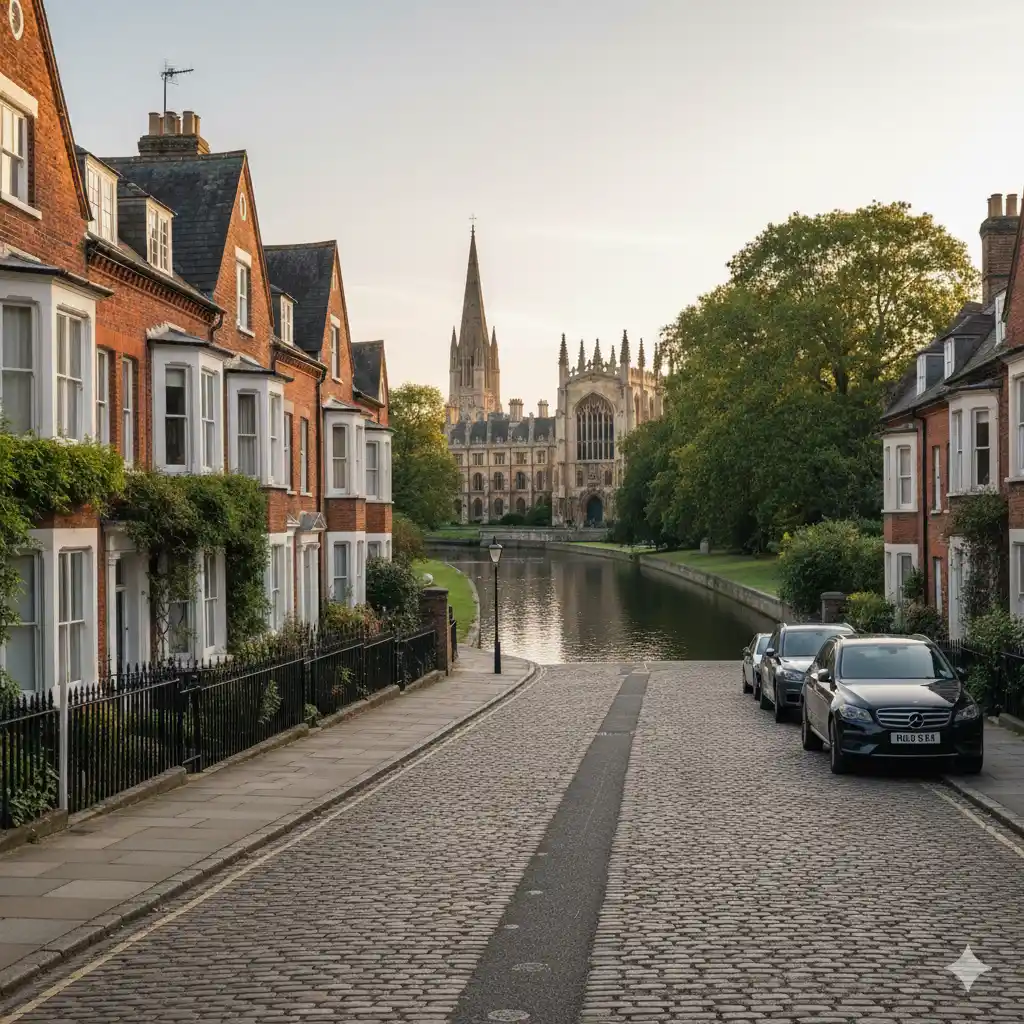
A brief history of Newnham and its character today
Understanding Newnham’s history helps explain why its streetscape and atmosphere feel so distinct, and why this matters for long‑term value. The earliest settlement grew on a small island of permanently dry land on the west bank of the Cam, surrounded by low‑lying pasture that was prone to winter flooding. A watermill at Newnham is recorded in the Domesday Book of 1086, and for centuries the hamlet was linked to Cambridge by a series of modest bridges and fords over the river channels.
In the thirteenth century, the Carmelite order founded a convent at Newnham, but frequent flooding and the desire to be closer to the developing university led the monks to relocate into the town by the 1290s. For long periods afterwards the area remained largely agricultural, defined by orchards and meadows on the city’s western edge. Major change arrived in the later nineteenth century, when the enclosure of Cambridge’s open fields paved the way for planned residential streets; Newnham Croft grew in this era as a predominantly middle‑class suburb, partly in the borough of Cambridge and partly in the parish of Grantchester.
By 1911, Newnham Croft was formally incorporated into Cambridge, and Newnham became a separate ecclesiastical parish later in the decade. Many of the terraced and semi‑detached houses from this period survive with their original brickwork, bay windows and long gardens, and are now recognised for their heritage value within the Newnham Croft Conservation Area. That combination of historic fabric, human‑scale streets and mature trees has become part of the area’s identity, making it especially attractive to buyers who prioritise architecture, character and a sense of place over newer‑build districts on the city fringe.
Housing stock and who lives here
Newnham’s housing stock is surprisingly varied for a compact area, but it is united by a consistently high baseline of quality. Victorian and Edwardian terraces dominate many streets in Newnham Croft, often with modest front gardens and long, narrow rear plots accessed by pedestrian alleys. These homes typically offer well‑proportioned rooms and period features, and they are in strong demand from young families and early‑career academics who want a freehold house close to the river and city‑centre schools.
Larger detached villas and substantial semi‑detached houses can be found in parts of “Old Newnham” and along some of the ward’s leafier avenues, attracting buyers with higher budgets and often commanding the area’s top sale prices. On the other end of the spectrum, there are also flats and maisonettes, including purpose‑built blocks that offer a more accessible entry point into the neighbourhood while still benefitting from the same amenities and green spaces. Taken together, recent transaction data indicate average sold prices of around £554,000 for flats, roughly £946,000 for terraced houses, and close to £1.94 million for detached properties in Newnham over the last three years.
The demographic mix reflects this range. Newnham is home to university academics, researchers and college staff, as well as NHS professionals linked to Addenbrooke’s and families drawn by school catchments. Retirees and downsizers are also well represented, attracted by walkable access to shops, churches, the river and the cultural life of central Cambridge. This diversity helps sustain a year‑round, lived‑in feel, avoiding the hollowing‑out that can affect areas dominated by transient student lets.
Schools, education and the academic pull
Education is one of Newnham’s strongest selling points and a major factor underpinning its premium. The catchment includes Newnham Croft Primary School, a community primary that has been rated “Outstanding” by Ofsted and is highly regarded locally for both academic outcomes and pastoral support. At secondary level, popular options such as Parkside and other city schools are accessible, and nearby independent providers including well‑known Cambridge day schools and sixth‑form colleges offer additional choice for families willing to pay fees.
Beyond school‑age education, the University of Cambridge itself is a constant presence. Several colleges lie within walking or cycling distance, and university departments in West Cambridge are particularly close, making Newnham a convenient base for staff and postgraduate students. This academic pull is long‑term and international; global demand for places at Cambridge ensures a steady stream of highly qualified professionals seeking homes nearby, which in turn supports both owner‑occupier demand and a robust high‑end rental market.
For buyers assessing value, this educational ecosystem is crucial. Homes in sought‑after catchment areas and close to major universities tend to hold their value better through market cycles, as schooling and academic employment generate a resilient underlying demand even when interest rates or economic conditions are less favourable.

Green spaces, river access and quality of life
Few parts of Cambridge can match Newnham’s immediate access to both river and countryside. Grantchester Meadows, stretching south along the Cam, are within the ward, offering classic Cambridge views of cattle‑grazed meadows, willow trees and punts drifting downstream. Lammas Land, a well‑established recreation ground with a playground and summer paddling pool, provides a focus for families and informal sport right on the edge of the built‑up area.
These spaces, along with the riverside paths and college backs nearby, allow residents to live a largely car‑free lifestyle while still enjoying extensive walking and cycling routes. For many buyers, this combination of urban convenience and semi‑rural scenery is unique: you can walk into central Cambridge for work, study or culture, then be out among meadows and orchards within minutes of leaving your front door. It is precisely this day‑to‑day experience – rather than any single flagship attraction – that makes Newnham feel worth a premium to those who live there.
A softer but equally important factor is community life. Local area guides describe Newnham as having a strong village feel, with independent shops, cafés and a regular rhythm of community events that give residents plenty of opportunities to meet neighbours. This sense of belonging can be difficult to quantify, but it often features prominently in buyers’ decision‑making when they are weighing up similarly priced options in less cohesive districts.
Connectivity, commuting and access to Cambridge
Despite its quiet, almost village‑like character, Newnham is far from isolated. The city centre is within walking or cycling distance along attractive routes, and there are bus services linking Newnham with key destinations including Cambridge railway station and major employment sites. For those commuting to London or other cities, the main station offers fast services to the capital, making Newnham particularly appealing to professionals who split their working week between Cambridge and London.
Within the neighbourhood itself, daily amenities are close at hand. Newnham’s local high street offers grocery shopping, cafés and basic services, reducing the need for frequent trips into the busier city centre. Combined with the extensive cycling infrastructure that Cambridge is known for, this allows many residents to rely far less on cars than in comparable high‑value suburbs elsewhere in the UK. For sustainability‑minded buyers and those seeking a healthier lifestyle, that reduced dependence on driving is a significant part of the area’s appeal.
From an investment standpoint, good transport connectivity usually supports both capital values and rental demand, because it broadens the range of potential occupants who can realistically live without long or complex commutes. Newnham’s ability to offer this while still feeling relatively tranquil is a key differentiator when compared with more traffic‑dominated inner‑ring suburbs.
Conservation status and long‑term value
One of the less visible but highly impactful aspects of Newnham’s premium is its planning and conservation context. Large parts of the area, including Newnham Croft, lie within designated conservation areas, reflecting their well‑preserved Victorian and Edwardian housing and historic street patterns. The Newnham Croft Conservation Area Appraisal notes the characteristic two‑storey terraces with small front gardens and long rear plots, as well as the cohesive townscape created by consistent building lines, materials and boundary treatments.
For homeowners, conservation status is a double‑edged sword. On the one hand, it can limit certain types of development and make alterations more complex or costly, since proposals must be sensitive to the area’s character. On the other, it provides a strong degree of protection against unsympathetic redevelopment, high‑rise blocks or the loss of gardens and traditional features, which helps to preserve the very qualities that buyers are paying for. In practice, this makes Newnham’s built environment relatively stable and predictable, allowing buyers to purchase with greater confidence that the surrounding streetscape is unlikely to change dramatically in ways that might undermine value.
In addition, the scarcity created by these protections reinforces the supply‑demand imbalance. With limited scope for intensification and very few large development sites, the number of additional homes that can be created in Newnham is constrained compared with peripheral greenfield locations. Over a multi‑decade horizon, this controlled scarcity is likely to remain a structural support for prices, assuming continued strength in Cambridge’s economy and university‑driven demand.
Weighing the premium: who is Newnham right for?
Whether Newnham is “worth” its premium prices ultimately depends on your priorities as a buyer or investor. For families looking for outstanding state primary provision, easy access to independent schools, and a safe, community‑oriented environment within walking distance of both river and city, the area’s attributes are difficult to replicate elsewhere in Cambridge. In this scenario, paying more for a smaller house in Newnham can make sense if it secures school catchments, short commutes and a lifestyle that would be hard to match in cheaper districts.
Academics, researchers and professionals working in West Cambridge or central colleges may find that Newnham offers the most efficient daily pattern of movement, with short cycles to labs and libraries combined with a quiet base for concentrated work. For these buyers, the premium can be justified as much by time and wellbeing as by bricks and mortar: fewer hours in traffic, more time outdoors, and an environment conducive to long‑term projects. Investors focused on the upper end of the rental market also benefit from this profile, as demand from visiting academics and high‑earning professionals supplies a consistent pool of tenants willing to pay for the area’s advantages.
However, buyers whose priority is maximising internal space or securing a larger garden for the lowest possible budget may find better value in emerging or peripheral parts of Cambridge that have not yet reached Newnham’s price levels. Likewise, those who favour contemporary architecture or new‑build energy performance standards might be better served by recent developments further from the historic core, where modern layouts and parking provision are more common.
So, is Newnham worth the premium?
Taken in the round, Newnham’s premium property prices are supported by a robust set of fundamentals: riverside and meadow access, historic character, conservation protection, exceptional educational options, strong community life and excellent connectivity to both central Cambridge and London. The area’s role as a favoured neighbourhood for academics and professionals, combined with tightly constrained housing supply, has created a market in which demand consistently outstrips the number of homes for sale and where prices have shown resilience and growth even amid wider market fluctuations.
For buyers and investors whose priorities align with what Newnham offers education, lifestyle, convenience and long‑term stability rather than sheer floor area the premium is therefore often justified. The key is to approach the market with a clear sense of your own objectives and to recognise that in Newnham, much of what you are paying for lies not only within the four walls of a property, but in the unique blend of river, city, history and community that begins the moment you step outside your front door.