Key Points
- Prime Minister Andy Burnham is due to meet European Union leaders in Brussels on Friday, November 20, 2026, for the second United Kingdom-European Union summit since Brexit.
- The proposed package covers food and drink trade, emissions-market cooperation and a youth experience scheme.
- The United Kingdom government says the measures could reduce trade barriers and support economic growth while preserving its post-Brexit red lines.
- Those red lines exclude rejoining the European Union, single market, customs union or restoring unrestricted freedom of movement.
- Disagreements remain over the size of the youth scheme, tuition fees and the long-term direction of relations.
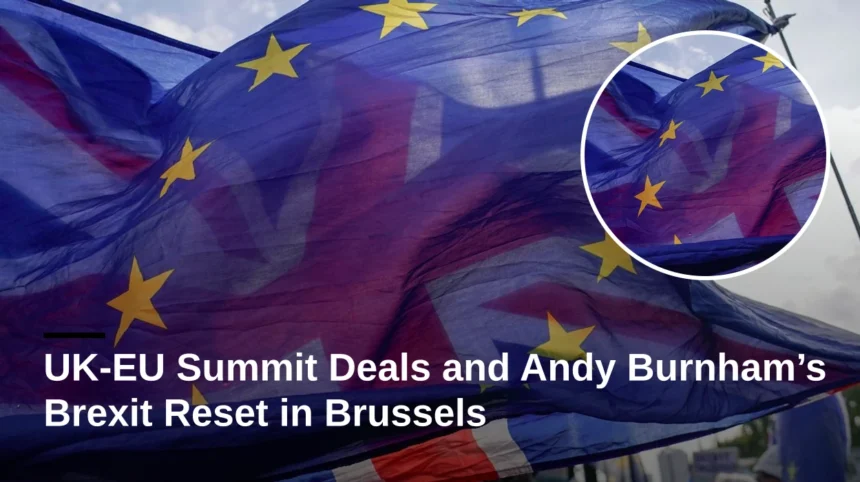
Brussels (Cambridge Tribune) November 19, 2026 – Prime Minister Andy Burnham is preparing to meet European Commission President Ursula von der Leyen and European Council President António Costa at a summit aimed at repairing relations between the United Kingdom and the European Union after Brexit. The leaders are expected to advance agreements on food and drink trade, carbon emissions and youth mobility. The proposed arrangements are intended to reduce post-Brexit barriers while stopping short of United Kingdom membership of the European Union, its single market or customs union.
- Key Points
- What is the United Kingdom and European Union summit expected to deliver?
- Why has Andy Burnham ruled out a full Brexit reversal for now?
- How have European Union officials responded?
- What is the background to the United Kingdom-European Union reset?
- What could the summit mean for businesses, young people and voters?
What is the United Kingdom and European Union summit expected to deliver?
As reported by the Associated Press, the summit is expected to produce a food and drink trade agreement, an emissions-trading arrangement and a plan allowing young people to work for limited periods across the United Kingdom and European Union. The Associated Press report, written with Brussels correspondent Lorne Cook’s contribution, said Mr Burnham had described the meeting as a step towards addressing damage caused by the 2016 referendum and the subsequent separation.
The United Kingdom Government’s factsheet said the food and drink agreement could add up to £5.1 billion a year to the economy by reducing paperwork and easing pressure on prices. It estimated that linking emissions markets could add as much as £3.8 billion annually and protect industries including steel and aluminium from the European Union’s carbon border charge.
Reuters reported that the summit package would also cover cooperation on trade, energy, mobility and defence. However, disagreements over the scope of youth mobility and university tuition fees mean some elements could take months to finalise. Reports cited by The Independent and The Guardian said a draft youth arrangement could allow people aged 18 to 30 to live, work, study, volunteer or travel on either side of the Channel for up to three years, with implementation potentially beginning in March 2028.
Why has Andy Burnham ruled out a full Brexit reversal for now?
Mr Burnham has said the government will consider longer-term options for the relationship later in 2026, but has maintained that existing Labour commitments will remain before the next general election, which must take place by 2029. The government has ruled out returning to the European Union, single market, customs union or unrestricted freedom of movement.
The Associated Press reported that Mr Burnham said the current Brexit settlement had produced fewer benefits than expected, while stressing that rejoining the European Union was not imminent and would require public support. Former Foreign Secretary and Deputy Prime Minister David Lammy has urged Labour to include rejoining the European Union in its next election platform.
Former Conservative Cabinet Minister Michael Gove opposed rejoining, arguing that it would return control over laws, borders, money and trade to Brussels. The Associated Press also reported that Brexit campaigners had raised concerns about European Union influence, including claims about smoky flavourings in crisps and other products. The government said smoky flavours would remain available in United Kingdom supermarkets.
How have European Union officials responded?
European Commission President Ursula von der Leyen said she wanted a summit focused on ambition and concrete results, including opportunities for young people, easier agri-food trade and stronger economic-security cooperation.
European leaders have welcomed the United Kingdom’s more cooperative tone, while officials have remained cautious about discussion of rejoining. Ireland’s ambassador to the United Kingdom, Sonja Hyland, said Britain would need to make a clear decision about what it wanted before reopening negotiations. Simon Usherwood, professor of politics and international studies at the Open University, said any deeper settlement would require an informed discussion about the possible costs, benefits and conditions.
What is the background to the United Kingdom-European Union reset?
The United Kingdom voted to leave the European Union in 2016 and completed its separation in 2020 after prolonged negotiations. The change introduced new barriers affecting trade, movement and regulatory cooperation with the United Kingdom’s largest nearby trading bloc. Friday’s meeting will be only the second United Kingdom-European Union summit since Brexit. The war in Ukraine, defence cooperation and irregular migration have encouraged both sides to seek closer practical coordination, although disagreements about sovereignty and market access remain.
What could the summit mean for businesses, young people and voters?
If completed, the food and drink agreement could reduce certification and border paperwork for agricultural and food exporters, while emissions cooperation could give some British industries closer access to European carbon-market arrangements. A youth mobility scheme would offer eligible people new opportunities to work, study and travel, but its final age limits, duration, fees and implementation timetable remain under negotiation.
For the United Kingdom’s political audience, the package would demonstrate closer European cooperation without crossing the government’s stated red lines. For European Union audiences, it could provide a more stable working relationship with a major neighbouring country while avoiding an immediate debate about membership. The summit is therefore likely to improve practical ties, but it is not expected to settle the longer-term question of whether the United Kingdom should move towards reversing Brexit.