

Key Points
- A fire involving roughly 100,000 creosote-treated wooden railway ties broke out along railroad tracks in the Delta and Dunnellon area of Marion County.
- The blaze produced dense, toxic smoke that drifted over nearby communities, leading local officials to declare a state of emergency and tell residents to shut doors and windows.
- Firefighters allowed portions of the pile to smoulder under controlled conditions because aggressive water use risked pushing chemical runoff into local water systems.
- The incident triggered public protests, emergency city hall meetings, and a class-action lawsuit against the companies linked to the site.
- Local officials and environmental groups criticized regulatory oversight and delays in clearing the illegally stored ties before the fire occurred.
Dunnellon (Cambridge Tribune) September 25, 2026 — A catastrophic industrial fire erupted early on Sunday morning in the Delta and Dunnellon region of Marion County, when an unauthorized stockpile of approximately 100,000 creosote-treated wooden railway ties ignited along the tracks near East McKinney Street and North Williams Street. The inferno sent dense, dark plumes of noxious smoke billowing across surrounding residential areas, including Blue Cove and Chatmire, forcing municipal leaders to declare a local state of emergency.
Emergency response agencies instructed residents to remain indoors, turn off air circulation units, and keep windows firmly shut to mitigate exposure to hazardous air pollutants released by the burning wood preservatives.
As reported by Emily Drelick of WUFT News, the blaze marked the culmination of months of unheeded community warnings regarding the severe environmental and safety hazards posed by the industrial storage site.
The massive pile of railway ties had been brought to the location by Track Line Rail, a Texas-based contractor intending to set up a commercial wood-grinding operation on property owned by rail operator CSX Transportation. According to official municipal documents, county inspectors had previously issued a notice of violation to CSX after identifying thousands of ties stockpiled without requisite local authorization.
Despite subsequent stop-work orders and magistrate court directives mandating the immediate clearance of the site, progress was plagued by delays, leaving tens of thousands of chemical-laden ties exposed.
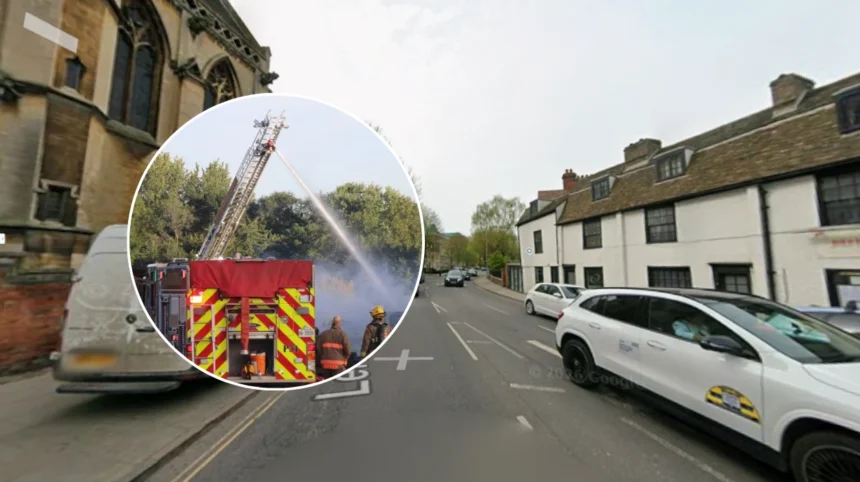
As reported by Rose Schnabel of WUFT News, emergency responders were forced into an exceptionally complex tactical response upon arrival. Fifty-four firefighters and fifteen specialized fire engines from Marion County Fire Rescue (MCFR) converged on the scene to suppress the flames.
However, as outlined in prior risk assessment correspondence from MCFR Chief James Banta to Dunnellon Mayor Walter Green, aggressive application of water and firefighting foam risked washing toxic chemical residues directly into the nearby Rainbow River ecosystem. Consequently, command crews had to balance active suppression at the edges of the inferno with allowing isolated central piles to smoulder under controlled parameters.
As reported by ClickOrlando, anger erupted across the community following the event, culminating in a packed, standing-room-only emergency meeting at Dunnellon City Hall.
Residents voiced intense frustration over perceived administrative inertia and corporate negligence. Local resident Leroy Thomas stated during the public assembly that “I don’t live far from there. We had a notice of evacuation. We didn’t know what to do. I went down to look around and the fire was everywhere. It’s bad”.
Representatives from environmental organisations, including the Sierra Club, echoed these worries, highlighting both immediate respiratory dangers and potential lingering soil and groundwater contamination.
In response to the disaster, legal actions quickly mounted against the corporations associated with the stockpile. Affected homeowners filed a comprehensive class-action lawsuit in circuit court targeting Track Line Rail, CSX Transportation, and Florida Northern Railroad. The complaint alleges that the companies acted with gross negligence by maintaining a known fire hazard in close proximity to residential neighborhoods despite receiving explicit municipal code violations and formal administrative removal orders months prior to the outbreak.
What Are The Specific Health And Environmental Risks Associated With Creosote Smoke?
The environmental and public health hazards generated by the fire stem directly from creosote, a complex petroleum- and coal-tar-based chemical mixture widely used across the railway industry to preserve timber supports against weathering and fungal decay. According to technical documentation published by Environment Canada and the U.S. Environmental Protection Agency (EPA), creosote contains over 250 distinct chemical compounds, including polycyclic aromatic hydrocarbons (PAHs), and is formally classified as a probable human carcinogen.
When burned at high temperatures, creosote releases airborne particulate matter alongside volatile organic compounds. Inhaling this smoke can provoke acute respiratory distress, throat irritation, severe nausea, and eye inflammation. Medical experts note that while the long-term impacts of brief, acute exposure remain difficult to quantify precisely, inhaling dense industrial combustion products presents serious short-term risks, particularly for vulnerable demographics such as asthmatics, children, and the elderly. Local resident Kristen Steward described the immediate impact, telling reporters, “When I walked outside the house, I could taste it”.
Furthermore, ecological advocacy groups such as the Rainbow River Conservation have raised alarms regarding surface run-off and air-fall ash. Unchecked chemical leachates entering the regional karst aquifer or local riverways could disrupt aquatic life and jeopardize regional freshwater resources, necessitating rigorous ongoing soil and water testing regimes across the affected discharge zone.
Background Of The Development
The industrial crisis in the Delta and Dunnellon region did not occur in isolation; it was the culmination of a multi-month regulatory dispute spanning several Florida jurisdictions. Track Line Rail had previously operated a similar railway tie processing setup in Newberry, Florida. However, regulatory authorities at the Florida Department of Environmental Protection (FDEP) required the firm to clear several truckloads of tie mulch and underlying soil from that location after finding the operations were proceeding without necessary environmental permits.
Following its departure from Newberry, Track Line Rail began transporting used ties to the site along East McKinney Avenue in Dunnellon during the late summer of 2025. On 29 August 2025, the company formally submitted an air construction permit application to the FDEP to establish a commercial tie-grinding operation. The initiative met immediate, overwhelming resistance from both local residents and elected leaders. On 24 October 2025, Marion County code enforcement served CSX Transportation with a formal notice of violation for storing thousands of unpermitted ties on the parcel.
Municipal opposition escalated swiftly. The Dunnellon City Council voted unanimously on 27 October 2025 to write to the FDEP formally opposing the permit, a step duplicated by the Marion County Board of County Commissioners on 4 November 2025. County officials explicitly warned state regulators that processing chemically treated ties presented an unacceptable threat to air quality, water safety, and public well-being. On 18 November 2025, the county issued a formal stop-work order demanding the immediate removal of the stockpiles.
Although CSX agreed in December 2025 to assist in hauling the materials away via rail cars, progress proved sluggish. On 9 January 2026, the FDEP granted Track Line’s air permit despite receiving 217 formal public objections. Four days later, a special magistrate ruled CSX was in direct violation of city codes, imposing a strict one-month deadline to clear the lot. By the time the fire erupted on 1 February 2026, corporate contractors had successfully removed only about 17,700 ties—roughly one-fifth of the total stockpile—leaving the remaining 100,000 ties vulnerable to ignition.
Future Outlook and Impact on Local Stakeholders
This development will significantly impact local residents, municipal authorities, regulatory agencies, and regional rail operators across several key domains:
- Impact on Local Residents and Homeowners: Residents in surrounding neighborhoods face immediate disruptions, including potential health monitoring needs, property cleanup costs associated with soot and ash, and temporary drops in residential property values. The ongoing class-action litigation will require extensive community participation as plaintiffs seek financial compensation for medical exposure risks and property devaluation.
- Impact on Municipal and Emergency Services: Local government budgets will experience considerable strain due to the high costs incurred during the multi-day emergency firefighting response and subsequent environmental remediation monitoring. Municipalities across Florida are expected to push for stricter local zoning powers to prevent rail operators from utilizing federal preemption loopholes to store hazardous industrial materials near residential zones.
- Impact on Railroad Operators and Contractors: CSX Transportation and Track Line Rail face severe reputational damage, direct legal liabilities, and potentially substantial financial penalties imposed by courts and state environmental regulators. This incident is likely to force rail companies to overhaul their supply chain and waste-handling protocols, accelerating the clearance of decommissioned ties and prohibiting long-term stockpiling on secondary rail spur properties nationwide.