

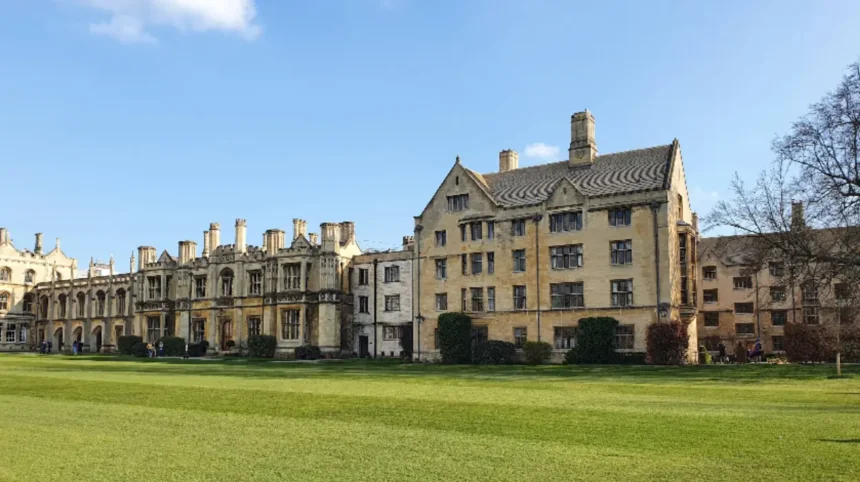
The University of Cambridge is a public collegiate research university located in Cambridge, United Kingdom, founded in 1209. It operates as the second-oldest university in the English-speaking world and the third-oldest operational university globally.
- What is the organizational structure of the University of Cambridge?
- How does the admission process work at the University of Cambridge?
- What teaching methods and educational models does Cambridge use?
- What key research contributions and global impacts has Cambridge made?
- What is the acceptance rate for the University of Cambridge?
- How do constituent colleges differ from central university departments?
- Can international students apply to the University of Cambridge?
- What is the Oxbridge application rule regarding Oxford and Cambridge?
- How many Nobel Prizes have been awarded to Cambridge affiliates?
The origin of the institution traces back to 1209 when scholars migrated from the University of Oxford following political and social conflict with local Oxford townspeople.
King Henry III granted the university a royal charter in 1231, establishing legal protections, academic governance structures, and regulatory powers over local housing rentals. Pope Gregory IX formally recognized the institution in 1233 by issuing a papal bull that protected scholars from external judicial summonses.
Pope John XXII further confirmed the institution as a studium generale in 1318, authorizing its graduates to teach across Christian Europe. The university expanded its physical footprint throughout the fourteenth and fifteenth centuries by founding constituent residential colleges.
Peterhouse was established in 1284 as the first official college, followed by Michaelhouse in 1324 and Clare College in 1326. The growth of these residential entities allowed students and academic masters to live, study, and dine in self-governing academic communities.
During the Protestant Reformation, King Henry VIII dissolved surrounding monastic houses and founded Trinity College in 1546 to consolidate academic power. The institution established Cambridge University Press in 1534, creating the oldest publishing house in continuous operation.
Intellectual developments during the Scientific Revolution positioned the institution at the center of modern mathematics and physics. Sir Isaac Newton published his foundational work on gravity and classical mechanics at Cambridge in 1687.
The nineteenth century introduced structural reforms, including the construction of modern scientific laboratories such as the Cavendish Laboratory in 1874. Female students gained entry through the founding of Girton College in 1869, though full degree rights for women were withheld until 1948.
In the twentieth and twenty-first centuries, the institution expanded into a global research powerhouse that educates over 24,000 enrolled students annually across undergraduate and postgraduate degree programs.
What is the organizational structure of the University of Cambridge?
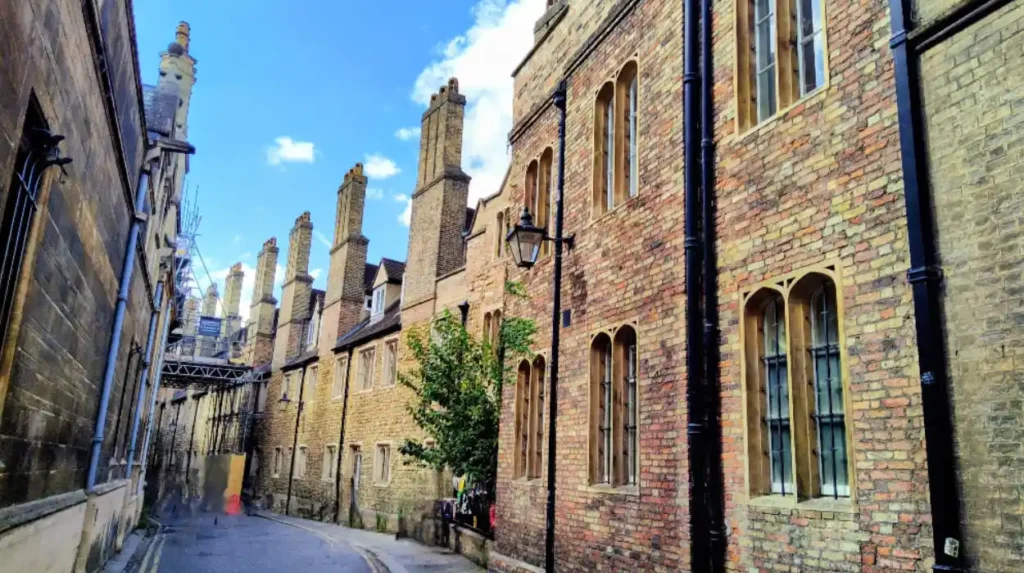
The University of Cambridge functions as a decentralized collegiate system composed of 31 semi-autonomous constituent colleges and six central academic schools. This dual model separates residential accommodation and pastoral support from central academic teaching.
The governance structure divides responsibilities between the central administration and individual constituent colleges. Central administrative bodies include the Regent House, the Council, and the General Board of the Faculties. The Regent House serves as the ultimate legislative authority, comprising administrative officials and academic staff.
The Vice-Chancellor acts as the chief academic officer, leading executive policy implementation across the main campus. The 31 constituent colleges manage student accommodation, domestic services, admissions selection for undergraduates, and small-group academic supervisions.
Examples of constituent colleges include Trinity College, King’s College, St John’s College, Gonville & Caius College, and Jesus College. Each college holds separate financial endowments, operates its own governing board, and owns independent real estate assets.
Central university departments and faculties run lectures, practical laboratory classes, central libraries, examination boards, and degree awards. Academic fields organize into six distinct central schools.
These include the School of Arts and Humanities, the School of the Biological Sciences, the School of Clinical Medicine, the School of the Humanities and Social Sciences, the School of the Physical Sciences, and the School of Technology.
Over 150 faculties, departments, and research centers operate within these six core divisions. Funding derives from student tuition fees, governmental research grants, corporate sponsorships, and university investment portfolios.
Financial reserves exceed several billion pounds, supporting large-scale infrastructure projects and long-term academic appointments. The central library system contains over 8 million print volumes.
How does the admission process work at the University of Cambridge?
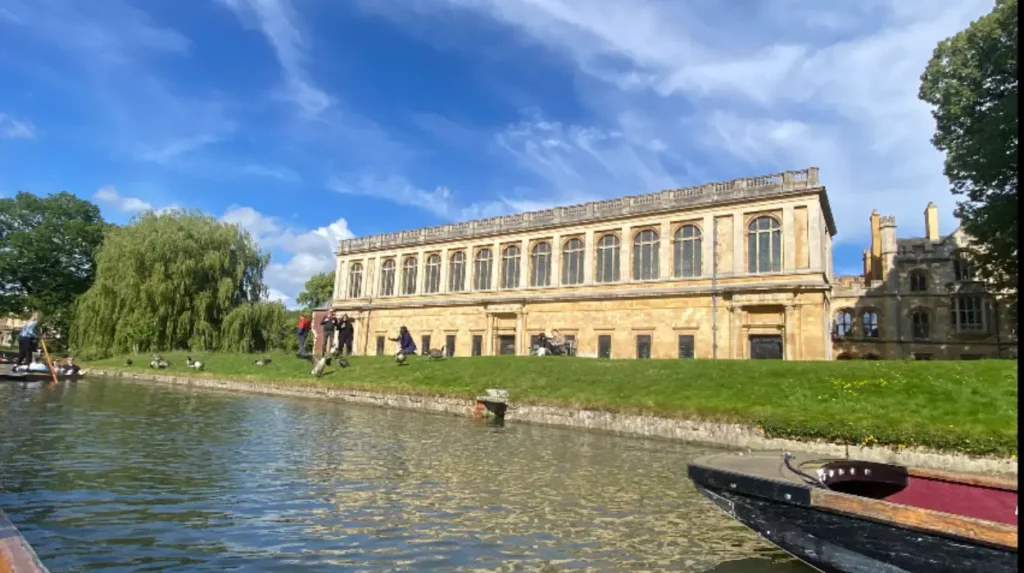
The admission process at the University of Cambridge evaluates academic performance, subject aptitude, written work, and intellectual capacity through a highly competitive selection procedure. Admissions officers evaluate applicants holistically without reliance on standardized test metrics alone.
Undergraduate applicants submit initial applications through the Universities and Colleges Admissions Service platform prior to an early annual deadline in mid-October. Candidates choose a specific course and select either a target constituent college or an open application route. Standard academic entry conditions demand high performance in secondary qualifications.
Applicants completing GCE Advanced Level qualifications generally receive conditional offers ranging from A*A*A to A*AA depending on the subject requirements. International qualification frameworks such as the International Baccalaureate Diploma typically require minimum scores of 40 to 42 points out of 45.
Specific subjects mandate standardized admissions tests administered prior to or during the interview phase. Examples of course-specific admissions tests include the Engineering Admissions Assessment, the BioMedical Admissions Test, the Test of Mathematics for University Admission, and written humanities assessments.
Shortlisted applicants participate in rigorous academic interviews conducted by college fellows and subject specialists. Interviews evaluate critical thinking skills, problem-solving capability, and subject enthusiasm rather than memorized facts. Admissions panels review secondary transcripts, personal statements, teacher references, submitted written essays, test scores, and interview performance.
Successful applicants receive conditional or unconditional admission offers in early January. Unsuccessful applicants showing exceptional academic merit enter the Winter Pool system.
The Winter Pool allows alternative constituent colleges with open placements to review and extend admission offers to top candidates. Overall undergraduate admission acceptance rates average approximately 15 percent to 20 percent annually across all degree fields.
Postgraduate admissions are coordinated directly through the central Postgraduate Admissions Office in collaboration with individual academic departments. Postgraduate candidates must demonstrate upper second-class or first-class honors undergraduate degrees, submit research proposals, and provide professional academic references.
What teaching methods and educational models does Cambridge use?
The University of Cambridge employs an intensive educational model centered around small-group teaching sessions, traditional academic lectures, practical laboratory experiments, and independent research study. This structure emphasizes critical analysis and autonomous scholarly development.
The core foundation of undergraduate education at Cambridge is the college supervision system. Supervisions consist of weekly teaching sessions featuring one to three students working directly with an academic specialist or doctoral researcher.
Students submit written essays or completed problem sets prior to each session. The supervisor critiques the work, poses complex theoretical questions, and debates concepts to test the student’s understanding.
Central university departments supplement supervisions with mass lectures, practical technical workshops, and seminars. Academic terms follow a short, highly condensed annual calendar divided into three eight-week terms. These terms are designated as Michaelmas Term in the autumn, Lent Term in the winter, and Easter Term in the spring. Undergraduate degree programs are structured around specialized course paths called Triposes.
Examples of Tripos programs include the Natural Sciences Tripos, the Mathematical Tripos, the Mathematical Sciences Tripos, the Engineering Tripos, and the Historical Tripos. A Tripos divides into Part I and Part II stages, allowing students to study broadly before specializing in specific subfields.
Formal assessment occurs primarily through end-of-year examinations known as Tripos exams. Final degree classifications award First Class Honors, Upper Second Class Honors, Lower Second Class Honors, or Third Class Honors based on cumulative exam scores.
Postgraduate research instruction focuses on advanced master’s coursework and independent doctoral thesis research under primary academic supervisors.
What key research contributions and global impacts has Cambridge made?
The University of Cambridge has generated major theoretical discoveries, technological innovations, and scientific advancements that have shaped modern human history. Institutional affiliates have received 126 Nobel Prizes across physics, chemistry, medicine, economics, literature, and peace.
Scientific advancements at Cambridge span foundational developments across physics, evolutionary biology, molecular biology, and computer science. Sir Isaac Newton formulated the laws of motion and universal gravitation while working at Trinity College.
Charles Darwin developed concepts of natural selection following his academic studies at Christ’s College. James Clerk Maxwell formulated electromagnetic field theory as the first Cavendish Professor of Physics. Structural breakthroughs continued into the twentieth century with J.J. Thomson discovering the electron in 1897.
Ernest Rutherford split the atomic nucleus at the Cavendish Laboratory in 1932. Francis Crick and James Watson discovered the double-helix structure of DNA at the Cavendish Laboratory in 1953. Alan Turing laid the theoretical foundations for modern computer science and artificial intelligence during his tenure at King’s College.
Stephen Hawking advanced theoretical cosmology through his theories on black hole radiation and space-time singularities. Economic and political thought saw major contributions from John Maynard Keynes, who established modern Keynesian macroeconomics.
Cambridge researchers also founded the modern biotech sector through innovations such as monoclonal antibody technology. Industrial collaboration around the university created the Cambridge Cluster, also known as Silicon Fen.
This technology hub houses over 5,000 high-tech companies generating billions in annual revenue. Modern computing breakthroughs include the development of the AlphaFold artificial intelligence framework by Cambridge alumni Demis Hassabis and John Jumper.
What is the acceptance rate for the University of Cambridge?
The average undergraduate acceptance rate at the University of Cambridge ranges between 15% and 20% depending on the specific application cycle. Competition varies widely by subject, with courses like Computer Science, Economics, and Medicine exhibiting significantly lower acceptance figures.
How do constituent colleges differ from central university departments?
Colleges manage residential housing, pastoral support, undergraduate admissions, and small-group supervision teaching for their enrolled students. Central university departments set the overall curriculum, deliver mass lectures, conduct laboratory sessions, host exams, and grant official degrees.
Can international students apply to the University of Cambridge?
Yes, international students from all nations can apply for undergraduate and postgraduate degree programs through standard application channels. International applicants must meet equivalent academic standards, satisfy English language proficiency criteria, and adhere to standard UCAS deadlines.
What is the Oxbridge application rule regarding Oxford and Cambridge?
Undergraduate applicants cannot apply to both the University of Oxford and the University of Cambridge within the same academic application cycle. UCAS regulations require candidates to choose one of the two institutions per application year, with rare exceptions for specific organ scholarship candidates.
How many Nobel Prizes have been awarded to Cambridge affiliates?
Affiliates, researchers, and alumni of the University of Cambridge have been awarded 126 Nobel Prizes across all official categories. These awards recognize foundational achievements in physics, chemistry, medicine, economics, literature, and peace.