

Key Points
- Nigel Farage took part in a question‑and‑answer session in Milton Keynes organised in collaboration with the Bucks Free Press (BFP).
- The event focused on local concerns including housing, transport links, crime, and access to public services in and around Milton Keynes.
- National issues such as immigration policy, the cost‑of‑living crisis, taxation and the future of the NHS were also raised by audience members.
- Farage used the session to defend his record and outline his current political priorities, positioning himself as a voice for voters who feel “ignored” by the main Westminster parties.
- Several questions challenged him on previous statements on Brexit, immigration and climate policy, prompting detailed responses and clarifications.
- Attendees included local residents, small business owners and community representatives, with questions pre‑submitted as well as taken from the floor.
- Farage sought to appeal to disillusioned Conservative and Labour voters, arguing that neither main party had delivered on promises to control borders or tackle rising living costs.
- He was pressed on how his proposals would be funded and whether they risked deepening divisions in society, particularly over immigration and asylum.
- The tone of the event remained largely orderly, though some questions drew audible reactions and occasional heckles from parts of the audience.
- Farage reiterated his criticism of existing net zero targets, arguing for a slower transition that he said would protect jobs and household budgets.
- On law and order, he called for tougher sentencing for repeat offenders and more visible policing in town centres, including in Milton Keynes.
- On housing, he argued that new development must be linked to infrastructure such as GP services, schools and roads, echoing long‑standing local concerns.
- Farage insisted that he wanted “fair but firm” immigration controls, saying he supported skilled migration while promising stricter enforcement against illegal entry.
- At the close of the event, he urged attendees to stay politically engaged and suggested that more such local Q&A sessions would follow in other towns.
Milton Keynes (Cambridge Tribune) March 17, 2026 – Nigel Farage has fielded a wide range of questions from local residents in Milton Keynes during a public session hosted in partnership with the Bucks Free Press, addressing everything from immigration and tax to housing shortages and pressures on the NHS.
- Key Points
- How did the Milton Keynes Q&A with Nigel Farage come about?
- What local issues did Milton Keynes residents put to Nigel Farage?
- How did Nigel Farage address questions on immigration and borders?
- What did he say about the cost‑of‑living crisis and taxation?
- How did Nigel Farage respond to questions on the NHS and public services?
- What position did he take on crime, policing and community safety?
- How did he address climate policy and net zero concerns?
- What was the tone of the event and how did Nigel Farage engage with critics?
- What happens next after this Milton Keynes Q&A?
How did the Milton Keynes Q&A with Nigel Farage come about?
The event was billed as an opportunity for residents to put “unfiltered” questions directly to Farage in a town that has seen rapid growth and shifting political allegiances in recent years. It formed part of a broader series of public conversations aimed at testing politicians’ responses to everyday concerns in the run‑up to future local and national contests.
Organisers invited questions in advance, with a selection chosen to reflect local priorities and national debates, while also allowing time for spontaneous contributions from the floor. The session took place in a hall in central Milton Keynes, drawing an audience that ranged from first‑time voters to long‑standing party members and undecided voters seeking clearer answers.
What local issues did Milton Keynes residents put to Nigel Farage?
Local residents were keen to highlight the strains of growth on housing, transport and public services in Milton Keynes. Several questioners described difficulties in finding affordable homes, long waits for GP appointments, and congestion on key routes in and out of the town, asking how Farage’s politics would translate into practical improvements.
In response, Farage argued that housing expansion had been driven by central government targets without sufficient regard for local infrastructure. He said he favoured empowering councils and communities to have a stronger say over where homes were built, insisting that
“no development should go ahead unless the services and roads are there to support it.”
He added that he supported incentives for brownfield development and measures to speed up planning decisions while protecting local character.
On transport, he acknowledged frustrations over rail reliability and road congestion, particularly for commuters travelling to and from London and neighbouring counties. He said investment priorities should tilt towards “fixing what we already have” including roads and local rail services before “mega‑projects” that, he argued, often overrun on cost and fail to deliver promised benefits to towns like Milton Keynes.
How did Nigel Farage address questions on immigration and borders?
Immigration remained a central theme, with several questions pressing Farage on his long‑standing criticisms of the UK’s border controls and asylum system. One attendee asked whether his rhetoric risked stoking division, while another challenged him on the economic contributions of migrant workers in sectors such as health and hospitality.
Farage drew a distinction between legal, skilled migration and what he described as “uncontrolled” or illegal entry, saying he wanted “firm but fair” policies that would prioritise the needs of local communities. He reiterated his support for strict enforcement against people‑smuggling networks and for rapid processing of asylum claims, arguing that lengthy backlogs were “cruel to genuine refugees and unfair on the taxpayer alike.”
He also maintained that successive governments had “lost the trust” of voters by failing to deliver on promises to reduce overall numbers, particularly in the years following the Brexit referendum. While acknowledging that sectors such as the NHS relied on overseas staff, he said long‑term policy should focus on training and retaining domestic workers rather than “plugging gaps with short‑term fixes from abroad.”
What did he say about the cost‑of‑living crisis and taxation?
Audience members repeatedly raised the cost‑of‑living pressures facing households and small businesses in Milton Keynes, from rising energy bills to higher rents and business rates. Some small business owners in the room said they were struggling to plan ahead amid unstable costs and concerns about consumer demand.
Farage argued that tax and regulatory burdens on small and medium‑sized enterprises had become “intolerable,” calling for targeted relief, particularly on business rates for high‑street firms. He suggested that easing the pressure on local businesses would help sustain jobs and keep town centres vibrant, a point that resonated with those who spoke about empty units and declining footfall.

On personal taxation, he said he favoured lifting more low and middle‑income earners out of higher tax bands and simplifying the system to encourage work and investment. He linked this to broader criticism of what he portrayed as wasteful government spending and “bureaucratic” programmes, claiming savings could be redirected to ease the burden on families and businesses, though some questioners pressed him for more detailed costings.
How did Nigel Farage respond to questions on the NHS and public services?
Concerns about access to healthcare and other public services featured heavily in the Bucks Free Press questions, with residents citing difficulties in securing GP and dentist appointments in Milton Keynes. A number of audience members recounted personal experiences of long waiting times, cancelled procedures and staff shortages.
Farage said the NHS faced “a crisis of capacity and management rather than a lack of money alone,” pointing to what he described as inefficiencies and top‑heavy administration. He argued for more resources to be directed to frontline staff, particularly nurses and GPs, and suggested that cutting waste and tightening procurement could free up funds without continual tax rises.
He also stressed the importance of linking population growth whether through housing development or migration to realistic planning for health, education and policing. In his view, national and local authorities had “consistently underestimated” the pressure on services in fast‑growing areas such as Milton Keynes, leaving residents feeling “short‑changed.”
What position did he take on crime, policing and community safety?
Questions on crime and anti‑social behaviour reflected anxieties about safety in and around the town centre, including reports of shoplifting, vandalism and late‑night disorder. Some residents said they rarely saw officers on patrol and worried that reporting lower‑level offences achieved little response.
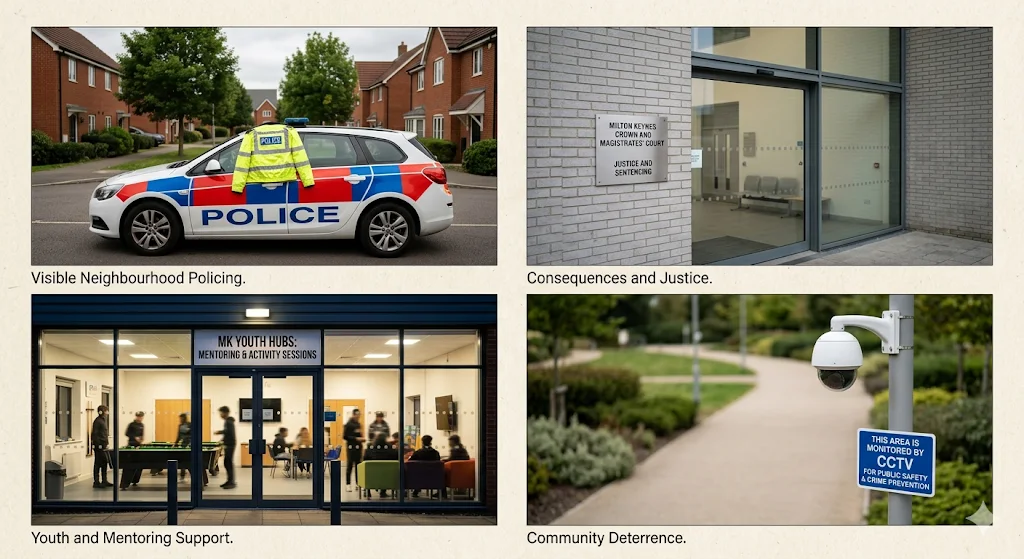
Farage said he believed in a “visible, active” model of policing, with more officers on the streets and a stronger focus on neighbourhood teams. He argued that tough action against repeat offenders and greater support for victims would help restore confidence in the justice system. He also endorsed stronger sentencing for serious violent and sexual offences, saying that “the public deserve to feel that justice is being done.”
At the same time, he acknowledged that policing is only one part of the picture, pointing to the role of social services, schools and community groups in preventing young people from becoming involved in crime. He suggested that local initiatives in Milton Keynes, such as youth clubs and mentoring schemes, could be better supported as part of a broader strategy to tackle offending and anti‑social behaviour.
How did he address climate policy and net zero concerns?
Climate policy and the UK’s net zero commitments formed another line of questioning, with one attendee asking whether Farage’s scepticism about current targets risked undermining efforts to tackle the climate crisis. Others raised practical concerns about the affordability of changes such as heat pumps and electric vehicles.
Farage reiterated his criticism of what he described as “unrealistic timetables” for net zero that he argued would impose heavy costs on households and industries. He said he favoured a slower, more gradual transition that would protect jobs in energy‑intensive sectors and avoid pushing up bills for consumers already under strain.
He maintained that he was not opposed to reducing emissions or pursuing cleaner technologies, but insisted that the pace and scale of change must be “proportionate, evidence‑based and honest about the costs.” Critics in the audience, however, warned that delaying action could increase long‑term risks and expenses, leading to a brief but pointed exchange over scientific consensus and economic modelling.
What was the tone of the event and how did Nigel Farage engage with critics?
Throughout the session, Farage adopted a combative yet largely controlled tone, engaging directly with critical questions while also playing to supporters in the room. Some of his answers drew applause, particularly on tax and policing, while comments on immigration and climate policy prompted audible murmurs and occasional heckles.
He repeatedly framed himself as a politician who speaks “plainly” and is prepared to take positions that may be unpopular with parts of the establishment, a message that appeared to resonate with some undecided voters present. At the same time, several questioners expressed concern that such rhetoric could deepen polarisation, and pressed him to explain how his approach would bring communities together rather than drive them apart.
The format combining pre‑submitted Bucks Free Press questions with unscripted audience interventions ensured that topics moved quickly and at times unpredictably, mirroring the breadth of issues currently animating political debate. By the close, Farage had been given space both to restate long‑held positions and to respond to fresh challenges rooted in the specific experiences of Milton Keynes residents.
What happens next after this Milton Keynes Q&A?
In his closing remarks, Farage thanked the audience and said he welcomed the opportunity to be questioned in detail on policy rather than “soundbites and slogans.” He indicated that he hoped to take part in similar sessions in other towns and cities, suggesting that direct engagement events could complement traditional campaigning and media appearances.
For many in the room, the evening offered a chance to test whether his national profile and high‑impact messaging translated into practical answers on local issues such as housing, transport and access to public services. Some attendees left saying they felt clearer about his priorities, while others remained unconvinced by his explanations on key topics including immigration and climate.
What is clear is that towns like Milton Keynes with their mix of new development, commuter populations and shifting party loyalties will remain central battlegrounds for any politician seeking to channel discontent with the political status quo. Whether Farage’s approach gains lasting traction there will depend not only on his performance at such events, but also on how residents judge the tangible impact of policies proposed in response to the questions they have raised.

