
Key Points
- A Middlesex County grand jury indicted 47-year-old Tyler Brown of Boston on more than 40 criminal charges connected to a shooting along Memorial Drive in Cambridge.
- Prosecutors said Brown fired over 60 rounds from an FF-15 assault-style rifle into rush-hour traffic, hitting several occupied cars.
- Two male drivers with no known connection to Brown suffered life-threatening injuries when bullets struck their vehicles.
- A Massachusetts State Police trooper and a licensed civilian Marine veteran shot Brown in the extremities, ending the gunfire.
- Brown was on active parole during the incident after serving prison time for a 2020 shootout with Boston police.
- Hours before the shooting, Brown reportedly showed a rifle during a FaceTime call with his parole officer and expressed suicidal thoughts.
Woburn (Cambridge Tribune) September 10, 2026 – A Boston man accused of unleashing an chaotic barrage of gunfire along a packed thoroughfare in Cambridge, Massachusetts, has been formally indicted on dozens of felony charges, public law enforcement officials announced.
- Key Points
- What Charges Have Grand Jurors Formally Brought Against Tyler Brown?
- How Did The Memorial Drive Active Shooter Incident Unfold?
- What Warning Signs and Criminal Antecedents Preceded the Attack?
- Background Of The Memorial Drive Prosecution
- Prediction: How This Case Will Impact Public Policy and Local Communities
As confirmed by Ken Paiva of the Fall River Reporter, Middlesex District Attorney Marian Ryan, Massachusetts State Police Colonel Geoffrey Noble, and Cambridge Police Commissioner Pauline Wells announced that 47-year-old Tyler Brown of Boston faces arraignment in Middlesex Superior Court in Woburn on an extensive indictment following the active shooter event on Memorial Drive.
As reported by WBZ NewsRadio, prosecutors allege that Brown walked along Memorial Drive in the middle of a busy afternoon commute, erratically firing a multi-caliber FF-15 rifle at civilians and passing vehicles attempting to flee the intersection. Law enforcement authorities confirmed that upwards of 60 to 70 rounds of ammunition were discharged during the incident, striking multiple motor vehicles, a Massachusetts State Police cruiser, and wounding two innocent motorists.
What Charges Have Grand Jurors Formally Brought Against Tyler Brown?
As documented by Boston 25 News, the grand jury indictment returned against Tyler Brown includes over 40 distinct counts. According to official court filings cited by Boston 25 News, the list of charges presented by Assistant District Attorney Nicole Allain encompasses:
- Six counts of armed assault to murder.
- Assault and battery with a dangerous weapon causing serious bodily injury.
- Two counts of assault and battery by discharging a firearm.
- Four counts of attempted assault and battery by discharging a firearm.
- Six counts of assault and battery with a dangerous weapon.
- Four counts of assault with a dangerous weapon on a person over the age of 60.
- Seven counts of malicious damage to a motor vehicle.
- Two counts of intentional reckless discharge of a firearm.
- Possession of a firearm after being convicted of a felony.
- Two counts of wanton destruction of property over $1,200.
- Three counts of destruction of property under $1,200.
- Carrying a firearm without a license.
- Two counts of possession of ammunition.
- Two counts of possession of a large-capacity magazine.
How Did The Memorial Drive Active Shooter Incident Unfold?
As reported by Ken Paiva of the Fall River Reporter, the emergency response commenced shortly after 1:00 p.m. when the Cambridge Police Department received an urgent communication from the Boston Police Department. Boston officers advised that an individual, later identified as Tyler Brown, was observed acting erratically, was believed to be in Cambridge, and was suspected to be armed with a rifle.
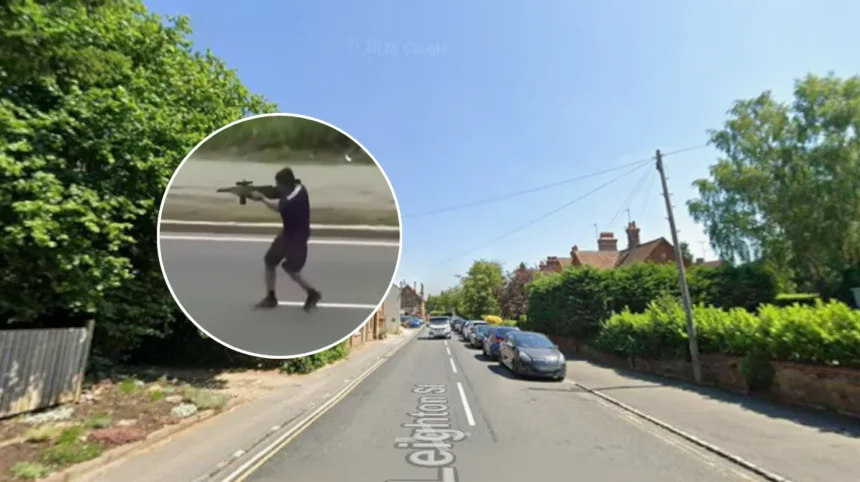
As detailed in the Fall River Reporter, responding Massachusetts State Police troopers and Cambridge police officers arrived at Memorial Drive to find an active shooter situation. Suspect Brown was moving on foot eastward down the roadway while actively discharging an assault-style rifle at civilian traffic.
As reported by Boston 25 News and WBZ NewsRadio, two male motorists in separate vehicles—neither of whom had any prior connection to Brown—were struck by gunfire and sustained life-threatening injuries.
As stated by WBZ NewsRadio, the armed rampage ended when Brown was confronted by a Massachusetts State Police trooper alongside a civilian Marine veteran who was legally carrying a firearm. Prosecutors note that Brown continued to discharge his rifle, striking a State Police cruiser, before both the trooper and the armed civilian fired their handguns, striking Brown multiple times in his extremities to subdue him. Brown was rendered first aid at the scene by officers before being transported under guard to a Boston hospital.
What Warning Signs and Criminal Antecedents Preceded the Attack?
As reported by Neal McNamara of Patch, prosecution documents presented by Assistant District Attorney Nicole Allain outline significant prior criminal history and alarming behavioral markers leading up to the attack.
As confirmed by Patch and Boston 25 News, Brown was actively on parole at the time of the Cambridge shooting. In the spring of 2020, Brown had been involved in an armed confrontation with Boston police officers, during which he discharged 13 rounds at law enforcement officials. He subsequently pleaded guilty to eight criminal counts—including armed assault with intent to murder—and was sentenced to five to six years in state prison. Brown was released on parole in 2025.
As reported by WBZ NewsRadio and Patch, Brown’s parole officer reported that shortly before the Memorial Drive incident, Brown placed a FaceTime video call to the officer. During the call, Brown appeared to be under the influence of narcotics, expressed suicidal thoughts, and openly displayed a rifle. The parole officer immediately raised alarms with police authorities. Court records cited by Patch also reveal that Brown had been released from McLean Psychiatric Hospital in Belmont just three days prior to the rampage, and neighbors observed him drinking alcohol and acting erratically the night before the incident.
Background Of The Memorial Drive Prosecution
The indictment of Tyler Brown in Middlesex Superior Court represents the transition of the criminal prosecution from the local district court level to the state superior court, where felony offenses carrying substantial state prison sentences are adjudicated.
Initially, following his release from the hospital, Brown was arraigned in Cambridge District Court, where he entered pleas of not guilty to an initial slate of eight charges, including two counts of armed assault with intent to murder.
Following the completion of the Middlesex County Grand Jury investigation, prosecutors secured the comprehensive 40-plus count indictment to encompass every vehicle struck, every civilian targeted, the destruction of municipal and state property, and the illegal possession of high-capacity magazines and firearms by a violent felon.
Assistant District Attorney Nicole Allain successfully argued for Brown to be held in custody without bail pending trial, citing his extensive violent record, violation of parole terms, and the extraordinary danger posed to the public.
Prediction: How This Case Will Impact Public Policy and Local Communities
This major indictment and the circumstances surrounding Tyler Brown’s release are anticipated to trigger legal, regulatory, and institutional policy scrutiny across Massachusetts, directly impacting several distinct groups:
1. Parole Boards and Judicial Oversight Authorities
The revelation that a violent offender with a history of shooting at law enforcement was released on parole—and subsequently obtained an assault rifle despite active supervision—will likely prompt formal legislative inquiries into parole conditions, dangerousness evaluations, and tracking protocols for high-risk probationers.
2. Mental Health Facilities and Post-Discharge Protocols
Because Brown was discharged from a psychiatric hospital three days prior to committing a mass shooting, healthcare regulators and legal experts anticipate heightened demands for mandatory reporting mechanisms between psychiatric inpatient facilities, parole officers, and law enforcement agencies when high-risk individuals are released back into the community.
3. Local Residents and Commuters
For residents of Cambridge, Boston, and the broader Greater Boston metropolitan area, the incident has renewed intense public debates surrounding firearm access, illegal weapons trafficking, and public safety along high-density traffic corridors, likely leading to increased police presence and security surveillance around major arterial roadways like Memorial Drive.