
Key Points
- More than 500 Cambridge University workers have been involved in strike action over pay and the cost of living in the city.
- The union Unite is demanding the introduction of a “Cambridge weighting”, a local pay supplement similar to support available at Oxford University.
- Staff in library, museum, estates management, finance, student services and IT roles are among those taking part.
- Unite says Cambridge’s 1.4 per cent pay increase for 2025/26 amounts to a real-terms pay cut.
- The dispute also includes a call for a full pay review to address wage compression at lower grades.
- Further strike days were announced for May, after earlier walkouts in April.
Cambridge(Cambridge Tribune) May 21, 2026 — Hundreds of University of Cambridge support staff are continuing a dispute over pay, with unions arguing that workers need a local supplement to keep pace with the city’s high living costs.
What is the Cambridge University pay protest about?
The strike is centred on a demand for a “Cambridge weighting”, which Unite says would act as a pensionable local pay supplement for staff facing unusually high housing and living costs in the city. According to Unite, the pay gap has become more pressing because the university’s latest settlement does not, in the union’s view, match the cost of living pressure on lower-paid staff.
As reported by BBC News, more than 500 workers were taking part in the action, while Unite said the dispute covers staff in several services that keep the university running day to day. Those roles include library staff, museum workers, estates management, finance, student services and IT staff.
What have unions and staff said?
Unite has argued that Cambridge should offer a local supplement similar to Oxford’s arrangement, saying staff should not be left behind in one of the UK’s most expensive cities. The union has also said the university’s 1.4 per cent pay increase for 2025/26 amounts to a real-terms cut, especially for workers already on lower salaries.
Unite has further said the dispute is not only about immediate pay but also about a wider review of wage progression. The union says lower grades have suffered from “compression”, meaning that pay differences between grades are too narrow to reward advancement properly.
How has Cambridge responded?
Reporting from Varsity said the university acknowledged the cost-of-living pressures and pointed to several measures already introduced. Those measures included a 2.5 per cent supplement of basic pay for employees on lower grades, a higher minimum starting salary for research assistants and more paid family leave.
The available reporting also indicates that the university did not accept the union’s central demand for a separate “Cambridge weighting” in the form sought by Unite. The dispute therefore remains unresolved, with both sides presenting different views of whether current pay arrangements are enough.
How has the strike unfolded?
When did the Cambridge University strike action take place? Earlier strike days were reported in April, including walkouts on 21 and 22 April, with further action on 30 April and 1 May. By 11 May, reporting said Unite had escalated the dispute further, announcing an additional 10 strike days across the month.
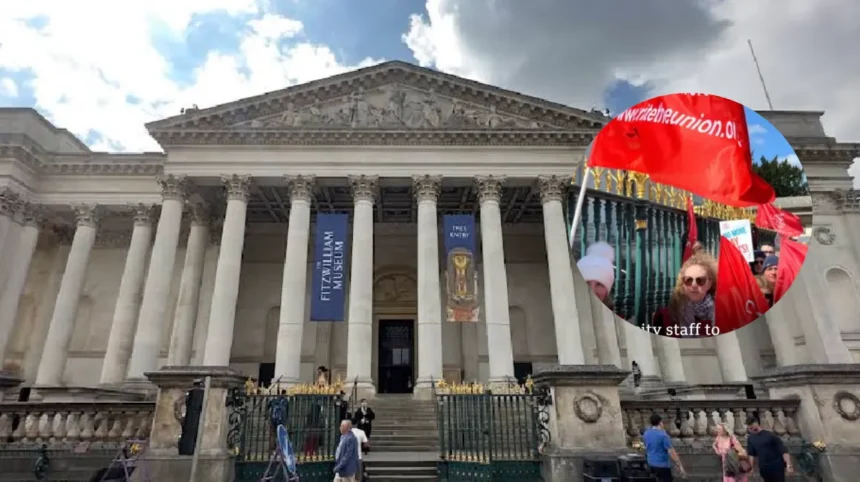
Those later stoppages were expected to affect a wide range of services, including libraries and museums, showing that the impact of the dispute extends beyond a single department. Picketing and strike activity were also reported at university sites, including the University Library and the Fitzwilliam Museum.
What does this mean for students and the university?
The immediate effect is likely to be disruption to services relied on by students, researchers and visitors, particularly library and museum access, administrative support and some IT functions. Because the dispute involves support staff rather than only academic workers, the consequences can spread across everyday university services.
The wider issue is reputational as well as operational, because the dispute highlights the challenge of retaining staff in a high-cost city. If the university and union remain far apart, the likelihood of repeated walkouts rises, creating further uncertainty for the rest of the term.
Background to the dispute
How did the Cambridge weighting demand develop?
The current row sits within a longer-running argument about pay at the university and the gap between salaries and local living costs. Earlier coverage shows that low-paid staff have previously raised concerns about below-inflation awards and whether wage rises match inflation in Cambridge’s housing market.
Oxford’s use of a local allowance has become a reference point in this argument, because Cambridge workers and union organisers say a similar supplement would help address the city’s higher costs. That comparison has shaped the dispute’s public framing and made the phrase “Cambridge weighting” central to the campaign.
Prediction for affected audiences
How could this development affect Cambridge University staff and students next?
For staff, the most likely short-term effect is continued industrial action if negotiations do not produce a settlement acceptable to Unite. For students and researchers, that could mean more disruption to library access, museum operations and support services during busy academic periods.
If the university keeps its current position while the union maintains pressure, the dispute could widen into a longer pay campaign rather than a one-off protest. That would place more strain on service delivery and could also intensify debate over whether universities in expensive cities need local pay supplements to recruit and retain staff.