

Key Points
- Landmark Investment: The £10 million National Institute for Health and Care Research (NIHR)-funded EDITH trial is the largest in the world to test artificial intelligence-assisted tools in breast cancer screening.
- Nationwide Rollout: Cambridgeshire is the first region to launch the study, which will expand to 30 breast screening sites across the UK.
- Clinical Efficiency: Currently, two specialist radiologists review every mammogram, even though fewer than 1% show signs of cancer. The AI tool could reduce this requirement to a single human radiologist per scan, freeing up specialists for diagnosis and patient care.
- Unchanged Patient Experience: Women aged 50 to 71 invited for their routine three-yearly NHS screening will experience no changes during their appointment, and every scan will still be checked by at least one human radiologist.
- Opt-Out Option: Invitation letters will include full details of the study alongside instructions on how eligible women can opt out if they do not wish to participate.
- Ministerial Backing: Health and Social Care Secretary Yvette Cooper MP visited Addenbrooke’s Hospital in Cambridge to mark the launch alongside trial leaders Professor Fiona Gilbert and Professor Sian Taylor-Phillips.
- Supporting Infrastructure: As the study progresses, it will be supported by AIR-SP, an AI research screening platform built by NHS England with nearly £6 million in government funding.
Cambridgeshire (Cambridge Tribune) November 23, 2026 – A landmark £10 million clinical trial, known as EDITH, has launched in Cambridgeshire to test whether artificial intelligence-assisted tools can help radiologists detect breast cancers earlier, marking the largest study of its kind anywhere in the world.
How Will the £10 Million EDITH Trial Operate Across the UK?
Funded by the National Institute for Health and Care Research (NIHR) in close collaboration with NHS England and the UK National Screening Committee, the EDITH trial will eventually operate across 30 breast screening sites throughout the United Kingdom. Under current NHS guidelines, all women aged 50 to 71 are invited for breast screening every three years. Approximately 2.1 million women undergo screening annually across the UK, a programme credited with preventing around 1,300 deaths each year.
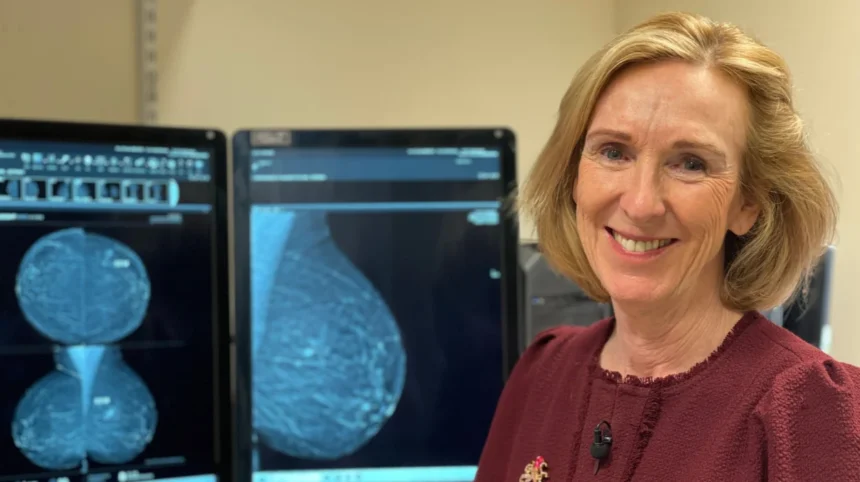
Reviewing breast screening X-rays, known as mammograms, is a highly time-intensive process. At present, every mammogram is independently examined by two specialist radiologists. Because fewer than 1% of routine mammograms show signs of cancer, specialists spend a substantial proportion of their clinical hours reviewing negative screening images.
During the EDITH trial, the AI-assisted software will work alongside human specialists to examine mammograms for malignancies that may be too small to see or feel. If proven effective, the technology could allow many mammograms to be reviewed by just one radiologist rather than two, freeing up specialist capacity to focus on complex diagnoses and direct care for women diagnosed with cancer.
Will the AI Trial Change What Happens at Routine Breast Screening Appointments?
The introduction of the trial will not alter the physical experience of a woman’s breast screening appointment. The NHS will continue to provide mammograms at local breast screening clinics situated within GP practices and hospitals, as well as via mobile screening vans stationed in supermarket and community car parks.
The trial strictly affects how the captured images are analysed after the appointment. Crucially, the AI tool is being evaluated alongside the existing clinical pathway rather than replacing human expertise; every mammogram will still be reviewed by at least one human radiologist. The NHS has confirmed that permanent changes to standard screening procedures will only be made if the trial generates robust evidence proving the technology is just as safe and effective as current care standards.
Eligible women will receive information about the EDITH study within their standard NHS screening invitation letters, which will also outline clear instructions on how to opt out of the trial should they prefer not to take part.
What Have Government Ministers and Trial Leaders Said About the Study?
To mark the official opening of the trial, the Secretary of State for Health and Social Care, Yvette Cooper MP, visited the Breast Unit at Addenbrooke’s Hospital in Cambridge. During her visit, she met with the study’s co-leaders: Professor Fiona Gilbert, from the University of Cambridge and Addenbrooke’s Hospital, and Professor Sian Taylor-Phillips, from the University of Warwick.
As reported by Cambridge University Hospitals NHS Foundation Trust, Secretary of State for Health and Social Care Yvette Cooper stated that:
“This is the biggest AI breast cancer trial in the world, backed by £10 million of government investment to speed up diagnosis and potentially deliver life-saving improvements.
“If successful, this technology could help women get a breast cancer diagnosis and start treatment much more quickly, giving them the best possible chance of recovery.
“AI has huge potential, but we also need proper safeguards in place to make sure we’re using it safely and effectively to improve treatment and research.”
As reported by Cambridge University Hospitals NHS Foundation Trust, Professor Fiona Gilbert, Department of Radiology at the University of Cambridge and Honorary Consultant at Cambridge University Hospitals NHS Foundation Trust, stated that:
“Millions of women have a mammogram each year, and fewer than one in 100 will be diagnosed with cancer. EDITH will test whether an AI-assisted mammogram-reading tool can help experts review images more efficiently, while maintaining professional oversight and the standards women expect from NHS breast screening.”
As reported by Cambridge University Hospitals NHS Foundation Trust, Professor Sian Taylor-Phillips from the University of Warwick stated that:
“EDITH will test whether AI can assist NHS staff improve the service for women attending the NHS Breast Screening Programme. AI-assisted technology could support staff by flagging areas of a mammogram where cancer might be missed to improve early cancer detection.”
As reported by Cambridge University Hospitals NHS Foundation Trust, Professor Lucy Chappell, CEO of the NIHR and Chief Scientific Adviser to the Department of Health and Social Care, stated that:
“The NIHR is proud to be funding one of the world’s largest studies of AI-assisted breast screening. Bringing together researchers, NHS staff and hundreds of thousands of women from all walks of life, EDITH will generate vital evidence on whether this technology could transform how cancer is detected and diagnosed.”
As reported by Cambridge University Hospitals NHS Foundation Trust, UK Minister for Artificial Intelligence Kanishka Narayan stated that:
“Finding cancer earlier can make all the difference to patients and their families, including saving lives. Through this landmark trial, we’re putting AI to work alongside our expert radiologists to test whether it can help spot warning signs sooner and free specialists to spend more time on direct patient care.”
Background
The launch of the EDITH trial builds upon ongoing clinical research and service modernization in Cambridge. Previous research led by Professor Fiona Gilbert demonstrated how breast screening could be enhanced by offering supplementary imaging to specific women based on their individual risk profiles. Professor Gilbert is also actively investigating how artificial intelligence can be utilised to identify which women face the highest risk of developing breast cancer.
Locally, the Breast Unit at Addenbrooke’s Hospital has introduced several initiatives to streamline patient access to oncology services, including a direct referral pathway via NHS 111 that provides rapid support to women concerned about potential breast cancer symptoms. These clinical developments are expected to expand in both speed and scale once the Breast Unit relocates into the upcoming Cambridge Cancer Research Hospital.
At a national infrastructure level, the rollout of the EDITH study is backed by the AI research screening platform (AIR-SP). Built by NHS England with nearly £6 million in government funding, AIR-SP is specifically designed to streamline the technical process for NHS Trusts joining large-scale AI screening trials.
Prediction: How Could This Development Affect Patients and NHS Staff?
If the EDITH trial confirms that AI-assisted image analysis matches or exceeds the safety and accuracy of double human review, the findings could reshape routine breast cancer screening across the UK. For the roughly 2.1 million women aged 50 to 71 who attend NHS screenings each year, the technology holds the potential to identify microscopic malignancies that might otherwise go unnoticed, enabling earlier diagnoses and faster access to life-saving treatment without altering the familiarity or accessibility of local clinic and mobile van appointments.
For NHS radiologists and clinical teams, transitioning from mandatory dual-radiologist reviews to a single-radiologist model supported by AI could alleviate significant workforce pressures. By reducing the clinical hours spent examining the more than 99% of mammograms that show no signs of disease, specialist staff could reallocate their time towards complex diagnostic evaluations, patient consultations, and direct oncology care, while the AIR-SP infrastructure provides a standardized framework for future NHS Trusts to adopt validated AI diagnostic tools.