

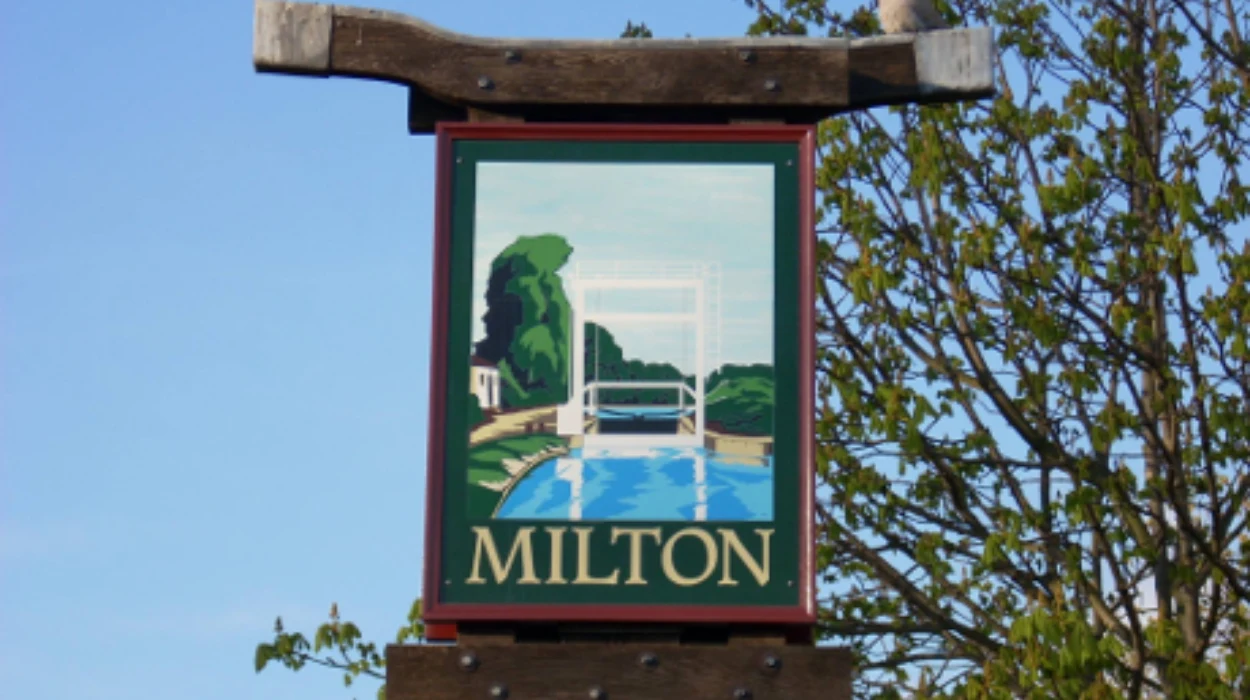
Milton, a village immediately north of Cambridge and separated only by the A14, provokes unusually strong reactions for such a compact community. Some people see it as a convenient, well‑connected place with green spaces and access to the city, while others feel it symbolises overdevelopment, traffic pressures and planning uncertainty on Cambridge’s edge.
- From Farming Hamlet to Edge‑of‑Cambridge Community
- Location, Green Belt and the Sense of “Creeping Cambridge”
- Housing Growth: Opportunity or Overdevelopment?
- Transport, Traffic and the Park & Ride Effect
- Commercial Development and Local Character
- Environment, Sewage Works and the Edge of the Fens
- Community Identity: Old Milton vs New Milton
- Governance, Planning and Trust in Decision‑Making
- Why Milton Will Keep Dividing Opinion
Understanding why Milton divides local opinion means looking at its deep rural roots, its rapid late‑20th‑century expansion, and the way major infrastructure, employment sites and growth plans now bear down on a small historic settlement.
From Farming Hamlet to Edge‑of‑Cambridge Community
For most of its history, Milton was a small agricultural community on light, fertile soils west of the River Cam, with farming centred on land owned by the manor, the church and later the Cambridge colleges. In the Domesday Book of 1086 there were only 31 peasants recorded in the parish, and even by 1728 the population had risen to around 170 people in about 40 families.

Maps from the late 19th and early 20th century show a compact village clustered around the High Street and Fen Road, with Milton Hall, two churches, a school, a smithy, a brewery and five public houses but little development beyond that core. Through the early and mid‑20th century the population remained broadly static at several hundred residents, and Milton retained the character of a quiet Fen‑edge village despite being relatively close to Cambridge.
Everything changed in the late 20th century. Two large housing estates built between the bypass and the old village in the late 1980s doubled the population between the 1981 and 1991 censuses, transforming Milton into a much larger settlement tied closely to Cambridge for employment, services and transport. By the 2021 census the village and wider parish population was about 4,400, down slightly from 4,679, but still far above its historic levels.
This rapid shift from small farming village to suburban‑style community on the edge of a growing city underpins many of the mixed feelings people now hold about Milton.
Location, Green Belt and the Sense of “Creeping Cambridge”
Milton sits immediately north of Cambridge, just across the A14, within the Cambridge green belt. On the one hand this location makes it highly attractive for commuters and businesses who want easy access to the city and strategic roads while retaining some village feel. On the other, it places Milton directly in the path of regional growth pressures, infrastructure projects and debates about where new homes, jobs and services should go.
Supporters of continued, carefully managed growth argue that Milton is well‑placed to absorb some of the demand generated by Cambridge’s strong knowledge‑economy and housing market, especially given its existing connections, facilities and nearby employment sites. Critics, however, worry about “creeping Cambridge” – the idea that the city is steadily expanding into surrounding villages, eroding their distinct identities and rural setting despite the protective intent of the green belt.
This tension becomes particularly clear in discussions about large‑scale development frameworks around North East Cambridge and the Anglian Water sewage works near Milton, where decisions about relocation, density and land use have major implications for both the village and the city. The cancellation of central government funding to move the sewage works from Milton to Honey Hill has forced planners to rethink options for thousands of new homes in the area, reinforcing uncertainty and debate about Milton’s long‑term role in the Cambridge growth story.
Housing Growth: Opportunity or Overdevelopment?
For many residents and would‑be residents, the expansion of Milton’s housing stock is one of its biggest advantages. Newer estates and infill development have increased the range of homes available close to Cambridge, providing options for families, professionals and older residents who want village life without being far from the city’s jobs, universities and hospitals.
However, the scale and pace of this growth continue to divide opinion. Some locals feel the housing surge of the late 20th century and subsequent additions have already stretched the village’s infrastructure, including schools, health services and local roads. Others point to the way new estates have changed the visual character of the settlement, replacing historic cottages and farmland views with modern architecture and denser layouts.
As greater Cambridge plans further expansion, Milton often features in discussions about where additional homes should go, given its location near major employment clusters and transport links. Supporters argue that concentrating development in well‑connected areas like Milton is more sustainable than dispersing it into even more remote villages, while opponents fear that any further large‑scale building will permanently blur the boundary between village and city.
This clash of perspectives is not unique to Milton but is particularly intense here because the village has already experienced a dramatic shift in size and character within living memory.
Transport, Traffic and the Park & Ride Effect
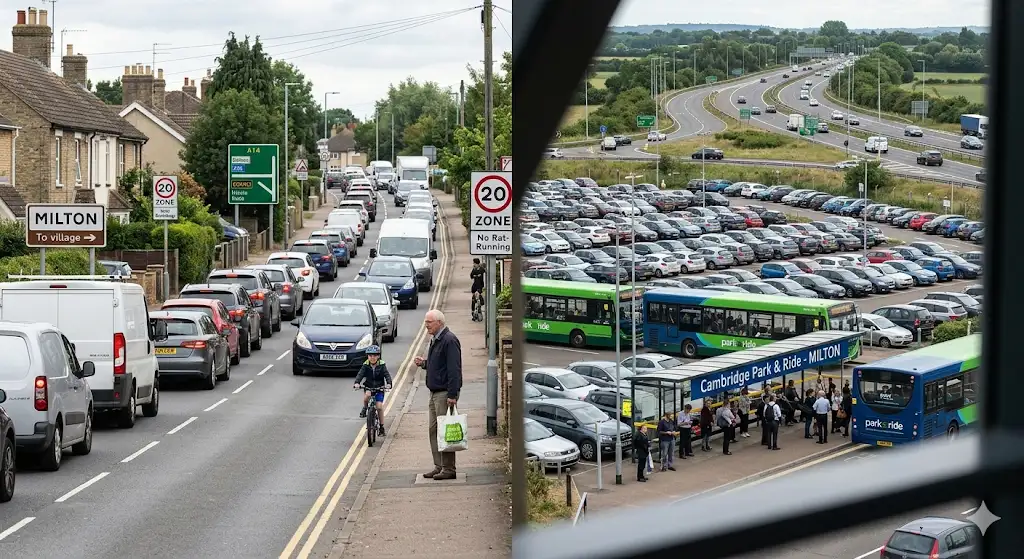
Transport is another major reason why Milton provokes strong reactions. The village lies close to the A14 and A10, and it hosts the Milton Park & Ride, which is part of the wider Cambridge Park & Ride network designed to reduce traffic into the city centre.
For commuters, the Park & Ride and nearby road network are key strengths. They offer relatively quick access into Cambridge without the need to drive directly into the city, and they make Milton an attractive base for people working in the science parks, business parks and institutions around north and east Cambridge. For many residents this connectivity is a major plus, boosting property appeal and supporting local services.
Yet these same transport assets bring challenges that frustrate others. Traffic volumes on local roads can be heavy at peak times, particularly where residential streets intersect with routes to the A14 or the Park & Ride. Concerns about congestion, rat‑running, air quality and road safety are common themes in local debates, especially when new developments or commercial schemes are proposed.
Wider transport projects in greater Cambridge also ripple into Milton. Work on the Cambridge Eastern Access programme, which includes improvements to walking, cycling and public transport on Newmarket Road and relocation of another Park & Ride, has sparked wider conversations about how different sites will interact and what that means for traffic patterns and environmental impacts. Some people welcome investment in sustainable travel infrastructure, while others worry about greenfield loss and cumulative impacts on the countryside around Cambridge.
For Milton residents, the net result is a mixed picture: excellent access and public transport options, but also noticeable traffic pressure and a sense that regional transport decisions can reshape village life without always feeling locally controlled.
Commercial Development and Local Character
Milton’s location on a key route into Cambridge has also attracted commercial proposals that divide opinion. A recent example is the plan to convert a commercial building on Ely Road into a Kia dealership, which received approval despite objections from local residents.
Supporters of schemes like this point to economic benefits, such as job creation, broader choice of services and potential uplift to local business rates. They argue that Milton is already more of a mixed‑use community than a purely residential village, and that carefully designed commercial uses can sit comfortably alongside homes, especially on main roads.
Opponents raise concerns about noise, light pollution, traffic, safety and the incremental erosion of residential and village character. In the Kia dealership case, objectors highlighted worries about large car transporters using Ely Road, potential hazardous materials, increased vehicle movements and loss of privacy for nearby homes.
These disputes are about more than single planning applications. They touch on the deeper question of what kind of place Milton should be: a primarily residential village with modest local services, or a more urbanised edge‑of‑city node where commercial, industrial and residential uses coexist.
Because Milton already contains significant employment sites and infrastructure, some see further commercial activity as a logical continuation of its role, while others feel each new scheme inches the community further away from its historic rural identity.
Environment, Sewage Works and the Edge of the Fens
The environment is another source of both pride and contention. Milton sits on river gravels over gault clay near the River Cam at a height of roughly 5–8 metres above sea level, with light soils that historically supported productive agriculture. For many residents, proximity to river paths, fields and the broader Fen landscape remains a key attraction, offering a sense of openness and nature close to Cambridge.
At the same time, Milton is closely associated in regional planning with the Anglian Water sewage treatment works just to the north of the city, within the parish. Proposals to relocate this plant to Honey Hill were tied to ambitious plans to free up the existing site for thousands of homes and new urban quarters, but central government’s decision to withdraw funding has left those plans in flux and the works in place for now.
For some, the sewage works have long been an unwelcome neighbour, associated with odour, visual intrusion and the perception that Milton bears more than its fair share of infrastructure serving the wider Cambridge area. Others view the site as an accepted part of the landscape, and are more concerned about the scale and density of any new development that might replace it, fearing that new urban blocks would have a greater impact on traffic, skyline and green belt than the existing plant.
The broader environmental debate around Milton also intersects with concerns about the Cambridge green belt, biodiversity and the impact of new roads, busways and housing on sensitive landscapes and habitats around the city’s fringe. Supporters of compact, transit‑oriented growth stress the need to accommodate housing demand in sustainable locations like Milton, while critics warn that once green belt boundaries are relaxed or heavily built‑up, it is difficult to reverse the loss of openness and ecological value.
Community Identity: Old Milton vs New Milton
Perhaps the most intangible but powerful source of division is community identity. Longstanding residents, whose families may have lived in Milton back when it was a small farming village with a handful of pubs and trades, often remember a close‑knit, slow‑changing community where everyone knew their neighbours.
The late 20th‑century estates and more recent development have brought in large numbers of newcomers, many of whom are attracted by the proximity to Cambridge’s jobs and facilities as much as by the village itself. This inflow has diversified the population and helped sustain local services, but it has also changed social patterns and expectations.
Some residents welcome this evolution, pointing to revitalised community groups, better amenities and a broader mix of ages and backgrounds. Others feel that the traditional character of Milton has been diluted, with commuter lifestyles and externally driven planning priorities overshadowing local traditions and decision‑making.
This perceived divide between “old Milton” and “new Milton” can colour responses to almost every issue: housing, transport, commercial development, environmental change and the village’s relationship with Cambridge. People who moved to Milton recently may see further growth and infrastructure as natural, even necessary, while long‑term residents may view the same projects as another step away from the village they remember.
Governance, Planning and Trust in Decision‑Making
Another reason opinions in and around Milton are so strongly split is the complexity of governance. The village sits within South Cambridgeshire District, interacts closely with Cambridge City, and is affected by strategies from bodies such as the Greater Cambridge Partnership and Cambridgeshire County Council.
Major decisions about transport corridors, Park & Ride locations, sewage works relocation, and strategic housing allocations are often made at a regional level, with consultation but not always with outcomes that align with local sentiment. This can erode trust among residents who feel that their concerns about traffic, pollution or village character are acknowledged but ultimately outweighed by wider growth targets.
At the same time, some locals and planners emphasise the importance of looking beyond individual villages when tackling issues like housing affordability, climate targets and economic competitiveness. From this perspective, Milton’s strategic location makes it a key part of solutions for the greater Cambridge area, even if that means accepting more change and infrastructure than a typical rural village would.
The interplay between local parish desires and regional planning imperatives ensures that Milton remains a focal point for debates about democratic legitimacy, consultation quality and the balance between local and wider interests.
Why Milton Will Keep Dividing Opinion
Taken together, these factors explain why Milton, Cambridge, is likely to keep dividing local opinion for years to come. It is a place of contrasts: historic and modern, rural and urban‑adjacent, tranquil in parts but affected by major roads and infrastructure.
People who value convenience, access to Cambridge and a mix of housing and employment see Milton as a highly practical and increasingly well‑connected community. People who prioritise traditional village character, low traffic and strict protection of green spaces often feel that Milton has already changed too much and faces further pressure from regional growth agendas.
As long as Cambridge continues to grow as a major economic and academic centre, its nearest neighbours will sit at the sharp edge of planning decisions, and Milton’s unique position just across the A14 means it will remain central to these debates. For some, that makes Milton an exciting, evolving place with a pivotal role in shaping greater Cambridge; for others, it is precisely why the village’s future will continue to be contested.