

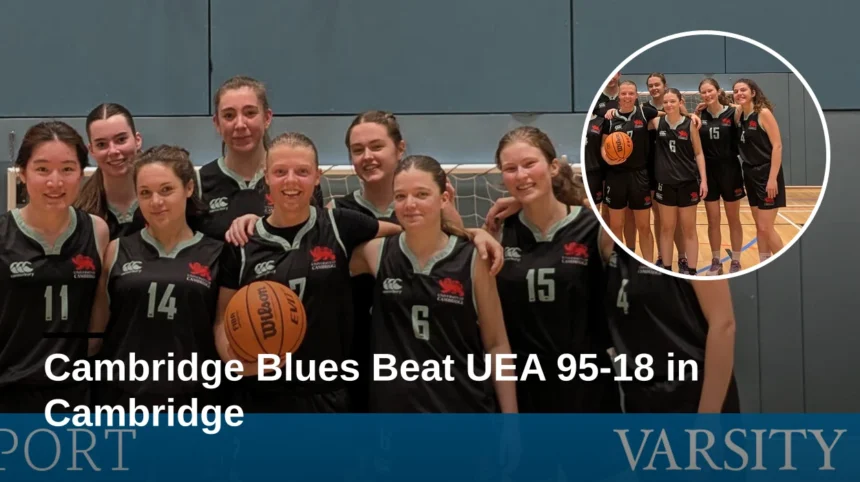
Key Points
- Cambridge Women’s Basketball Blues defeated the University of East Anglia Panthers 95-18.
- Co-captains Faye Parker and Selma Vangstein helped lead a dominant performance at the University Sports Centre.
- Coach Navid Fatemi-Ghomi said the team could challenge for the division title.
- Cambridge were scheduled to face Nottingham 2s before travelling to Nottingham Trent University on 2 December.
- The team’s stated aims include promotion to Division One and victory over Oxford.
Cambridge (Cambridge Tribune) November 27, 2026 – Cambridge Women’s Basketball Blues strengthened their unbeaten start with a 95-18 victory over the University of East Anglia Panthers at the University Sports Centre. The result underlined Cambridge’s attacking depth and defensive control, while co-captains Faye Parker and Selma Vangstein directed a fast-paced display. First-season coach Navid Fatemi-Ghomi said the squad had enough talent to win the division. Cambridge were due to host Nottingham 2s before ending the term away against Nottingham Trent University on 2 December.
- Key Points
- How did Cambridge Women’s Basketball Blues defeat the University of East Anglia?
- What did the players and coach say after the match?
- What were Cambridge’s remaining end-of-term fixtures?
- What does the result mean for the team’s end-of-term ambitions?
- Background to Cambridge’s campaign
- How could the result affect supporters and Cambridge women’s basketball?
How did Cambridge Women’s Basketball Blues defeat the University of East Anglia?
As reported by Varsity in “Women’s Basketball Blues’ end-of-term triumph”, Cambridge built an early lead through rapid transitions, accurate passing and sustained defensive pressure. The Blues led 24-3 at the end of the first quarter, with the Panthers taking more than eight minutes to score their first basket.
Varsity reported that Parker produced blocks, rebounds and passes for cutting team-mates, while Vangstein repeatedly created scoring opportunities on fast breaks. Athena Oliver and Beier Chen converted several of Vangstein’s assists, and Lucy Payne contributed disruptive defence and mid-range shooting.
Erin Lambe, a first-year geographer, was also noted for her rebounding and defensive work. Olga Garcia added three consecutive baskets in the final quarter as Cambridge completed the 95-18 win.
What did the players and coach say after the match?
According to Varsity, Parker said the team’s aim was to enjoy its basketball and highlighted that every player scored against the Panthers. Vangstein said Cambridge had been working on making the extra pass to create open shots.
Vangstein described the season as positive but said the team had not yet faced its toughest games. Parker identified Loughborough as a likely major test, noting that the side could improve before a later meeting. Vangstein also referred to Oxford as an important future challenge.
Fatemi-Ghomi said the squad had substantial talent, strong attendance at training sessions and the potential to win the division. The coach also praised the players’ focus.
What were Cambridge’s remaining end-of-term fixtures?
Varsity reported that Cambridge were scheduled to welcome Nottingham 2s to the University’s Sports Centre for a Midlands Conference Cup fixture. The Blues had already beaten Nottingham 2s twice in league matches during the season.
The final match of the term was scheduled for 2 December at Nottingham Trent University. Cambridge aimed to preserve its perfect league record and enter the Christmas period as division leaders.
What does the result mean for the team’s end-of-term ambitions?
The result gave Cambridge further momentum towards its stated objective of reaching Division One next season. It also strengthened the team’s position ahead of its remaining fixtures, although the players and coach acknowledged that more demanding contests remained.
Background to Cambridge’s campaign
Cambridge Women’s Basketball Blues compete in the British Universities and Colleges Sport Midlands competition. The squad includes Parker, who previously represented Great Britain at under-20 level, and Vangstein, a former Norway under-18 international. The team had recorded wins over Nottingham 2s and faced Loughborough and Oxford as significant reference points for the season. Fatemi-Ghomi is in his first season as Cambridge’s coach.
How could the result affect supporters and Cambridge women’s basketball?
For Cambridge students, alumni and supporters following Women’s Basketball Blues’ end-of-term triumph, the win provides a strong platform for the remaining cup and league fixtures. A continued unbeaten run would improve the team’s prospects of finishing the term as division leaders. The result may also increase attention on the women’s programme as Cambridge pursues promotion and prepares for future contests against Loughborough and Oxford.