

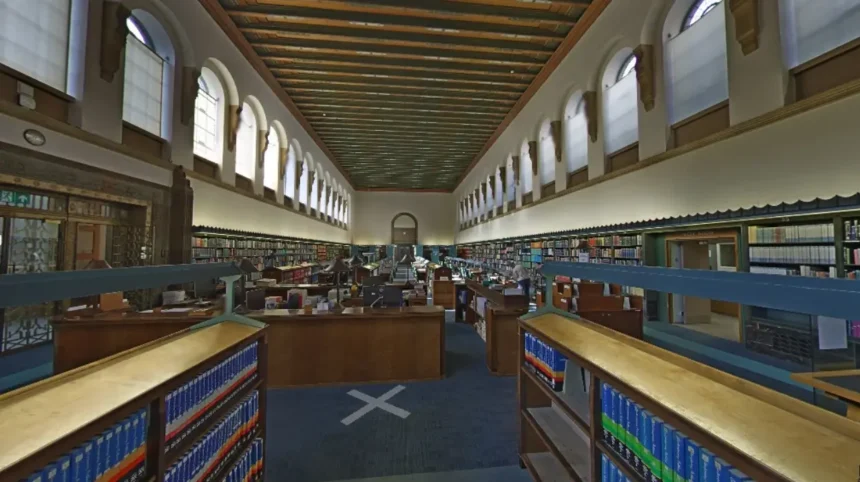
Cambridge architecture spans over eight centuries of continuous development across educational, civic, and commercial spaces. The city contains iconic English Perpendicular Gothic chapels, Neoclassical libraries, Victorian academic halls, Mid-Century Modern accommodation blocks, and contemporary sustainable technology parks across its urban fabric.
- How did medieval Gothic architecture define early Cambridge colleges?
- What role did Classicism and the Renaissance play in shaping Cambridge?
- How did the Victorian era introduce Gothic Revival and eclectic designs?
- How did 20th-century Modernism and Brutalism transform the academic landscape?
- How are modern tech hubs and commercial parks reshaping Cambridge today?
- What is the oldest surviving building in Cambridge?
- Why is red brick used prominently alongside stone in Cambridge colleges?
- How do conservation laws protect Cambridge historic architecture?
- What is the significance of the Backs in Cambridge urban design?
- How are modern Cambridge buildings achieving net-zero carbon status?
Cambridge was established as an academic center in 1209 when scholars migrated from Oxford. Early university structures relied on domestic wood and local clunch stone. Stone masonry soon replaced these initial timber structures.
The built environment evolved through distinct historical phases. Late medieval foundations introduced quadrangle layouts inspired by monastic cloisters. Renaissance influences appeared in the late 16th century, modifying traditional Gothic forms.
Sir Christopher Wren brought Baroque classicism to the city during the 17th century. The 18th and 19th centuries saw a surge in Neoclassical and Gothic Revival construction across expanding collegiate sites.
The 20th century transformed Cambridge through Brutalism and Modernism. The establishment of the Cambridge Science Park in 1970 marked the shift toward high-tech commercial architecture. Today, zero-carbon technology hubs sit alongside protected ancient monuments.
How did medieval Gothic architecture define early Cambridge colleges?
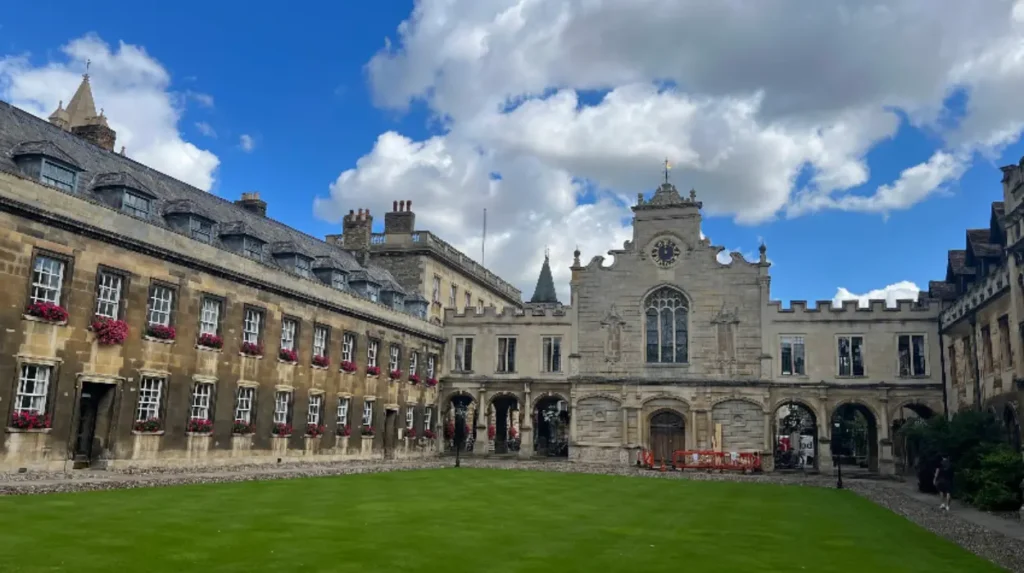
Medieval Gothic architecture established the spatial layout, structural systems, and visual identity of Cambridge colleges. Between 1284 and 1500, master masons used stone vaulting, pointed arches, buttresses, and timber roofs to build self-contained academic courtyards around central chapels.
Peterhouse was founded in 1284 as the first official college of Cambridge. Early medieval college layouts adapted the traditional monastic cloister into an academic court model. This design enclosed residential chambers, a dining hall, and a chapel.
Gothic construction in Cambridge utilized local materials including Barnack limestone, Weldon stone, and clunch. Masons implemented pointed arches to distribute heavy ceiling loads onto vertical piers. External flying buttresses supported expansive window openings.
King’s College Chapel stands as the premier example of late Perpendicular Gothic design in Europe. Royal masons Reginald Ely and John Wastell oversaw construction from 1446 to 1515. The structure features the world’s largest stone fan-vaulted ceiling.
3 primary examples of medieval Gothic structures in Cambridge include:
- King’s College Chapel (Built 1446–1515): Masterpiece of Perpendicular Gothic style featuring massive stained-glass windows.
- Queens’ College Old Court (Built 1448–1450): Preserved red-brick medieval quadrangle incorporating an asymmetrical gatehouse.
- The Round Church (Built circa 1130): Rare Norman Romanesque circular church modeled after the Church of the Holy Sepulchre.
These early Gothic complexes established gated perimeter walls for security. The enclosed court system remains the foundation of university urban planning.
What role did Classicism and the Renaissance play in shaping Cambridge?
Classicism and Renaissance design introduced symmetrical geometry, proportioned columns, and Italianate decorative motifs to Cambridge between 1550 and 1850. Architects moved away from medieval Gothic forms to adopt classical Greek and Roman structural proportions.
The English Renaissance influenced Cambridge during the mid-16th century. Dr. John Caius designed the Gate of Honour at Gonville & Caius College in 1575. This stone structure combined Roman classical orders with Renaissance symbolic carvings.
Sir Christopher Wren introduced full Baroque classicism to Cambridge in 1665. Wren designed the chapel at Pembroke College using precise mathematical proportions derived from Roman temples. He later built the Wren Library at Trinity College between 1676 and 1695.
Neoclassical design expanded across the city during the late 18th and early 19th centuries. Architect William Wilkins designed Downing College in 1807 using Ionic porticos and Greek revival stone facades. The Fitzwilliam Museum, designed by George Basevi in 1836, features a monumental Corinthian portico.
3 prominent Classical and Renaissance landmarks in Cambridge include:
- Wren Library at Trinity College (Built 1676–1695): Baroque library featuring large arched windows and classical balustrades.
- Senate House (Built 1722–1730): Corinthian-style administrative center designed by James Gibbs.
- Downing College Quadrangle (Built 1807–1820): Early Greek Revival campus planned around wide open lawns.
Classicism shifted Cambridge away from dense medieval enclosures toward open, light-filled academic monuments.
How did the Victorian era introduce Gothic Revival and eclectic designs?
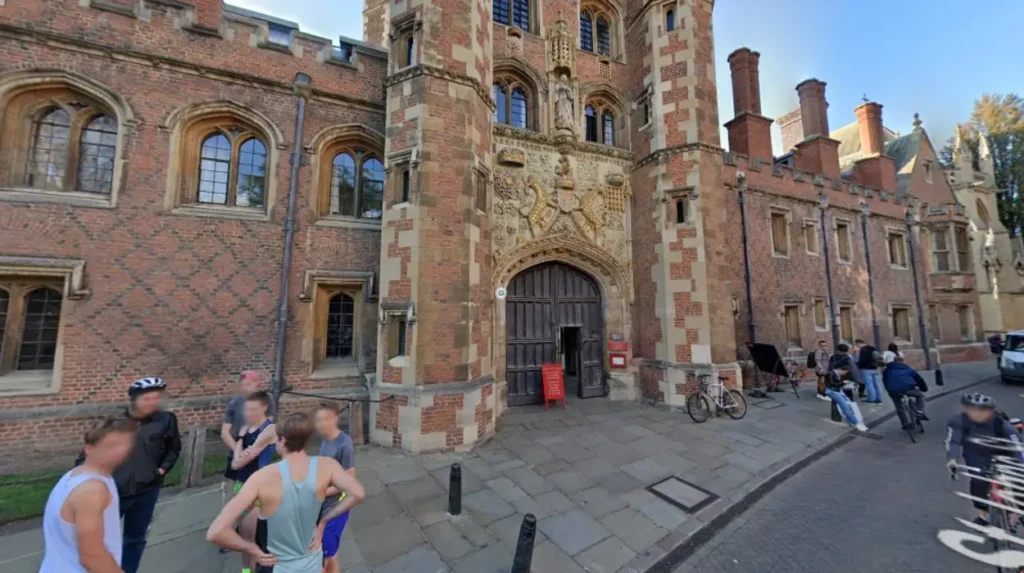
The Victorian era introduced Gothic Revival and historicist architecture to Cambridge between 1837 and 1901. Industrial manufacturing, high-volume brick production, and structural iron enabled architects to re-interpret medieval, Tudor, and Flemish styles on an unprecedented scale.
Victorian growth in Cambridge responded directly to rising student enrollments and university modernization reforms. The Cambridge Camden Society, founded in 1839, advocated for a return to medieval Gothic principles in ecclesiastical design.
Architects utilized new industrial materials alongside traditional stonework. Cast iron beams enabled wider structural spans, while mass-produced red bricks allowed rapid construction. Decorative terracotta, stained glass, and encaustic floor tiles became common features.
Sir George Gilbert Scott restored and expanded numerous college structures during this era. High Victorian Gothic reached its peak at St John’s College with Scott’s massive Chapel, constructed between 1866 and 1869. The building features an 80-meter tower inspired by Sainte-Chapelle in Paris.
3 major examples of Victorian architecture in Cambridge include:
- St John’s College Chapel (Built 1866–1869): Monumental Gothic Revival chapel constructed with Ancaster stone.
- Selwyn College Old Court (Built 1882): Tudor Gothic residential quadrangle built using red brick and stone dressings.
- Girton College (Built 1873): Alfred Waterhouse-designed brick complex featuring Victorian Gothic towers and corridors.
Victorian developments expanded the physical footprint of the university beyond its historic medieval core.
How did 20th-century Modernism and Brutalism transform the academic landscape?
Modernism and Brutalism transformed 20th-century Cambridge by introducing raw concrete, exposed structural steel, glass curtain walls, and modular geometric layouts. Between 1950 and 1980, architects rejected historical revivalism in favor of functionalist academic design.
Post-war expansion required low-cost, high-density housing and specialized research facilities. British architects experimented with bold structural forms across new college foundations and central administrative sites.
The Cambridge School of Architecture became a center for Modernist theory under Sir Leslie Martin. Architects replaced traditional load-bearing stone walls with reinforced concrete frames. Modular prefabricated panels and floor-to-ceiling glass replaced heavy stone masonry.
Brutalism emerged as a major style within the city during the 1960s. The History Faculty Building, designed by James Stirling in 1968, features a glass-clad cascade attached to a red-brick structural core. Powell & Moya designed the Cripps Building at St John’s College in 1967, integrating modern concrete zigzags into historic lawns.
3 significant Modernist and Brutalist structures in Cambridge include:
- The History Faculty Building (Built 1968): Post-modern structural glass pyramid combined with industrial brickwork.
- The Cripps Building at St John’s College (Built 1967): Portland stone and concrete modern residential block.
- Churchill College Campus (Built 1959–1968): Board-marked concrete and brick complex designed by Sheppard Robson & Partners.
These structures modernized the city’s educational facilities while sparking debate over historic preservation.
How are modern tech hubs and commercial parks reshaping Cambridge today?
Modern tech hubs are reshaping Cambridge by introducing sustainable, steel-and-glass, low-energy commercial architecture. Since 1970, high-tech developments around the Cambridge Silicon Fen have integrated intelligent building management, solar arrays, and flexible laboratory spaces.
The emergence of the “Silicon Fen” commercial cluster created demand for specialized corporate research buildings. Trinity College founded the Cambridge Science Park in 1970 as the first science park in the United Kingdom.
Contemporary technology architecture prioritizes operational sustainability and environmental certifications such as BREEAM Excellent. Buildings utilize glulam timber framing, triple-glazed green facades, rainwater harvesting systems, and natural ventilation chimneys.
The Cambridge Biomedical Campus and West Cambridge Innovation District host global technology and pharmaceutical centers. Norman Foster designed the Law Faculty building in 1995 with a curved glass atrium. Herzog & de Meuron completed the AstraZeneca Global R&D Centre in 2021, featuring a saw-tooth disc design.
3 key modern commercial and technology hubs in Cambridge include:
- AstraZeneca Global R&D Centre (Built 2021): Circular glass facility focused on low-carbon research infrastructure.
- The Abcam Headquarters at Cambridge Biomedical Campus (Built 2019): Contemporary glass structure with exterior solar fins.
- The Bradley Building at Cambridge Science Park (Built 2022): High-efficiency laboratory space constructed with sustainable composite materials.
Modern tech infrastructure aligns economic growth with advanced ecological engineering across outer Cambridge.
What is the oldest surviving building in Cambridge?
The St Bene’t’s Church tower stands as the oldest surviving building in Cambridge. Constructed around 1020 AD during the Anglo-Saxon period, the tower features classic long-and-short stone masonry.
Why is red brick used prominently alongside stone in Cambridge colleges?
Red brick became popular in the 15th century due to local clay availability and lower costs compared to imported stone. Colleges like Queens’ and St John’s used brick for residential courtyards while reserving imported limestone for chapels.
How do conservation laws protect Cambridge historic architecture?
Over 1,500 buildings in Cambridge hold listed status under national planning laws. The central conservation area restricts external alterations, structural modifications, and new height profiles to protect historic sightlines across the city.
What is the significance of the Backs in Cambridge urban design?
The Backs refers to the green parkland area located behind the historic colleges along the River Cam. This landscape integration allows unobstructed views of Gothic chapels, classical bridges, and private college grounds.
How are modern Cambridge buildings achieving net-zero carbon status?
Modern developments utilize ground-source heat pumps, high-performance insulation, timber framing, and rooftop photovoltaic systems. New campus projects must adhere to strict local planning rules requiring low-carbon materials and net biodiversity gains.
