Key Points
- The UK government has dropped full planning permission requirements for installing cross-pavement electric vehicle home chargers.
- Drivers without driveways can save up to £300 by avoiding local authority planning application fees.
- Motorists can now charge vehicles at domestic electricity rates of roughly 7p per kWh (2p per mile) instead of public charger rates averaging 50p per kWh.
- Switching from public chargers to home rates can lower annual running costs by up to £1,750 per vehicle.
- Homeowners now only need approval from their local highway authority rather than full planning permission.
- Ministers launched two consultations alongside the rule change to require EV chargers in new builds and expand public charging networks.
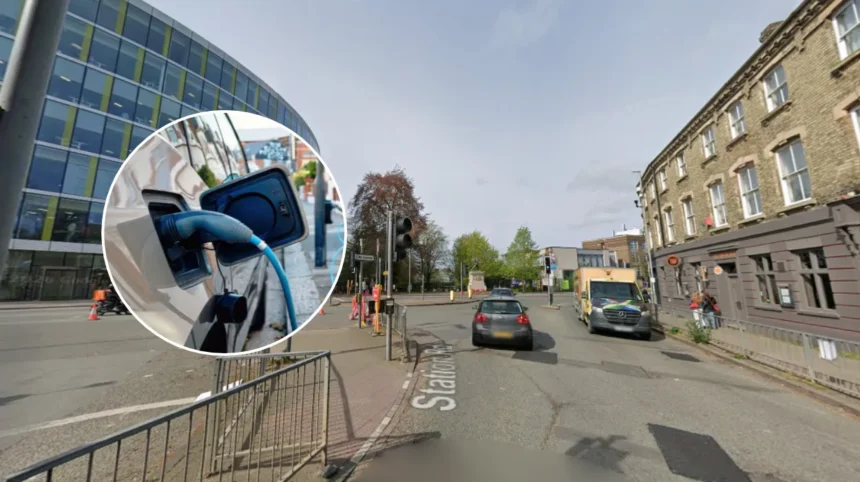
London (Cambridge Tribune) October 21, 2026 – Millions of electric vehicle owners without off-street parking can now save up to £300 on home charger installation following a major government rule change designed to slash bureaucracy and boost zero-emission vehicle adoption across the United Kingdom.
- Key Points
- What is the new electric vehicle home charger planning rule?
- How will removing planning red tape benefit British drivers?
- What do industry figures and official data show about EV charging costs?
- What is the background to this electric vehicle policy decision?
- What is the prediction for how this rule change will impact UK drivers and local authorities?
What is the new electric vehicle home charger planning rule?
Under regulatory changes taking effect on 21 October 2026, UK motorists who lack dedicated off-street driveways will no longer be required to secure formal planning permission to install cross-pavement home charging solutions.
By eliminating the need to submit formal planning applications to local councils, households can avoid paying administrative and processing fees that previously cost up to £300 per installation.
Instead of navigating the complex and protracted local authority planning system, motorists now simply require standard local highway authority authorisation to safely route charging cables across public footpaths.
How will removing planning red tape benefit British drivers?
Prior to this legislative update, as many as eight million UK households lacked access to off-street parking, leaving millions of potential electric vehicle adopters reliant on expensive public charging networks.
By streamlining the legal process for cross-pavement solutions—such as under-pavement cable channels or specialized protective covers—drivers without driveways can now charge their vehicles using domestic electricity tariffs.
As reported by the Department for Transport press team on GOV.UK, Buses and Local Transport Minister Simon Lightwood stated that “We’re saving drivers up to £300 off the cost of installing home charging by cutting unnecessary red tape. The EV transition is in full swing – sales are up 36% on last year and over 190,000 have saved thousands making the switch in the last year alone.”
This policy shift allows EV drivers without driveways to access domestic overnight electricity rates as low as 7p per kilowatt-hour (kWh), compared to public charging tariffs that frequently average nearly 50p per kWh.
What do industry figures and official data show about EV charging costs?
According to analysis highlighted by government officials and motoring groups, switching from public chargers to cross-pavement home charging systems could yield cumulative running cost savings of up to £1,750 per year for typical British motorists.
Despite the obvious financial benefits, uptake of cross-pavement charging technology has historically remained exceptionally low due to administrative hurdles and lack of public awareness.
As reported by Luke Chings of The Express, findings from Electric Vehicle Association (EVA) England revealed that “less than 1% of EV drivers are using cross-pavement technology, with 57% not even aware they existed.”
The government’s decision to drop planning barriers aims to rapidly improve these figures, allowing charge point operators and local authorities to install both domestic solutions and larger public charging hubs far more quickly and cost-effectively.
Alongside the rule change, ministers launched two national consultations focused on ensuring newly constructed residential and commercial properties are fitted with charging infrastructure from the outset.
What is the background to this electric vehicle policy decision?
For several years, the discrepancy between home charging costs and public charging costs has been a major barrier to equal electric vehicle adoption across the UK.
Drivers with private driveways have enjoyed access to ultra-cheap off-peak domestic tariffs, while motorists living in terraced housing, flats, or urban dwellings without private parking were forced to rely on commercial charging hubs.
Local councils previously held differing, complex policies regarding cross-pavement cable channels, resulting in a fragmented landscape where planning permission costs and processing delays varied significantly by region.
To resolve these disparities, the UK government initiated statutory reviews into Permitted Development Rights, aiming to align infrastructure rules with national decarbonisation targets and lower barriers for urban motorists.
What is the prediction for how this rule change will impact UK drivers and local authorities?
This rule change is predicted to accelerate electric vehicle adoption among urban households, flat dwellers, and terraced homeowner demographics who previously hesitated due to high public charging fees.
For motorists without driveways, the removal of the £300 planning fee and the reduction in processing times will dramatically lower the barrier to entry, enabling millions to reduce their annual vehicle running costs by up to £1,750.
Local highway authorities will likely experience a significant surge in applications for cross-pavement cable channel approvals. While this will streamline the process for drivers, councils will need to establish efficient standardisation frameworks to ensure pedestrian safety and prevent trip hazards on public footpaths.
Furthermore, charge point operators are expected to scale up installation services rapidly, driving competition and reducing hardware costs for UK consumers throughout 2026 and beyond.