
Britain is about to get its seventh prime minister in a decade, and if the mood inside Labour’s special conference on Friday was anything to go by, most of the party is treating it less like a crowning and more like a rescue mission.
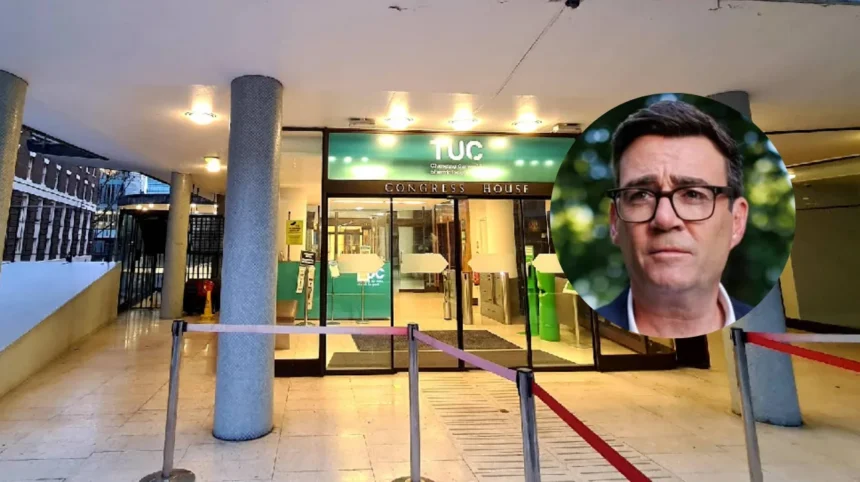
Andy Burnham was confirmed as Labour leader after securing backing from 379 of the 403 Labour lawmakers in the House of Commons, in a contest where he stood entirely unopposed. He takes over from Keir Starmer, who was forced out by a Labour rebellion, on Monday. Whichever way Downing Street tries to spin it, this was not a triumphant handover between allies. It was a party cutting its losses.
From Manchester to Westminster
The result, delivered at a special conference at TUC headquarters in London, was never in doubt. What’s striking is how little groundwork Burnham has had to lay in Westminster terms. He has effectively been prime minister-in-waiting for weeks, having won a special election for a Commons seat only a month ago. He arrives at Number 10 largely unknown to voters outside Manchester, having held no press conferences and given few interviews since.
In his first speech as leader, Burnham struck a deliberately hopeful note, telling the hall he wants to “give them hope back.” He was also generous towards his predecessor, crediting Starmer with taking Labour “from our worst defeat to one of the best victories in our history.”
The formal transfer of power will follow Starmer’s travel to Buckingham Palace to resign, the King’s invitation to Burnham to form a government, and Burnham’s heading to Downing Street to address the country for the first time as PM. He’ll formally take office on Monday, with Starmer departing after facing down criticism over the cost-of-living crisis and two ongoing wars.
Promise to ‘fix the big things’
Burnham’s platform leans heavily on the regional agenda that made his name. He has promised “the biggest rebalancing of power our country has seen,” arguing Whitehall has grown too dominant at the expense of Britain’s regions, and also arguing that growth cannot be ordered from the top down, only nurtured from the bottom up.
Burnham’s opening pitch reads like an attempt to be all things to all Labour factions: public ownership of water and energy to please the left, a fiscal rule commitment and a promise not to touch income tax, VAT or National Insurance to reassure the markets and the centre. Bringing essential services back under state control while also holding the purse strings tight is not, on paper, an easy circle to square.
Then there’s social care, where the graveyard of several prime ministerial reputations lies before him. Floating a land-value tax or a death duty to pay for it takes some nerve this early in a premiership. It also, tellingly, tells you where Burnham thinks his political capital is best spent: not on caution, but on the one issue voters have been begging Westminster to fix for a generation.
The bottom line
Burnham is inheriting a party desperate for a fresh face and a country in no mood for warm words. The unopposed coronation was the easy part. Governing, with Reform UK snapping at Labour’s heels in seat after seat, as seen even in Thursday’s Cambridgeshire result, will be considerably harder. Whether his more relaxed style and reputation as one of Labour’s sharper communicators can shift the political weather where Starmer couldn’t is, for now, the only question that matters.