
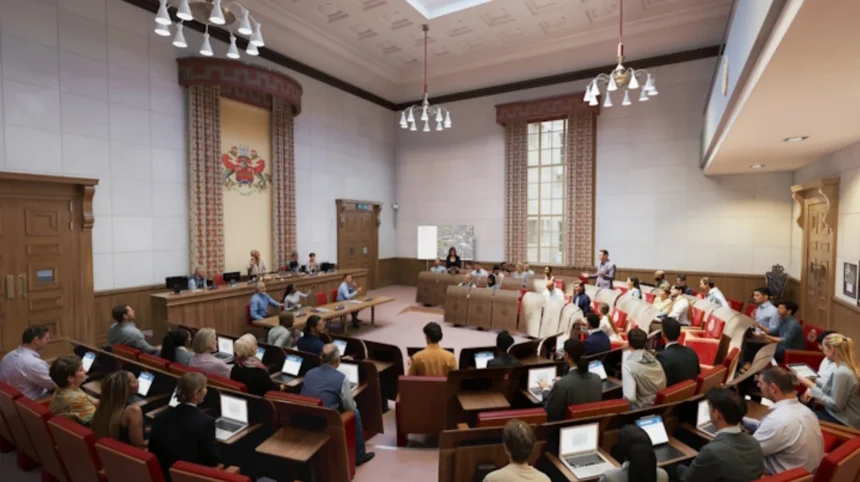
Cambridge has a new mayor – but the city’s council is in a political uncertainty after the councillors failed to elect a leader during the Annual Meeting on Thursday 21 May, leaving the authority unable to carry out key functions of local government.
Green Councillor takes the mayoral seat
Councillor Maria Cleminson is a Green Party member and a long-standing Abbey resident and is widely known for her volunteer work with Citizens Advice and local community groups, as well as involvement in heritage and biodiversity projects across the city. Maria was formally elected Mayor of Cambridge at the meeting on 21 May.
Liberal Democrat councillor Amanda Taylor was elected Deputy Mayor.
Outgoing Mayor Dinah Pounds and former Deputy Mayor Richard Swift were paid tributes for their service over the past year, supporting community organisations, charities and civic events.
Three former councillors – Richard Robertson, Anna Smith, and Baiju Thittala – were also appointed Honorary Councillors in recognition of their years of public service. While the title itself is ceremonial and carries no voting rights, it comes with an invitation to certain civic events alongside the Mayor.
Council fails to appoint a leader
Labour’s Katie Thornburrow was the only candidate put forward for council leader but was voted down by the council. With no alternative candidate nominated, the Annual Council Meeting was adjourned and will reconvene on Monday 1 June.
The appointment of a council leader is a legal requirement, and the council’s head of legal services told councillors that one must be in place by 2 June. Without a leader, the authority cannot appoint cabinet members or confirm committee roles – effectively paralysing many of its normal decision-making functions.
A divided council
The impasse is a direct consequence of this month’s local elections, which left no single party with overall control. Labour remains the largest group with 17 seats, but the combined opposition – 12 Greens, 11 Liberal Democrats, 1 Conservative and 1 Your Party councillor – now outnumbers them.
Cambridge operates under a leader and cabinet system, where the leader appoints cabinet members responsible for areas including housing, planning, culture and environmental services.
During debate following two unsuccessful votes on the leadership question, Liberal Democrat group leader Tim Bick called for a “progressive alliance” between Labour, the Liberal Democrats and the Greens to keep the council functioning. Labour’s Thornburrow pushed back, telling opposition members that Labour had “not said we would work with you in that way” and challenging them to put forward their own candidates if they opposed her leadership.
The discussions highlighted growing tensions between the city’s main political groups as negotiations continue over how the council will be run over the coming year.
What happens next
Councillors are expected to reconvene on 1 June in an attempt to appoint a leader before the legal deadline.
Until then, uncertainty remains over how the council’s administration will be formed and which parties, if any, may work together to secure stable leadership at Cambridge City Council.