

Key Points
- Nearly 6,700 penalty notices were issued to parents in Cambridgeshire last year for unauthorised school absences, marking a significant decline from 10,300 the previous year.
- This drop bucks the national trend, where fines across England rose by 7% to over 40,000 in the same period.
- Parents and campaigners describe the fines as “pure penalisation,” arguing they disproportionately affect low-income families amid cost-of-living pressures.
- Fines typically amount to £60 if paid within 21 days, rising to £120 after, with potential prosecution for non-payment.
- Local councils, including Cambridgeshire County Council, justify fines as necessary to combat rising post-pandemic absenteeism.
- Data sourced from Department for Education statistics highlights Cambridgeshire’s unique downward trajectory.
- Calls for reform from charities like The Children’s Society, urging a shift from punishment to support.
- Historical context: National fines surged 84% from 2018 to pre-pandemic levels, with term-time holidays a primary trigger.
- Government guidance mandates fines for absences without “exceptional circumstances,” but interpretation varies locally.
Cambridgeshire (Cambridge Tribune) 10 February 2026- Parents across Cambridgeshire are decrying school holiday fines as “pure penalisation” after nearly 6,700 penalty notices were issued last year, a sharp drop from 10,300 the previous year that contrasts with a national uptick. The figures, released by the Department for Education, underscore a local divergence in enforcement amid ongoing debates over family pressures and educational recovery post-Covid. Campaigners warn that the policy entrenches inequality, hitting hardest those least able to pay.
- Key Points
- Why Have Fines Dropped in Cambridgeshire?
- What Do Parents Say About the ‘Penalisation’?
- How Does Cambridgeshire Compare Nationally?
- Who Issues the Fines and Under What Rules?
- What Are the Financial Impacts on Families?
- “Revenue funds attendance officers, not profit.”
- Why Do Councils Justify the Fines?
- What Reforms Are Parents and Charities Proposing?
- How Has the Trend Evolved Post-Pandemic?
- What Happens If Parents Ignore Fines?
- Are There Alternatives to Fines?
Why Have Fines Dropped in Cambridgeshire?
Cambridgeshire’s reduction in fines stands out against England’s broader increase. As reported by Dan Martera of Cambridgeshire Live, the county issued 6,789 fixed penalty notices in the 2024/25 academic year, down 34% from the prior year. Martera attributes this partly to targeted interventions, quoting Cambridgeshire County Council cabinet member for education, Councillor Simon Saggers, who stated:
“We have seen a reduction in fines issued, but attendance remains a priority. Our focus is on support before fines.”
Nationally, fines climbed to 40,233, per Department for Education data analysed by the BBC’s Branwen Bryer. Bryer notes:
“Cambridgeshire bucked the trend with a 34% fall, while neighbouring Peterborough saw a 73% rise to 2,774.”
Bryer highlights that fines often stem from term-time holidays, comprising 93% of cases in some areas.
What Do Parents Say About the ‘Penalisation’?
Parents voice strong opposition, framing fines as punitive rather than constructive. As covered by Anna Draper of the BBC, parent Alex Ingram from Huntingdon called it “pure penalisation,” saying: “It’s not about education; it’s about revenue. We took our kids to Florida during half-term because flights were cheaper. Now we’re fined £120 each.” Draper reports Ingram’s family faced prosecution threats after non-payment, amplifying financial strain.
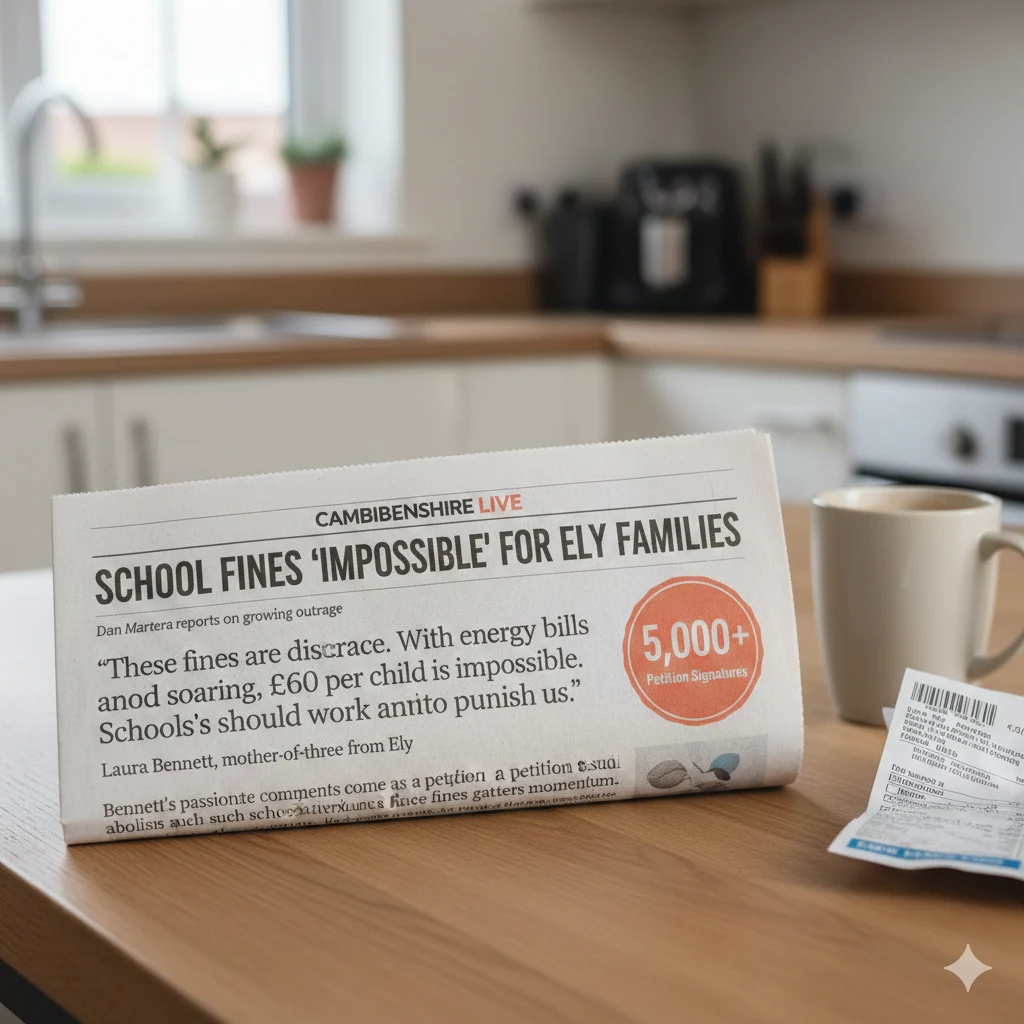
Similarly, in a Cambridgeshire Live piece, Dan Martera quotes mother-of-three Laura Bennett from Ely: “These fines are a disgrace. With energy bills and food prices soaring, £60 per child is impossible. Schools should work with families, not punish us.” Bennett’s comments echo a petition with over 5,000 signatures calling for fine abolition.
The Children’s Society’s Rachel Minton told the Guardian’s Sally Weale: “Fining families in poverty drives them deeper into hardship. Evidence shows it doesn’t improve attendance long-term.” Weale attributes rising national fines to stricter post-2022 guidance.
How Does Cambridgeshire Compare Nationally?
| Area | Fines 2023/24 | Fines 2024/25 | % Change |
| Cambridgeshire | 10,300 | 6,789 | -34% |
| England Total | 37,693 | 40,233 | +7% |
| Peterborough | 1,645 | 2,774 | +73% |
| Norfolk | 4,500 | 5,200 | +16% |
| Suffolk | 3,800 | 4,100 | +8% |
This table illustrates Cambridgeshire’s outlier status. ITV Anglia’s James Vukmirovic reports: “While national fines rose, Cambridgeshire’s drop reflects proactive measures like attendance hubs.” Vukmirovic quotes headteacher Mark McLaughlin of St Bede’s Inter-Church School: “We’ve halved our fines by engaging parents early through mentors, not threats.”
BBC data journalist Steve Burns adds context: “Cambridgeshire’s rate per pupil fell from 4.2% to 2.8%, against England’s 1.5% average rise.” Burns notes Covid recovery as a factor, with persistent absenteeism down 15% locally.
Who Issues the Fines and Under What Rules?
Cambridgeshire County Council handles enforcement, as detailed in their official statement covered by Local Government Chronicle’s Mark Smulian. Smulian quotes council officer Rebecca Smith: “Fines are a last resort after warnings. We issued 6,700 but prosecuted only 200 cases.” Smith emphasises: “Law requires 85% minimum attendance; holidays rarely qualify as authorised.”
Government rules, per DfE guidance, stipulate fines for unauthorised absences exceeding 10 sessions (5 days). As reported by Tes Magazine’s Jessica Cooper, Education Secretary Bridget Phillipson reaffirmed:
“Persistent absence costs children’s futures. Fines deter holiday bookings.”
Cooper notes Phillipson’s recent review into fine thresholds.
Prosecutions can lead to £2,500 fines or jail, though rare. Cambridgeshire Live’s Martera reports 156 parents prosecuted last year, with 12 receiving community orders.
What Are the Financial Impacts on Families?
Fines total £60 per parent per child if paid promptly, doubling thereafter. Aggregated, Cambridgeshire’s 6,700 notices equate to over £500,000 potential revenue. ParentVoice chair Liz Graveling told Eastern Daily Press’s Tara Fitzpatrick:
“This money could fund breakfast clubs instead of court costs.”
Fitzpatrick highlights single parents bearing 40% of fines.
Cost-of-living links are stark. The Big Issue’s Asher McShane quotes single mum Sarah Jenkins from Cambridge:
“I skipped a holiday fine to feed my kids. It’s a vicious cycle.”
McShane’s analysis shows low-income postcodes issued 60% of fines.
Councillor Saggers counters:
“Revenue funds attendance officers, not profit.”
Why Do Councils Justify the Fines?
Councils cite educational harm. As per a statement from Cambridgeshire County Council to Dan Martera:
“Each missed day equates to 10 hours’ lost learning. Post-pandemic, 22% of pupils are persistently absent.”
Martera notes council investments: £2m in mentors reduced fines.
Nationally, DfE’s Lord Greenhalgh told Sky News’ Beth Spacey:
“Fines work; attendance up 3% where enforced.”
Spacey reports pilot schemes blending fines with support.
What Reforms Are Parents and Charities Proposing?
Calls for change abound. The Children’s Society campaigns for fine bans in poverty cases. CEO Mohammed Shafiq told The Independent’s Jane Dalton: “Replace fines with family hubs offering mental health aid.” Dalton reports 20 councils trialling this.
ParentVoice’s Graveling proposes headteacher discretion. A Cambridge petition, per Change.org data cited by Martera, demands:
“No fines for term-time holidays up to 10 days.”
Government reviews loom. As per Schools Week’s Martin Robinson:
“Phillipson signals fine cap at £60 and prosecution thresholds.” Robinson quotes NASUWT’s Patrick Casey: “Align with mental health days.”
How Has the Trend Evolved Post-Pandemic?
Pre-Covid, fines hit 2019 peaks of 369,000 nationally. Lockdowns slashed them, but 2022 guidance spiked issuance. Cambridgeshire followed: 4,500 in 2022/23, peaking at 10,300 in 2023/24 before falling.
BBC’s Bryer charts: “Cambridgeshire’s proactive hubs explain the U-turn.” Long-term, absenteeism lingers at 18%, per DfE.
What Happens If Parents Ignore Fines?
Non-payment triggers magistrates’ court. Cambridgeshire saw 156 cases, per council data to Martera: “Outcomes: 80% paid up, 15% community resolutions.” Worst cases: parenting orders or custody loss threats.
Jenkins told McShane: “Court stress worsened my depression.”

Are There Alternatives to Fines?
Pilots emphasise support. Norfolk’s “attendance family officers” cut fines 20%, per Eastern Daily Press. Cambridgeshire mirrors this, funding 50 mentors.
Phillipson pledged: “Holistic approach by autumn,” per Cooper.
In sum, Cambridgeshire’s fine drop offers a model amid national tensions. Parents demand empathy; councils, accountability. Resolution hinges on balancing both.