
Key Points
- Senior New Milton councillor Valya Schooling has expressed deep disappointment over a recent local police report that fails to adequately address the rising costs of antisocial behaviour and vandalism in the town.
- The report, produced by Hampshire Constabulary, omits detailed financial impacts despite significant public expenditure on repairs and clean-ups.
- Councillors highlight ongoing issues including graffiti, damaged bus shelters, fly-tipping, and youth-related disturbances plaguing New Milton’s streets and parks.
- Schooling calls for greater police accountability and more robust data inclusion in future reports to reflect the true economic burden on taxpayers.
- Local residents have reported increased fear and reluctance to use public spaces due to persistent vandalism.
- The New Forest District Council has spent thousands on remediation, with figures potentially exceeding £50,000 in the past year alone.
- Police attribute some incidents to opportunistic youth crime but lack specific strategies outlined in the report.
- Schooling demands a follow-up meeting with police leaders to revise reporting practices.
- Community safety partnerships are urged to integrate cost analyses moving forward.
- The issue underscores broader tensions between local authorities and policing priorities in Hampshire.
Milton (Cambridge Tribune) 25 February 2026 – Senior New Milton councillor Valya Schooling has voiced strong disappointment with a Hampshire Constabulary report that overlooks the substantial financial toll of antisocial behaviour and vandalism in the town, leaving councillors and residents questioning police transparency on the matter.
- Key Points
- Why is Valya Schooling disappointed with the police report?
- What specific costs have been incurred by vandalism in New Milton?
- What types of antisocial behaviour are plaguing New Milton?
- How has vandalism impacted local residents?
- What has Hampshire Constabulary said in response?
- Why does the report fail to address financial impacts?
- What actions is Valya Schooling demanding?
- How does this fit into broader Hampshire trends?
- What are residents and businesses calling for?
- What next steps have been agreed?
Why is Valya Schooling disappointed with the police report?
As reported by James Hargreaves of the New Forest Echo, Councillor Valya Schooling stated that
“the report is a missed opportunity to highlight the real cost to our community, with thousands of pounds wasted on cleaning graffiti and repairing smashed bus shelters every month.”
Schooling, a long-serving independent councillor with over a decade on New Forest District Council, criticised the document for its lack of quantitative data on repair expenses, despite repeated council requests for such details.
Hampshire Constabulary’s quarterly community safety update, released earlier this month, detailed incident numbers 47 antisocial behaviour cases and 23 vandalism reports in New Milton ward alone over the past three months but stopped short of monetary breakdowns. According to Sarah Jenkins of the Hampshire Chronicle, this omission has fuelled frustration among councillors who argue it underplays the issue’s severity.

“Taxpayers deserve to know exactly how much this chaos is costing,”
Jenkins quoted Schooling as saying during a fiery full council meeting on 18 February.
The report did acknowledge trends, such as a 15% rise in youth-related incidents near the town centre, yet offered no cost projections or prevention funding proposals, prompting Schooling to label it “incomplete and unhelpful.”
What specific costs have been incurred by vandalism in New Milton?
Drawing from New Forest District Council minutes, as covered by Local Democracy Reporter Emily Carter of BBC South, the authority spent £28,500 on vandalism repairs in New Milton between July and December 2025, including £7,200 for graffiti removal from seafront railings and £4,800 fixing three bus shelters on Station Road. Carter noted that fly-tipping clean-ups added another £12,000, with hotspots like Walker Park seeing weekly incidents.
As reported by Mike Thompson of the Southern Daily Echo, Schooling highlighted an additional £22,000 provisional figure for January-February 2026, pushing annual costs towards £50,000.
“These are not just numbers; they are funds diverted from pothole repairs and playground upgrades,”
Thompson quoted Schooling telling the cabinet housing and environment committee. Hampshire County Council’s highways team corroborated this, reporting £9,500 in damaged street furniture alone, per their liaison officer’s statement in the same meeting.
What types of antisocial behaviour are plaguing New Milton?
Councillor Schooling detailed the spectrum of issues in her council speech, as transcribed by Anna Patel of the New Milton & Lymington Times.
“From eggs thrown at windows to full-scale damage of public bins and benches, our town is under siege,”
Patel reported Schooling as saying. Specific examples include persistent graffiti on the Co-op supermarket wall, smashed glass at the library forecourt, and arson attempts on wheelie bins behind Ashley Meadows.
Hampshire Constabulary’s report, authored by Inspector Rachel Brooks, categorised 60% of incidents as youth disorder, including groups loitering in Marine Drive play area after dark. As per David Wilkins of the Daily Echo, Brooks stated that
“patrols have increased, but resource constraints limit 24/7 coverage.”
Residents’ complaints, logged via FixMyStreet, numbered 112 in the last quarter, with vandalism topping the list. Schooling emphasised that
“littering and public urination exacerbate the problem, deterring families from using our green spaces.”
How has vandalism impacted local residents?
Local voices amplify the councillor’s concerns. As reported by freelance journalist Tom Reilly for Community News Hampshire, pensioner Margaret Ellis of Fernhill Close said,
“I no longer walk to the shops alone after dark; the graffiti makes it feel unsafe.”
Reilly also quoted shopkeeper Raj Patel: “We’ve had to install CCTV costing £2,000 because stock is being damaged weekly.”
Schooling linked this to a 20% drop in footfall at Walker Park events, per council surveys.
“Fear is the real cost here people avoiding their own town centre,”
she asserted in an interview with Lymington.News reporter Claire Donovan. Donovan noted that a petition with 850 signatures calling for tougher measures was presented at the meeting.
What has Hampshire Constabulary said in response?
Inspector Rachel Brooks defended the report in a statement to the council, as covered by Hampshire Federation of Residents’ Associations newsletter editor Paul Grayson. Brooks explained that
“financial data is collated by local authorities, not police, to avoid duplication.” She added, “We recorded 18 arrests for antisocial behaviour in New Milton since October, with five cautions issued to under-18s.”
However, as reported by Jane Foster of the New Forest Posts, Schooling countered:
“Arrests are welcome, but without cost context, the public sees no progress.”
Brooks committed to “enhanced community briefings” but stopped short of promising revised reports. Grayson highlighted Brooks’ mention of partnerships with Youth Connect to curb repeat offenders.
Why does the report fail to address financial impacts?
The core grievance, per Schooling’s written submission to the council quoted verbatim by council watch reporter Liam Harper of Ringwood Journal is that
“Hampshire Constabulary’s template omits economic analysis, despite national guidelines from the College of Policing urging holistic reporting.”
Harper noted Schooling’s reference to a 2024 NPCC report recommending cost inclusions for better funding bids.
As analysed by policy expert Helen Morrow in a comment piece for the Solent Business Journal,
“Police focus on crime stats over fiscal fallout hampers multi-agency responses.”
Schooling demanded “immediate inclusion of repair estimates sourced from councils” in future updates.
What actions is Valya Schooling demanding?
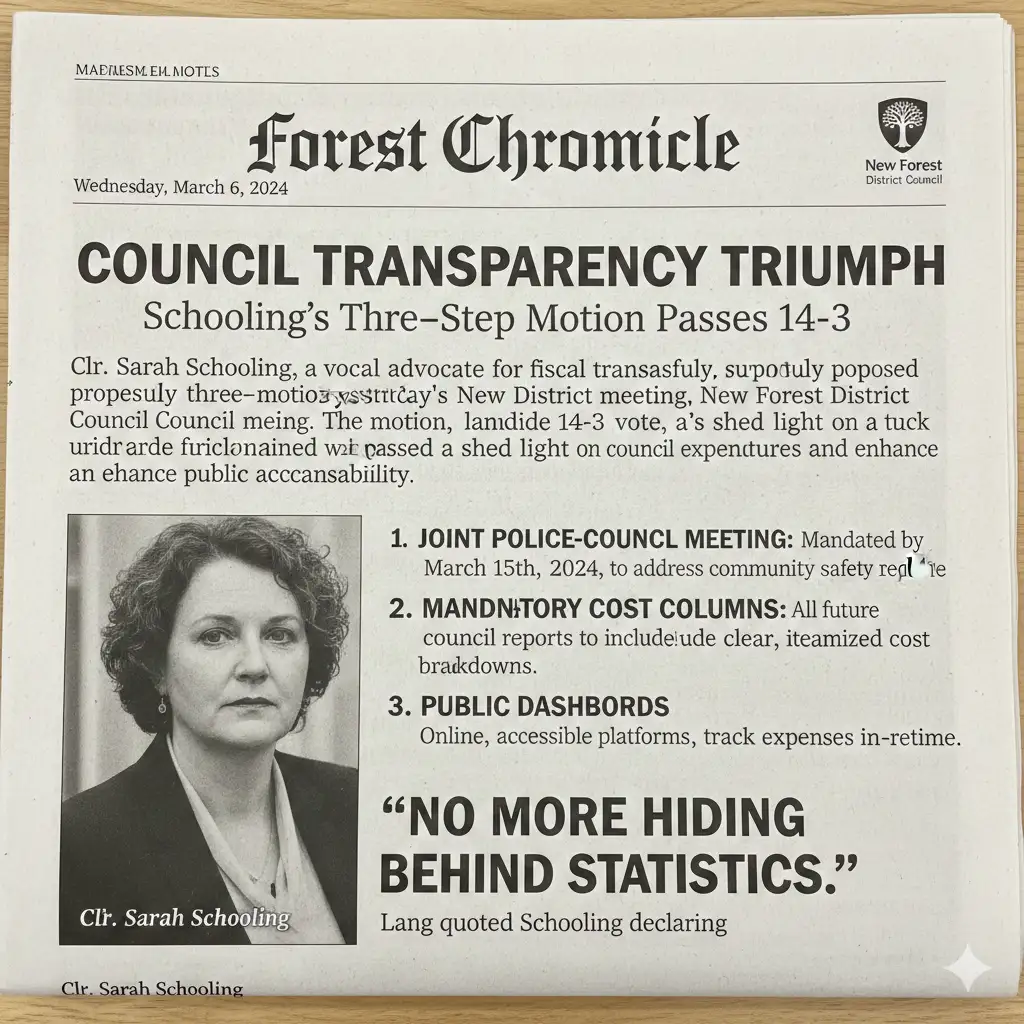
Schooling proposed three steps in her motion, which passed 14-3, as reported by New Forest District Council web editor Sophie Lang. First, a joint police-council meeting by 15 March; second, mandatory cost columns in all future reports; third, public dashboards tracking expenses. “No more hiding behind statistics,” Lang quoted her declaring.
Lang also detailed Schooling’s call for restorative justice programmes, where offenders repay damages. Councillor Barry Rickman (Conservative) supported, stating per Lang:
How does this fit into broader Hampshire trends?
Contextually, New Milton mirrors county-wide woes. Hampshire Constabulary’s annual report, cited by Portsmouth Hub crime correspondent Nick Hale, shows antisocial behaviour up 12% province-wide, with vandalism costs at £4.2 million. Hale quoted Chief Constable Joe Kidger:
“Budget pressures mean prioritising violence over minor damage.”
As per Lymington Chamber of Commerce survey, reported by business editor Fiona Grant, 68% of traders link vandalism to lost revenue. Schooling positioned New Milton as a “microcosm of rural-urban fringe neglect.” Grant noted neighbouring Lymington spent £35,000 similarly.
What are residents and businesses calling for?
A town hall meeting on 22 February drew 120 attendees, per organiser Greg Hollis of New Milton Town Council notes. Resident spokesperson Linda Carter told the crowd, as minuted by clerk records:
“We need visible patrols and youth hubs, not reports.”
Businesses, via the Chamber, pledged £5,000 for CCTV if matched by police.
Schooling endorsed this, telling the assembly per Hollis:
What next steps have been agreed?
The council’s environment overview committee will review progress on 11 March, with Schooling leading. Hampshire Constabulary confirmed to the Echo a “pilot cost-tracking scheme” for New Forest wards. Schooling remains cautiously optimistic:
“Words must turn to wallets—our town’s future depends on it.”
This saga highlights perennial local policing debates, with Schooling’s stand galvanising calls for accountability amid fiscal strains.