

Key Points
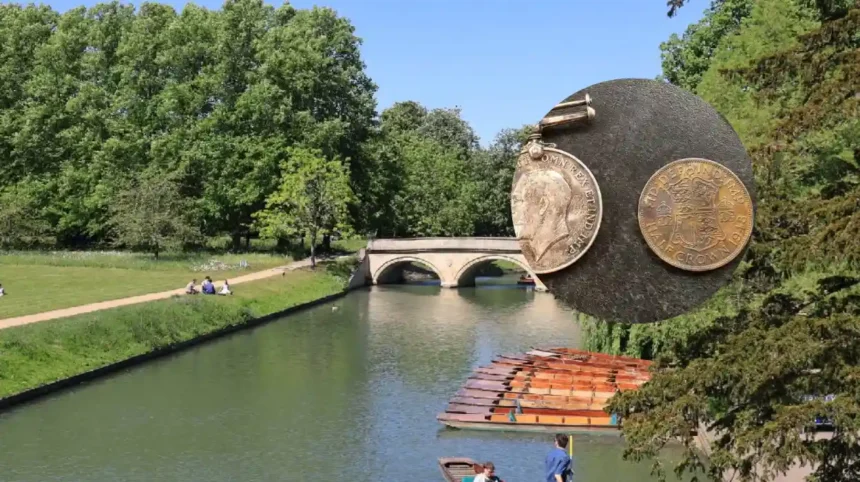
- Treasure hunter and magician Harvinii Richards discovered a First World War medal at the bottom of the River Cam near Jesus Green, Cambridge.
- The medal, in good condition, is inscribed with the name A.M. Schoefield and linked to Alfred M. Schoefield of the 2807 Essex Regiment, who died in 1915.
- Richards also recovered a woman’s Rotary wristwatch, silver bangles and other items during the same search on July 18, 2026.
- He has publicly stated he wants to trace the medal’s current owner in case it was taken in a burglary and ensure it can be returned.
Cambridge (Cambridge Tribune) July 25, 2026 – A keen treasure hunter has uncovered a First World War medal at the bottom of the River Cam, prompting efforts to trace its rightful owner and preserve a tangible link to a soldier who died more than a century ago. The discovery, made by treasure hunter and magician Harvinii Richards near Jesus Green on July 18, has drawn attention to both the historical significance of military medals and the ongoing work of voluntary finders who help reunite lost artefacts with families or institutions.
- Key Points
- What was found in the River Cam and where?
- Who was Alfred M. Schoefield of the Essex Regiment?
- How did the medal end up in the River Cam?
- What steps are being taken to trace the owner?
- Background: Campaign medals and their historical significance
- Prediction: How could this discovery affect local historians, families and the treasure-hunting community?
What was found in the River Cam and where?
The discovery occurred in a well-known stretch of the River Cam close to Jesus Green, an area frequently used by swimmers, rowers and leisure walkers in Cambridge. Harvinii Richards was conducting a search in the water when he noticed circular patterns on the riverbed. Using polarised glasses to cut through surface glare, he identified a woman’s Rotary wristwatch lying at the bottom.
Richards removed his t-shirt and reached into the water, retrieving the watch along with silver bangles and other items. As he continued searching, another object “glinted” in the sediment. On pulling it from the river, he realised it was a medal. He described the item as being in “really good condition” despite its time submerged, and noted the inscription bearing the name A.M. Schoefield.
Who was Alfred M. Schoefield of the Essex Regiment?
Following the find, Richards undertook research late into the night, staying up until 1.30am to identify the medal’s original recipient. His inquiries led him to an Alfred M. Schoefield, recorded as serving with the 2807 Essex Regiment. Historical records indicate that Alfred M. Schoefield died in 1915, during the First World War.
The Essex Regiment was a line infantry regiment of the British Army, active from 1881 until 1958, and saw extensive service in the First World War across multiple campaigns. Service records for soldiers up to 1920 are held by The National Archives and are accessible through genealogy platforms such as Ancestry and Findmypast, which often include medal rolls and index cards detailing entitlements, ranks and service numbers. First World War campaign medals were typically engraved with the recipient’s name, rank, service number and regiment, aiding identification even when paperwork is lost.
How did the medal end up in the River Cam?
The precise circumstances under which the medal entered the River Cam remain unclear. Richards acknowledged the uncertainty, stating: “His death was during the First World War and somehow these medals have ended up here”. Military medals can become separated from families for a range of reasons, including loss, sale, donation, or theft. In some cases, medals have been discarded deliberately, as in the well-known instance involving poet Siegfried Sassoon, whose Military Cross was long believed to have been thrown into the Mersey before later resurfacing in an attic chest.
River finds of military medals are not unprecedented. In 2018, a World War One service medal belonging to Lance Corporal Stephen Smith, who was killed in action at Gallipoli in 1915, was recovered from the River Loxley in Sheffield by police divers and later reunited with the soldier’s extended family through a media-led appeal. Such cases underscore how waterways can act as unintended repositories for personal effects, whether through accidental loss, disposal, or criminal activity.
What steps are being taken to trace the owner?
Richards has made clear his intention to trace the medal’s current lawful owner. He explained: “The first thing I wanted to do is try and reach out in case it has been taken in a burglary. It gives the opportunity for the owner to get the medal back”. His statement reflects a broader ethical approach among metal detectorists and treasure hunters, many of whom work with the Portable Antiquities Scheme (PAS) and local museums to record and, where appropriate, return significant finds.
In practice, tracing ownership can involve cross-referencing the engraved name with service records, contacting regimental associations or museums, and liaising with local police in case the item was reported stolen. For First World War medals, the engraved name often provides a direct route to the original recipient’s service file, which can then be used to identify living descendants or relevant custodians. Where medals are confirmed as treasure under the Treasure Act 1996, finders must report them to the coroner, though individual campaign medals are not always classified as treasure unless they form part of a larger hoard or meet specific criteria.
Background: Campaign medals and their historical significance
British military campaign and service medals from the First World War were issued to recognise participation in specific theatres of war or general service during the conflict. These medals are documented in official records held by The National Archives, including medal rolls and index cards that list recipients, units and qualifying service periods. Unlike many Second World War awards, First World War medals were generally engraved with the recipient’s details, making them easier to identify and trace even when separated from accompanying documentation.
Regimental museums and local heritage organisations often maintain collections of such medals, either donated by families or acquired through official channels. In the Sheffield case, for example, the recovered medal was ultimately placed within the York & Lancaster Regimental collection at Clifton Park Museum, where it was displayed to honour the soldier’s service. The preservation and contextualisation of these items help ensure that individual stories of service and sacrifice remain accessible to the public and to researchers.
Prediction: How could this discovery affect local historians, families and the treasure-hunting community?
This development is likely to resonate across several audiences. For local historians and genealogists in Cambridgeshire and Essex, the find offers a concrete prompt to revisit service records of the Essex Regiment and related units, potentially uncovering further connections between Cambridge and First World War servicemen. For families with military ancestry, the publicity surrounding the medal may encourage renewed searches for lost or mislaid awards, especially where oral histories suggest items went missing decades ago.
Within the treasure-hunting and metal-detecting communities, the case reinforces the importance of responsible reporting and ethical conduct. Finders who proactively seek to return items to rightful owners or appropriate institutions help maintain public trust and reduce the risk of tighter regulatory restrictions on detecting activities. For the wider public, the story serves as a reminder that historical artefacts can surface in unexpected places, and that careful handling and transparent communication can turn a chance discovery into an opportunity for remembrance and reconnection.