

Key Points:
- Severe thunderstorms hit southern Ontario late Wednesday afternoon, bringing red-level emergency alerts, high winds, heavy rain, and ping-pong-ball-sized hail.
- Western University’s Northern Tornadoes Project sent survey teams on Thursday to check for potential tornado tracks between Bayfield and Cambridge.
- Fallen trees and downed lines cut power to tens of thousands of homes across the Waterloo Region, Cambridge, Ayr, and North Dumfries, according to GrandBridge Energy and Enova Power Corp.
- Kitchener forestry crews handled more than 60 emergency calls for downed trees and structural debris blocking roads.
- Hydro One reported more than 155,000 total outages across southern Ontario during the peak of the storm.
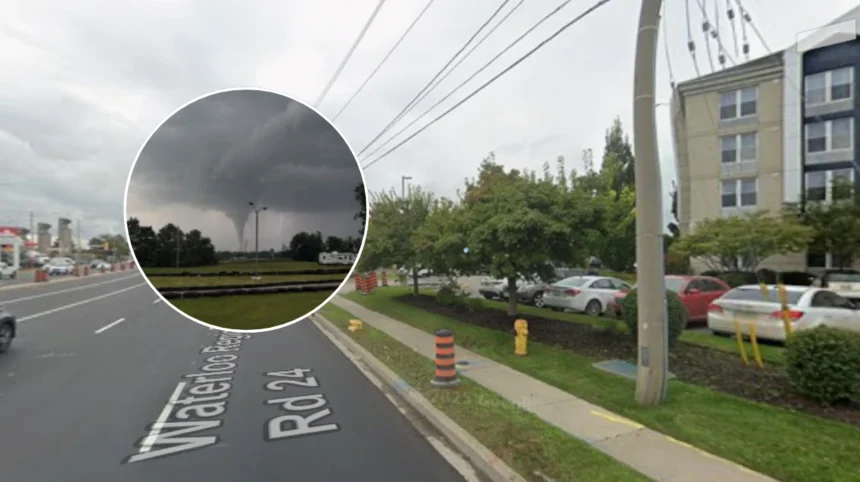
CAMBRIDGE (Cambridge Tribune) September 3, 2026 – As reported by Paul C. on local public safety alert monitors and corroborated by Environment Canada, an intense line of severe thunderstorms swept through the province late Wednesday afternoon, prompting official red-level emergency notifications—the meteorology agency’s highest alert classification. Moving rapidly eastward at speeds exceeding 75 km/h, the storm system unleashed destructive wind gusts exceeding 100 km/h, intense rainfall, and hail ranging from the size of loonies to ping-pong balls.
- Key Points:
- What is the extent of power outages and infrastructure damage?
- How are municipal emergency services managing the cleanup effort?
- How is the Northern Tornadoes Project conducting its investigation?
- Background of the particular development
- Prediction: How this development could affect local residents and property owners
The atmospheric instability created extensive localized damage along a broad corridor stretching from the coastal shores of Lake Huron in Bayfield through to the City of Cambridge. Weather observers noted that the storm possessed physical characteristics consistent with tornadic rotation, prompting structural experts to evaluate whether one or multiple tornadoes made touchdown along the path.
What is the extent of power outages and infrastructure damage?
As detailed by reporting staff at CityNews Kitchener, local utility networks sustained severe impact as high winds uprooted trees, snapped heavy branches, and pulled down live power cables across multiple municipalities. GrandBridge Energy, which services consumers throughout Cambridge and Brantford, confirmed that at least 12,000 customers were left without electricity during the height of the storm on Wednesday evening. Utility restoration crews worked continuously into Thursday morning to repair damaged infrastructure in Ayr and across North Dumfries.
Simultaneously, Enova Power Corp. reported that over 17,000 of its clients lost power in the Waterloo region. Official statements from Enova representatives confirmed that “extensive damage due to trees & branches on powerlines means some customers will be out of power overnight,” forcing emergency response teams to navigate hazardous conditions to restore the electrical grid. Across the wider province, Hydro One recorded more than 155,000 total customer outages as the storm system moved toward the Greater Toronto Area.
How are municipal emergency services managing the cleanup effort?
As reported by CityNews Kitchener, municipal services in Waterloo Region faced immediate pressure following the storm’s clearance. In Kitchener, forestry crews were dispatched to manage more than 60 individual calls regarding fallen trees and scattered debris. Local authorities prioritized clearing primary traffic corridors to ensure emergency vehicles retained unimpeded access before transitioning staff toward clearing municipal sidewalks and residential zones.
In neighbouring Cambridge, local news reporters at Cambridge Today noted that city maintenance teams worked through the night to clear blocked thoroughfares, pumping water away from flooded roads where multiple vehicles had become stranded during the torrential downpours.
How is the Northern Tornadoes Project conducting its investigation?
According to researchers at Western University’s Northern Tornadoes Project (NTP), survey teams were dispatched early Thursday morning to trace the complete path of destruction left behind. The team utilizes ground-level damage assessments, high-resolution satellite imagery, and drone photography to determine whether the damage pattern resulted from concentrated microbursts or confirmed tornadic activity.
NTP field personnel examine structural markers—such as the vector of fallen trees, roof uplift patterns, and debris displacement—to assign an official rating on the Enhanced Fujita (EF) scale.
Background of the particular development
The severe weather event from Bayfield to Cambridge comes amid a noticeable rise in extreme weather activity across southern Ontario during late summer periods. The region, often referred to locally as part of “Canada’s Tornado Alley,” frequently experiences severe convective storms due to the interaction of warm, moist air masses moving north from the Gulf of Mexico colliding with cooler lake breezes from Lake Huron and Lake Erie.
The Northern Tornadoes Project was originally established at Western University in 2017 to improve Canada’s detection and tracking of severe convective wind events. Over recent years, modern radar technology, crowdsourced social media reports, and high-resolution satellite mapping have allowed researchers to identify microbursts and isolated tornadoes that historically went unrecorded in rural corridors. Investigations such as the one currently underway between Huron County and Waterloo Region play a critical role in refining regional building codes and updating emergency broadcast protocols.
Prediction: How this development could affect local residents and property owners
This severe storm event and the subsequent NTP investigation are likely to have direct short-term and long-term implications for residents, business owners, and local municipalities across southwestern Ontario:
- Insurance Rates and Property Claims: Property owners across Bayfield, Kitchener, and Cambridge facing structural damage to roofs, vehicles, and outdoor property from fallen limbs and hail will likely drive a surge in localized insurance claims. Accumulating severe weather events in southern Ontario may prompt home insurers to adjust risk profiles and premiums for the region.
- Infrastructure Upgrades and Tree Management: Municipalities in the Waterloo and Huron regions will come under increased public pressure to accelerate tree-trimming programs around public power lines. Utilities like Enova Power Corp. and GrandBridge Energy may be forced to allocate additional capital toward grid resilience and underground wiring projects to minimize future mass outages.
- Building Code Adjustments: If the NTP confirms tornado touchdowns along the corridor, the findings will contribute to ongoing engineering research regarding structural vulnerability. This data could ultimately influence future provincial updates to Canada’s National Building Code, mandating enhanced roof-anchoring standards for new residential developments in high-risk zones.