
Key Points
- MIT Assistant Professor Thomas Rose, 37, died on 2 September 2026 from injuries sustained in a bicycle crash.
- The crash occurred around 6:00 a.m. on 21 August 2026 at the intersection of Memorial Drive East and Massachusetts Avenue in Cambridge.
- The driver involved stayed at the scene, and authorities have not released their name or filed charges.
- Rose was an archaeometallurgy expert and served as MIT’s POSCO Professor of Materials Science after joining the faculty in January 2026.
- The Massachusetts State Police and the Middlesex District Attorney’s Office are handling the investigation because Memorial Drive is a state roadway.
- MassDOT data classifies the intersection as a top bicycle crash cluster, and this is the fifth vulnerable road user death on Memorial Drive since 2014.
- Bike safety advocates criticized delayed communication between state investigators and Cambridge city officials following the incident.
CAMBRIDGE (Cambridge Tribune) September 5, 2026 — MIT Professor Thomas Rose, an esteemed 37-year-old scholar in ancient metallurgy, died on 2 September 2026 as a result of severe injuries sustained during an early-morning bicycle crash at the busy intersection of Memorial Drive East and Massachusetts Avenue.
- Key Points
- What details have authorities released regarding the investigation?
- Who was Assistant Professor Thomas Rose?
- How did the community and bike advocates react?
- What structural and municipal communication issues were identified?
- Background of the Memorial Drive Intersection Safety Developments
- Prediction: How This Development May Affect the Community and Urban Policy
As reported by Christian M. Wade of The Boston Globe and confirmed by local media outlets, emergency responders—including the Massachusetts State Police, Cambridge Police Department, and Cambridge Fire Department—were dispatched to the scene on 21 August 2026 at approximately 6:00 a.m. Rose was transported to Massachusetts General Hospital, where he fought for his life for nearly two weeks before succumbing to his injuries. The driver of the motor vehicle involved remained on the scene following the collision, according to official statements issued by the Middlesex District Attorney’s Office.
What details have authorities released regarding the investigation?
Very few specific details regarding the exact mechanics of the collision have been made public by investigating authorities. The Middlesex District Attorney’s Office, headed by District Attorney Marian Ryan, along with the Massachusetts State Police, maintain active jurisdiction over the open investigation. Officials have not yet disclosed the direction in which Professor Rose was travelling, the make or model of the vehicle, or whether any citations or criminal charges are being considered against the motorist.
As reported by Christian MilNeil of StreetsblogMASS, state authorities declined to answer immediate queries on whether any charges were pending, and MIT’s news release initially described the incident as a “bicycle accident” before updating their phrasing to “bicycle crash” to maintain neutral language during an ongoing police investigation.
Who was Assistant Professor Thomas Rose?
Assistant Professor Thomas Rose was a world-renowned specialist in archaeometallurgy—the study of how ancient civilizations extracted and worked metals. Rose joined MIT in January 2026 as the POSCO Professor of Materials Science and was a core faculty member of MIT’s Center for Materials Research in Archaeology and Ethnology (CMRAE). Prior to his appointment at MIT, Rose conducted research and taught at Goethe University in Frankfurt, Germany.
Colleagues and students described Rose as a uniquely gifted academic who was in the process of finalizing his research laboratory and preparing to teach his first full cycle of undergraduate and graduate courses this autumn.
As reported by MIT News, Professor Polina Anikeeva, head of the Department of Materials Science and Engineering at MIT, stated: “The field of archaeometallurgy is unique. We had been looking for a faculty with the right skill set for at least 20 years. We needed someone who was world class in archaeology and materials science. We were looking for a unicorn, and we found him”.
Similarly, Assistant Professor Tania Lopez-Silva, whose office was situated near Rose’s, shared with MIT News that “He was the kindest person you could meet. He was always smiling. He really cared about his students, and he had a lot of momentum here”.
How did the community and bike advocates react?
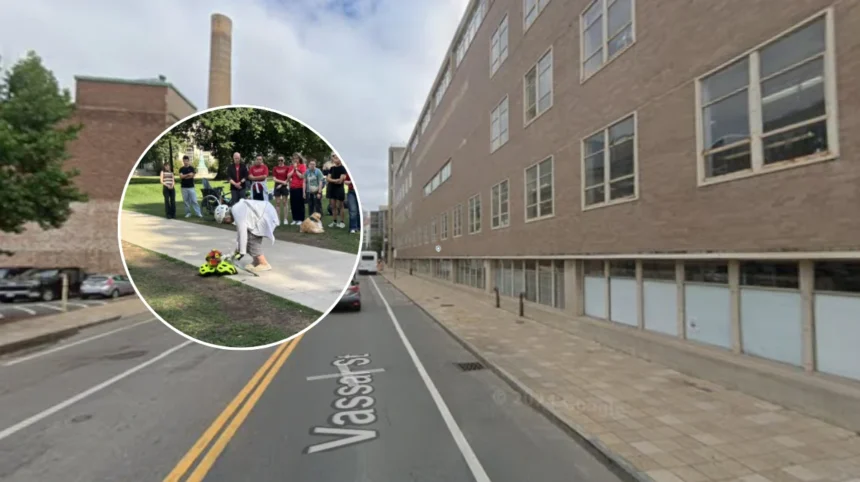
On Friday afternoon following the announcement, members of the MIT academic community, local cyclists, and Cambridge residents gathered at Killian Court for a silent vigil organized to honor Rose’s memory. Mourners laid tealight candles, floral bouquets, and bicycle helmets at a makeshift memorial set up near the campus green.
As reported by Marc Levy of Cambridge Day, the vigil was organized by Alexa Gomberg, a representative of MIT’s Graduate Student Council. Gomberg experienced a similar tragedy in 2024 when her close friend and fellow graduate student Minh-Thi Nguyen was struck and killed by a truck while cycling to campus. Speaking at the vigil, Gomberg remarked that she “wasn’t surprised at all to see people publicly mourning” Rose, adding that it would be unnatural if such a preventable death did not evoke strong collective grief within the community.
Local advocacy group Cambridge Bicycle Safety released a public statement expressing heartbreak over Rose’s death, noting that no individual should risk their life while cycling through the city. The group launched an online petition calling upon state agencies to immediately introduce permanent infrastructure upgrades.
What structural and municipal communication issues were identified?
The location where Rose was struck—the junction connecting Massachusetts Avenue and Memorial Drive—has long been flagged by urban planners and transportation advocates as hazardous. Data compiled by the Massachusetts Department of Transportation (MassDOT) indicates that the intersection falls within the top 200 overall crash clusters statewide between 2020 and 2022. Furthermore, MassDOT identified the site as a top 5% bicycle crash cluster between 2012 and 2021, recording 61 bicycle-related crashes within that window. Rose marks at least the fifth pedestrian or cyclist killed along Memorial Drive since 2014.
As reported by Marc Levy of Cambridge Day, Chris Cassa, a volunteer with Cambridge Bicycle Safety and an MIT lecturer, pointed out that confusing traffic signal placement contributes heavily to driver errors. Cassa argued for physical modifications, such as a “protected intersection” with curb extensions, stating: “If you can just kind of put some obstruction there, it makes people turn at a little bit more responsible speed”.
The fatal crash also highlighted jurisdictional and communication gaps. Because Memorial Drive is a state highway under the Department of Conservation and Recreation (DCR), the Massachusetts State Police leading the investigation are not obligated to share real-time medical updates with local municipal authorities. Jennie Lopez, Communications Director for the Cambridge Police Department, noted that municipal officers are “not necessarily provided with additional information or updates” once state agencies take control of a case. City spokesperson Jeremy Warnick echoed these sentiments, revealing that municipal staff often remain unaware of victim status updates during state-led investigations.
Cassa voiced concern over this lack of transparency, stating to Cambridge Day: “That should trigger some sort of communication and some sort of thought about what interventions might work”.
Background of the Memorial Drive Intersection Safety Developments
The fatal crash involving Professor Thomas Rose occurs amid a long-running, multi-year debate surrounding roadway safety along state-controlled corridors in Greater Boston. Memorial Drive, which runs parallel to the Charles River, is owned and managed by the Massachusetts Department of Conservation and Recreation (DCR), creating a distinct division of responsibility between local municipal governments like the City of Cambridge and state management agencies.
Over the past decade, urban bike networks across Cambridge have expanded significantly under the municipal Cycling Safety Ordinance, which mandates protected bike lanes during major road reconstructions. However, because state-administered roadways like Memorial Drive fall outside municipal jurisdiction, local safety ordinances do not automatically apply to them.
Public pressure on state agencies heightened dramatically following earlier fatalities along the corridor, including the 2024 death of cyclist John H. Corcoran near the BU Boathouse and pedestrian fatalities dating back to 2014. Just weeks prior to the August 2026 crash that claimed Rose’s life, local cycling advocates had installed warning banners and mounted renewed campaigns urging MassDOT and the DCR to redesign the Massachusetts Avenue and Memorial Drive exchange. Despite high crash statistics recorded by state agencies, structural modifications to turn radii, traffic signaling, and physical barriers at the intersection remained pending at the time of the collision.
Prediction: How This Development May Affect the Community and Urban Policy
The loss of a high-profile academic under preventable circumstances is expected to significantly accelerate political and regulatory pressures on state infrastructure agencies, specifically affecting local commuters, academic institutions, and regional transportation planners.
1. Accelerated Infrastructure Redesign on State Corridors
This fatality will likely force the Massachusetts Department of Conservation and Recreation (DCR) and MassDOT to expedite planned safety overhauls at high-risk intersections along the Charles River. The public pressure generated by both the MIT community and advocacy groups will likely transform the Massachusetts Avenue and Memorial Drive junction into a priority project, potentially forcing the implementation of quick-build protected intersections, altered signal phases, and traffic-calming curb extensions in the near term.
2. Reform of State-to-City Interagency Protocols
The exposed communication breakdown between the Massachusetts State Police and the City of Cambridge regarding crash updates is anticipated to prompt legislative inquiries. Municipal leaders in Cambridge and Boston are likely to demand formalized reporting protocols ensuring local city planners and emergency personnel receive immediate notifications regarding crash severity and post-incident medical outcomes, allowing cities to quickly implement temporary traffic interventions.
3. Increased Student and Faculty Cycling Activism
Within academia, Rose’s death—occurring two years after the death of student Minh-Thi Nguyen—will probably catalyze stronger institutional advocacy from major research universities like MIT and Harvard. University administrations may be pushed by student unions and faculty councils to take a direct legal and financial stance in lobbying state legislators for safer transit corridors surrounding university campuses, impacting how higher education institutions interface with state transportation policy moving forward.