Cambridgeshire’s transition from traditional, timetabled buses to an app-based “Tiger on Demand” service is raising fears of rural isolation as winter approaches.
Passengers warn that the loss of fixed routes is dismantling vital community connections and locking out the digitally excluded. Meanwhile, transport chiefs argue that traditional rural services are financially unsustainable in the current economic climate.
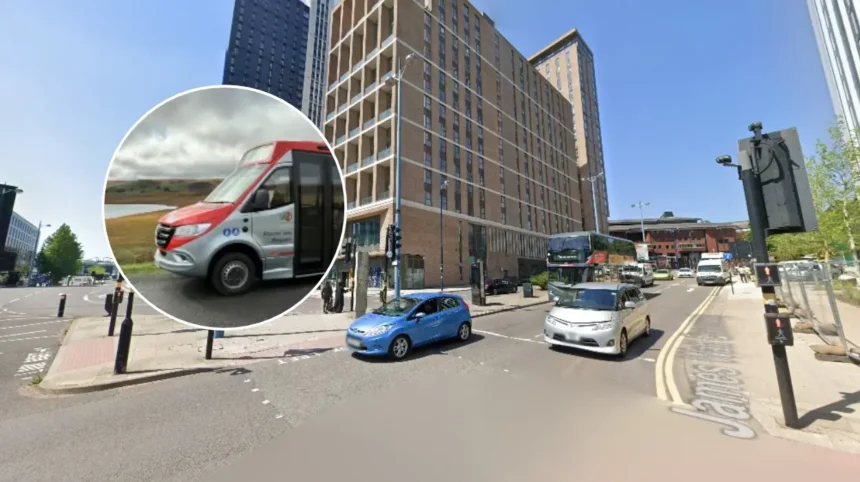
The Cambridgeshire and Peterborough Combined Authority (CPCA) introduced Tiger on Demand as a Demand Responsive Transport (DRT) system earlier this year. It is designed to replace several scheduled, low-ridership rural bus routes with a flexible, pre-booked minibus service.
Rather than waiting at a physical bus stop at a scheduled time, residents must now book their journeys in advance. Bookings are processed via a smartphone app or a dedicated telephone call centre. An algorithm then dispatches a vehicle to a “virtual stop” within designated travel zones, which currently include rural areas like West Huntingdonshire and East Cambridgeshire.
For the Combined Authority, the shift is driven by stark financial and environmental realities. Operating standard diesel buses on deep rural routes often results in large vehicles travelling hundreds of miles each week while carrying only a handful of passengers.
Early reports and council debates indicate that some of the most heavily subsidised traditional services were costing the local authority more than £180 per passenger in subsidies for a single journey.
Local government finances across the UK are under severe pressure, and subsidised transport, unlike social care or waste collection, is not a statutory requirement.
The Tiger on Demand service aims to maintain some level of transport provision at a fraction of the cost of fixed routes. The CPCA operates the service Monday to Saturday, between 06:00 and 19:30. To encourage uptake and align with national schemes, adult fares are capped at £2.50, and the service accepts standard concessionary bus passes.
However, the withdrawal of scheduled services has prompted a significant backlash from rural communities. For many residents, particularly those who live alone, a fixed-route bus provided much more than transport. It acted as a reliable community centre, offering a guaranteed weekly check-in with neighbours.
The recent withdrawal of the number 65 bus provides a clear case study of the resulting friction. The route, previously operated by Dews Coaches, ran on weekday mornings. It offered a regular, predictable link between the Market Square in St Neots and the surgery in Buckden, serving a string of villages including Great Paxton, Offord Darcy, and Offord Cluny along the way.
Its predictable timetable allowed residents to plan their week, coordinate medical appointments, and travel in familiar groups. Passengers report that the individualised, algorithm-driven nature of the new DRT system means they no longer travel with the same people.
Critics argue the Combined Authority’s metrics focus entirely on operational efficiency and raw ridership numbers, ignoring the unquantifiable social value of informal community networks.
Transport commentator Roger French, analysing the withdrawal of the 65 route, noted the sharp disconnect between DRT efficiency models and actual passenger habits. For rural users, “their preference is clearly for a fixed timed bus without any booking hassle where they can meet all their friends,” he wrote.
The digital-first nature of the Tiger on Demand system has also raised severe accessibility concerns among local advocates and parish councils.
While the CPCA heavily promotes the convenience of the smartphone app, and digital platforms reportedly feature 5-star reviews praising the “fabulous village service” and a 4.8 rating from 41 reviews, advocates warn these metrics exclude the demographics that rely most on public transport.
For elderly residents who do not own smartphones, lack internet access, or struggle with digital literacy, booking a minibus requires navigating a telephone call centre.
This presents immediate practical hurdles. The call centre only operates during specific hours, removing the spontaneity of travel. If a resident decides they need to travel on a Sunday, the service is entirely unavailable. Furthermore, drivers cannot accept cash or card payments on board the vehicles; all fares must be processed dynamically at the time of booking, which complicates travel for the unbanked or those who rely on cash budgeting.
Parish councillors across West Huntingdonshire have reported that the removal of physical timetables and marked bus stops leaves those without internet access feeling stranded and confused.
The concept of the “virtual stop” has also drawn criticism. Traditional bus stops often feature hardstanding, shelters, and benches, providing a safe place for people with mobility issues to wait. Virtual stops, designated by GPS coordinates on the app, can sometimes be located on road verges or areas without seating, making the wait physically difficult for elderly passengers.
Furthermore, booking journeys in advance removes the peace of mind that a fixed timetable provides. Passengers cannot simply turn up at a stop and know a bus will eventually arrive. Sharing a DRT minibus relies on other people booking similar routes at similar times, meaning there is no guarantee of a shared departure time with neighbours from the same village.
Health professionals frequently cite social isolation as a major health risk for rural, aging populations, linking it to cognitive decline and deteriorating physical health.
The Combined Authority faces a nearly impossible balancing act. Budget shortfalls, driver shortages, and the high cost of subsidising traditional routes make maintaining the status quo highly unlikely without cutting other essential council services. By moving to a demand-responsive model, the council avoids leaving these villages with zero public transport provision, which has been the fate of rural communities in other parts of the UK.
Transport officials continue to defend Tiger on Demand as an innovative, data-driven solution to a nationwide funding crisis.
Yet, as the days shorten and the winter months approach, community advocates warn the true cost of the transition is becoming apparent in the county’s most isolated areas.
The council has successfully saved the expense of running empty diesel buses through the countryside. But in doing so, critics say, they have quietly dismantled the rolling communities that held Cambridgeshire’s rural villages together.