
Key Points
- More than 500 Cambridge University staff are set to strike over pay and working conditions.
- The dispute involves Unite members across library, museum, estates management, finance, student services and IT roles.
- Workers are calling for a “Cambridge weighting” allowance to help cover higher living costs.
- Unite says the university’s 1.4% pay rise is effectively a real-terms pay cut.
- The union says the action will escalate through May, with multiple strike dates planned.
- Picket lines are expected to run at several university locations during the strike days.
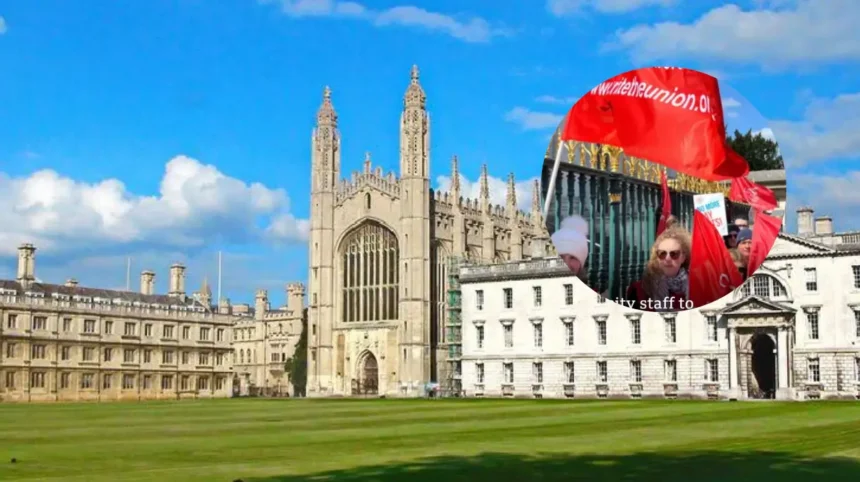
Cambridge(Cambridge Tribune) May 22, 2026 – more than 500 staff at the University of Cambridge are taking strike action as a dispute over pay, progression and local living costs intensifies, with Unite saying workers need a Cambridge-specific supplement to keep pace with the city’s rising expenses.
As reported by Unite and carried by the BBC, around 600 employees are expected to take part in further strike action this month, with the dispute centred on pay levels for support staff across the university. Unite says the main demand is a “Cambridge weighting” payment, which it argues would help staff cope with costs that are higher than elsewhere.
The union has also pointed to what it describes as pay compression at lower grades, saying staff have seen limited progression and that the current settlement does not reflect the cost of living in Cambridge. Unite says the university’s imposed 1.4% rise amounts to a real-terms cut, a claim repeated in strike messaging shared by the union.
What is the dispute about?
The dispute is primarily about pay, but it also covers longer-term concerns over wage progression and the ability of lower-paid staff to afford to live in Cambridge. According to Unite, the affected workers include staff in library, museum, estates, finance, student services and IT roles.
Unite’s general secretary, Sharon Graham, said Oxford University already provides a local pay supplement to help staff afford living expenses and argued Cambridge should do the same. That comparison to Oxford has become central to the union’s case, because it frames the dispute as one about parity with another major university in a similarly high-cost city.
The action is also linked to what Unite sees as a wider failure to tackle the gap between pay and local housing and living costs. The union says the problem affects everyday staff who keep the university running, rather than academic leadership or senior management.
Which dates are affected?
The BBC reported that strikes are due to escalate throughout May, with action scheduled for 13, 14, 15, 20, 21, 22, 26, 27, 28 and 29 May. Earlier strike trackers and union-related reports also show action on 21 and 22 April, followed by further dates on 30 April and 1 May.
The strike calendar for the University of Cambridge lists these Unite strike dates in 2026, showing how the dispute has unfolded across several rounds of industrial action. Picket lines are expected from 08:30 to 12:30 at various locations across the university during the action days.
The scale of the dispute matters because it is not a one-day stoppage, but a series of repeated walkouts designed to keep pressure on the university. That pattern suggests both sides remain far apart on the core issue of pay.
What has Unite said?
Unite says it will continue the dispute until its members secure a local supplement and a fuller pay review. The union argues that low grades have been squeezed for too long and that current pay arrangements do not reflect the cost of living in Cambridge.
The union also says the 1.4% pay increase is inadequate in the present economic environment and has characterised it as a real-terms pay cut. In its public statements, Unite has positioned the dispute as a matter of fairness for workers who are essential to the university’s daily operations.
Sharon Graham’s comments also show that the union wants to connect this dispute to a broader pay strategy across higher education. By referencing Oxford’s local supplement, Unite is signalling that it sees Cambridge as capable of adopting a similar policy.
How might the university be affected?
Repeated strike action can disrupt library access, museum operations, estates work, finance processes, student support and IT services. Even when a university remains open, industrial action can slow routine administration and affect the experience of staff and students.
Because the dispute involves staff in multiple operational departments, the impact may be felt across several parts of university life rather than in one isolated service. The university has not, in the material reviewed here, set out a public detailed response beyond the fact that a pay dispute is ongoing.
For students and researchers, the biggest effect is likely to be delays or reduced availability in services that depend on support staff. For workers, the strike is a way to escalate pressure while trying to secure a better long-term settlement.
Background to dispute
The Cambridge dispute sits within a wider pattern of industrial tension in UK higher education, where unions have increasingly focused on pay, workload and the cost of living. In this case, the central grievance is that staff in one of the country’s most expensive university cities are being paid without a local supplement.
The call for “Cambridge weighting” is important because it would create a specific allowance tied to local living costs, rather than relying only on a general pay award. Unite says that would better reflect the reality faced by support staff on lower grades.
The dispute has been developing across several strike dates this spring, with the BBC and strike calendars both showing a sustained campaign rather than a short protest. That makes the issue less about one pay round and more about how the university sets pay for staff working in a high-cost city.
Prediction for staff and students
If the dispute continues, support staff are likely to keep using repeated strike days to push for a higher settlement or a local allowance. That could maintain pressure on university operations and make the issue harder to ignore.
For staff, the most likely outcome of prolonged action is further attention on low pay and progression, which may eventually lead to renewed talks. For students and departments that depend on support services, the main effect will be uncertainty, slower services and possible disruption during strike windows.
If the university agrees to a Cambridge weighting or a revised pay package, the dispute could become a reference point for other higher education pay talks. If it does not, the pattern of escalating strike dates suggests the pressure is likely to continue.