

Key Points
- The Government says no planned Greater Cambridge development is stalled by sustainable water supply concerns.
- More than 9,000 homes and 500,000 square metres of commercial development were previously affected by water objections.
- Water-efficiency measures and updated supply analysis led to the withdrawal of those objections.
- The Grafham to Cambridge pipeline, the Fens Reservoir and wastewater upgrades remain important to long-term growth.
- Officials say wastewater capacity and infrastructure delivery still require continued monitoring.
Greater Cambridge (Cambridge Tribune) November 20, 2026 – The United Kingdom Government says no planned development in Greater Cambridge is currently stalled in the planning system because of sustainable water supply concerns. The update covers housing and commercial schemes in Cambridge and South Cambridgeshire and follows progress on demand reduction, supply infrastructure and wastewater capacity. More than 9,000 homes and 500,000 square metres of commercial development had previously been affected by water supply objections. The Government says those objections have now been withdrawn after measures were agreed by councils, regulators, developers and water companies.
- Key Points
- Why have water objections been withdrawn in Greater Cambridge?
- What infrastructure is planned to support Greater Cambridge growth?
- What does the Government’s update mean for Greater Cambridge development?
- Background to the water supply dispute
- How could this affect Greater Cambridge’s development audience?
Why have water objections been withdrawn in Greater Cambridge?
As reported by the Department for Environment, Food and Rural Affairs and the Ministry of Housing, Communities and Local Government in their progress report, combined water-efficiency programmes and updated supply-and-demand assessments have provided sufficient confidence that growth in the emerging Greater Cambridge Local Plan can be accommodated.
The report says the Government’s water-efficiency programme has been combined with Cambridge Water’s demand-management measures. It also says monitoring arrangements will be used to identify and manage future risks.
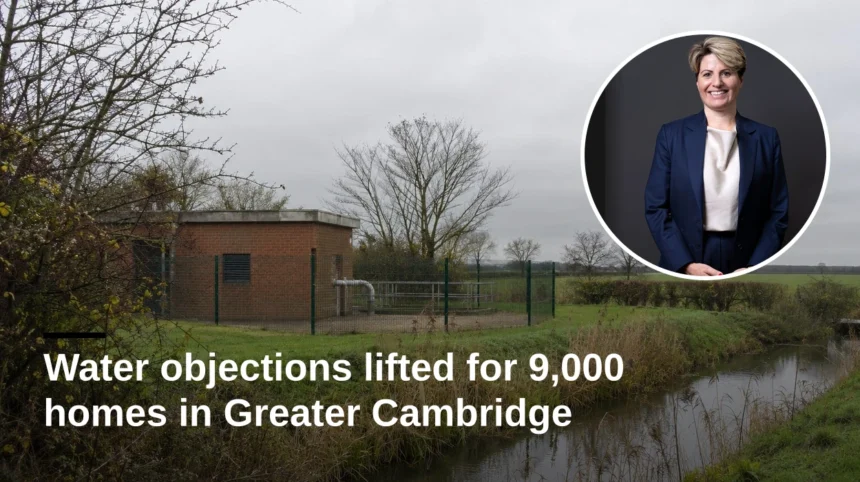
Water Minister Emma Hardy said the programme had removed planning objections affecting Greater Cambridge, according to Labour Home. The report says the decision does not mean water resources are guaranteed regardless of future infrastructure delivery.
What infrastructure is planned to support Greater Cambridge growth?
Cambridge Water is progressing the Grafham to Cambridge pipeline transfer, while the Fens Reservoir remains the principal longer-term strategic supply proposal. The Government’s Water Delivery Taskforce has supported coordination and greater transparency around delivery risks.
Anglian Water is also increasing capacity at Cambridge Milton Wastewater Treatment Works. The Government says wastewater infrastructure in parts of Greater Cambridge is operating close to, or above, capacity, making further investment and coordinated planning necessary.
The emerging Greater Cambridge Local Plan is expected to rely on water-efficiency requirements, infrastructure delivery and environmental safeguards. Longer-term regional planning has also begun because Cambridge’s future supply will depend on a wider interconnected system.
What does the Government’s update mean for Greater Cambridge development?
The immediate planning barrier created by sustainable water supply objections has been removed, allowing affected schemes to progress on that specific issue. However, development remains linked to the delivery of major water and wastewater projects, continued demand reduction and environmental protection.
The Government says the Greater Cambridge Development Corporation, established in July 2026, will play a greater role in coordinating development, water infrastructure investment and water-related risks.
Background to the water supply dispute
The Government published its latest progress report after a 2024 policy intervention addressing water scarcity and wastewater capacity in Greater Cambridge. The area’s planned growth had raised concerns about pressure on water resources and chalk-stream environments. A Cambridge Water Scarcity Group brought together councils, regulators, developers and water companies to identify short- and long-term solutions. The agreed approach combines efficiency measures with new infrastructure, including the Grafham transfer and the proposed Fens Reservoir.
How could this affect Greater Cambridge’s development audience?
Housebuilders, commercial developers and local authorities can continue progressing schemes without a current sustainable-water-supply objection blocking the planning system. The decision may provide greater certainty for projects affecting thousands of homes and substantial commercial floorspace. Residents and environmental groups will continue to have an interest in whether promised efficiency measures, wastewater upgrades and new supply infrastructure are delivered. The Government’s position indicates that water supply no longer stalls planned Greater Cambridge development, but future growth remains dependent on infrastructure and environmental safeguards.