

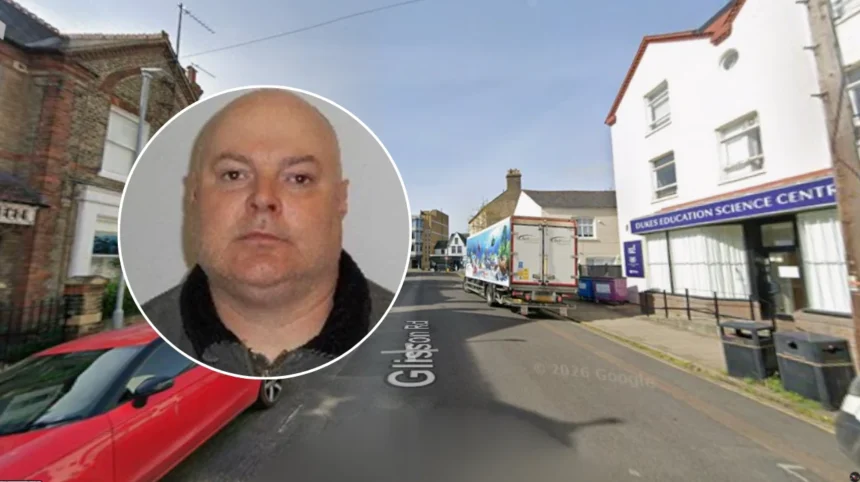
Key Points
- Authorities have issued a Canada-wide warrant for federal offender Mason Jenkins, aged 49.
- Jenkins is serving a life sentence for first-degree murder alongside charges of possession of a scheduled substance for the purpose of trafficking.
- He walked away from Collins Bay Institution in Kingston, Ontario, on 24 September 2026 after breaching his statutory release conditions.
- Police describe Jenkins as a Caucasian male, 5 feet 9 inches tall and 255 pounds, with brown eyes and a shaved head.
- Police say Jenkins is known to frequent Kitchener, Chatham, and Kingston.
- Authorities advise the public not to approach Jenkins and to contact 911 or law enforcement immediately if he is seen.
KINGSTON (Cambridge Tribune) September 28, 2026 — As reported by local media outlets based on official notices from the Ontario Provincial Police (OPP), a Canada-wide warrant has been issued for convicted murderer Mason Jenkins after he walked away from Collins Bay Institution on 24 September 2026 following a breach of his statutory release conditions.
- Key Points
- What led to the issuance of a nationwide warrant for Mason Jenkins?
- What physical characteristics can help the public identify the offender?
- How should members of the public contact authorities regarding his whereabouts?
- Background of the statutory release framework and Collins Bay Institution
- Prediction: How this development could affect local communities and correctional policy
What led to the issuance of a nationwide warrant for Mason Jenkins?
As reported by staff writers at Cambridge Today, the Repeat Offender Parole Enforcement (R.O.P.E.) Squad released an official statement requesting assistance from the public across Canada to locate 49-year-old federal inmate Mason Jenkins.
According to reporting by CTV News Kitchener, Jenkins walked away from the minimum-security facility at Collins Bay Institution in Kingston, Ontario, on 24 September 2026. Police confirmed that the search was formally launched after Jenkins violated the specific behavioral conditions attached to his statutory release.
As detailed by police spokespersons in local reports, Jenkins is currently serving an indeterminate life sentence following his conviction for first-degree murder, alongside additional federal counts of possession of a scheduled substance for the purpose of trafficking.
What physical characteristics can help the public identify the offender?
As published by Cambridge Today and corroborated by CTV News, law enforcement agencies have provided a comprehensive physical profile of the fugitive. Jenkins is described as a 49-year-old Caucasian male, standing approximately 5 feet 9 inches (175 cm) tall and weighing around 255 pounds (116 kg). He has brown eyes and brown hair, though authorities note that his head is currently shaved bald.
As reported by Brockville Daily, members of the provincial R.O.P.E. Squad stated that Jenkins maintains active community ties and is known to frequent several municipalities across Southwestern and Eastern Ontario, specifically highlighting Kitchener, Chatham, and Kingston.
How should members of the public contact authorities regarding his whereabouts?
As highlighted by journalists across regional outlets, police services have cautioned members of the public against taking independent action or approaching Jenkins directly if spotted. As noted in the official police release published by CTV News Kitchener, anyone who spots Jenkins or possesses information concerning his current whereabouts is instructed to immediately dial emergency services via 911.
Background of the statutory release framework and Collins Bay Institution
Statutory release is a mandatory conditional release required by federal legislation under the Corrections and Conditional Release Act (CCRA). Under Canadian law, most federal offenders who are serving fixed-length sentences are automatically released into the community under supervision once they complete two-thirds of their sentence. However, statutory release differs significantly for offenders serving life sentences or designated under specific detention provisions.
While offenders serving life sentences are not automatically entitled to statutory release in the same manner as fixed-term prisoners, correctional legislation governs strict supervised release parameters for individuals who transition through lower-security facilities like Collins Bay Institution. Located in Kingston, Ontario, Collins Bay Institution is a multi-level facility managed by Correctional Service Canada (CSC).
Inmates managed in minimum-security sectors are subjected to continuous risk assessments, and any non-compliance with curfew, residency, or behavioral boundaries results in an immediate suspension of release and the issuance of a Canada-wide arrest warrant.
Prediction: How this development could affect local communities and correctional policy
The escape and subsequent nationwide search for an offender serving a life sentence for first-degree murder is likely to trigger heightened public vigilance and intensify legislative scrutiny regarding federal conditional release oversight.
For residents living within the primary target municipalities—specifically Kitchener, Chatham, and Kingston—the immediate effect will be increased law enforcement presence, active community patrols, and public safety advisories. Local school boards and community centers in these regions often heighten localized safety protocols while high-profile manhunts are actively conducted.
On a broader administrative level, this breach is expected to prompt an internal review by Correctional Service Canada into minimum-security management protocols at Collins Bay Institution. Similar public high-visibility breaches historically lead to calls from victim advocacy groups and municipal leaders for stricter risk-assessment criteria before high-risk offenders convicted of violent crimes are placed in lower-security environments or granted conditional release privileges.