
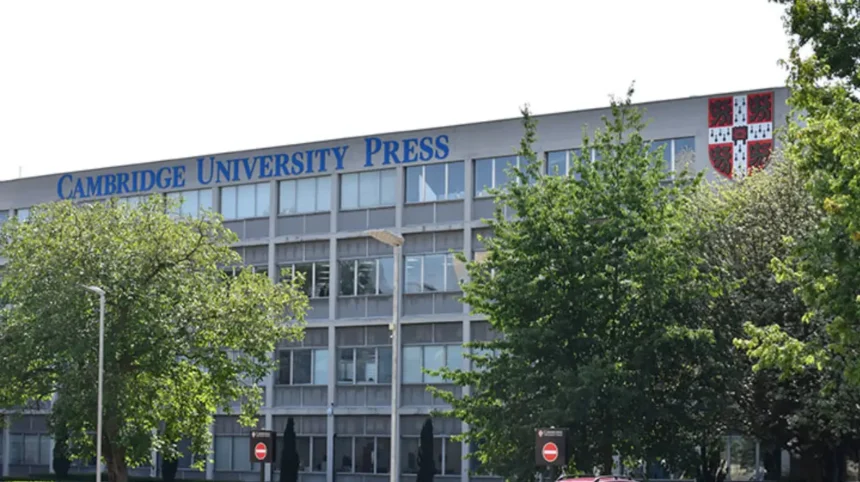
Cambridge University Press is the publishing division of the University of Cambridge, established in 1534 by royal charter from King Henry VIII. It is the oldest continuously operating university press in the world, with a mandate to disseminate knowledge globally across academic, educational, and research disciplines.
- How Did Cambridge University Press Develop Over Nearly Five Centuries?
- What Does Cambridge University Press Currently Publish?
- How Does Cambridge Core Work as a Digital Publishing Platform?
- What Is Cambridge University Press’s Approach to Open Access Publishing?
- What Subjects and Disciplines Does Cambridge University Press Cover?
- What Is the Financial Scale and Global Reach of Cambridge University Press?
- How Does Cambridge University Press Support Authors and Researchers?
Cambridge University Press holds letters patent granted by King Henry VIII in 1534, making it the oldest university press in the world. This royal authorization gave the University the legal right to print books, a privilege that no other institution in England held at the time. The Press operates not as a commercial enterprise but as a nonprofit organization, meaning all revenue is reinvested into its academic publishing mission. This structure separates it from commercial publishers whose primary obligation is to shareholders.
In August 2021, Cambridge University Press merged with Cambridge Assessment under approval from Queen Elizabeth II to form Cambridge University Press and Assessment, though the Press retains an independent existence within the larger entity. Today, the organization reaches over 100 million learners worldwide each year and operates across more than 40 countries, making it one of the most geographically expansive academic publishers on the planet. Its independence within a merged structure allows it to maintain its centuries-old publishing standards while benefiting from the combined resources of a broader educational organization.
How Did Cambridge University Press Develop Over Nearly Five Centuries?
University printing in Cambridge began when Thomas Thomas, the first practicing University Printer, set up a printing house in 1584. The first publication was a book titled Two Treatises of the Lord His Holie Supper. From that starting point, the Press grew into a globally dominant academic institution. In 1591, the Press printed its first Bible, an octavo edition of the Geneva Bible, establishing what became a 400-year tradition of religious text publishing. Scholar Richard Bentley reformed the Press in 1698, introducing the concept of a university-owned academic press supervised by senior academics and oriented toward scholarly reputation rather than commercial profit.
One of Bentley’s most significant achievements was a new edition of Isaac Newton’s Principia Mathematica in 1713, one of the most important scientific books ever produced. By the early 1800s, the Press pioneered stereotype printing, which allowed multiple successive printings from a single typesetting, dramatically reducing costs and increasing output. By the 1850s, the Press was using steam-powered machine presses, employing two to three hundred people. The journal publishing program began in 1893 with the Journal of Physiology. Over the following century, authors including Albert Einstein, Ernest Rutherford, Bertrand Russell, and Stephen Hawking published under its imprint.
What Does Cambridge University Press Currently Publish?
Cambridge University Press, a publisher, produces academic content across four primary areas: scholarly research publications, educational textbooks, English language learning materials, and religious texts. Its publications include more than 420 academic journals, monographs, reference works, school and university textbooks, and English language teaching and learning publications. The Press publishes over 2,500 books per year for distribution in more than 200 countries. Cambridge Core hosts 1.6 million journal articles and 46,000 ebooks, and its higher education website hosts additional learning materials.

The English Language Teaching division produces courses for all age groups, from beginners to advanced learners, and is used in schools, universities, and language institutes across the world. The Press also develops curriculum-based materials for both national and international school systems. Cambridge University Press is also the world’s oldest Bible publisher, a tradition that began in 1591 and has continued uninterrupted for over four centuries. Across disciplines, the Press covers science, technology, medicine, humanities, social sciences, law, economics, and mathematics. This scope reflects the comprehensive academic mission it has maintained since its founding in the sixteenth century.
How Does Cambridge Core Work as a Digital Publishing Platform?
Cambridge Core is the central digital platform through which Cambridge University Press publishes its online academic content to researchers, institutions, and students worldwide. The platform consolidates access to journal articles, ebooks, and research materials into a single, searchable interface. Cambridge Core hosts 1.6 million journal articles and 46,000 ebooks, representing one of the largest concentrations of peer-reviewed academic content on any single platform globally. Users access content either through institutional subscriptions, individual purchases, or open access channels. Cambridge Core supports advanced search functions, citation export, remote access for institutional members, and personal archive features that allow users to save and organize research materials.
The platform also integrates bibliographic reference linking, making it a standard tool in academic research workflows. In 2023-24, 125 million downloads of scholarly research, including book chapters and research papers, took place through Cambridge’s digital infrastructure. Cambridge Core replaced the earlier Cambridge Journals Online and Cambridge Books Online systems, providing a unified experience across formats. The platform serves universities, public institutions, independent researchers, and libraries across all continents
What Is Cambridge University Press’s Approach to Open Access Publishing?
Open access publishing is now a central strategy for Cambridge University Press, reflecting a global shift in how academic research is funded, distributed, and consumed. Open access means research articles are freely available to anyone online without a subscription paywall, funded instead through author-side fees, institutional agreements, or organizational support. As of 2023-24, 63 percent of new research articles published by Cambridge are now open access. This represents a major transformation from the traditional subscription model that defined academic publishing for most of its modern history. Cambridge has signed transformative agreements covering 2,000 institutions worldwide, enabling researchers at those universities to publish open research at no additional cost to themselves.
These agreements shift the cost of publication from the reader to the institution or funder. Open-access articles published via Cambridge Core receive approximately 3.5 times more full-text views and, on average, 1.6 times more citations than those behind subscription paywalls. The Press is also experimenting with open-access monographs through its Flip It Open program, which makes popular books freely available online once they reach a defined revenue threshold. Over 400 Cambridge journals offer open access options, with 66 operating as fully open access and 340 in a hybrid model.
What Subjects and Disciplines Does Cambridge University Press Cover?
Cambridge University Press publisher covers an exceptionally broad range of academic disciplines, reflecting its position as the publishing arm of one of the world’s most comprehensive research universities. The Press publishes in the natural sciences, including physics, chemistry, biology, and earth sciences. It covers engineering, mathematics, computer science, and medicine. In the humanities, the Press publishes in history, philosophy, linguistics, literature, classical studies, and religious studies. The social sciences coverage includes economics, law, political science, psychology, and sociology. Book series published by Cambridge span areas including African Studies, Global Health Histories, Cambridge Film Classics, Cambridge Molecular Science, and Cambridge Studies in the History of Art.
The Cambridge Companions series provides introductions to major writers, artists, philosophers, and intellectual periods, while the Cambridge Histories series covers over 400 volumes across fifteen subject areas. The Cambridge Histories series was first published in 1902 and has grown into a globally respected collection spanning political history, cultural history, literature, philosophy, religious studies, music, and the arts. This disciplinary breadth distinguishes Cambridge from specialized publishers and positions it as a comprehensive academic resource across both STEM and humanities fields
What Is the Financial Scale and Global Reach of Cambridge University Press?

The financial performance and geographic scope of Cambridge University Press reflect both its historical prestige and its modern operational effectiveness. Cambridge University Press and Assessment achieved revenues of more than £1 billion in 2023-24, with profits rising from £140 million to £203 million according to its annual report. This makes it one of the very few university presses in the world to operate at a billion-pound revenue scale. As a nonprofit, these revenues are reinvested into publishing programs, open access initiatives, educational development, and research infrastructure.
The Press has offices and publishing hubs in more than 40 countries and has published over 50,000 titles by authors from over 100 countries. It distributes books through global retail channels, institutional licensing, and its own digital platform. Cambridge has published works by almost 200 Nobel laureates, including seven from the most recent Nobel Prize cycle. The Press collaborates with over 200 academic societies and professional organizations, giving it deep roots in scholarly communities worldwide. More than 100 million learners worldwide interact with Cambridge content each year, spanning school-age students, university undergraduates, postgraduates, and professional researchers.
How Does Cambridge University Press Support Authors and Researchers?
The author support infrastructure at Cambridge University Press publisher is structured to serve both established academics and first-time scholarly authors across all disciplines. The Press operates an Author Hub, a dedicated resource portal providing guidance on manuscript preparation, peer review processes, copyright policies, and open access options. Cambridge combines publishing excellence with innovation to meet the needs of its customers, authors, and partners, with internationally renowned books and journals supporting learning, teaching, and research across higher education.
Every journal manuscript submitted to Cambridge undergoes rigorous double-blind peer review, conducted by subject-matter experts selected from a global network of academics. Books are reviewed by the Press’s Syndics, a body of senior University of Cambridge scholars that has overseen editorial standards since 1696. The Syndicate’s publishing committee meets eighteen times per year and reviews and approves planned output. Authors who publish with Cambridge gain access to one of the highest-impact distribution networks in academic publishing, with their work indexed across major global databases including Web of Science, Scopus, and Google Scholar. For open access authors, Cambridge provides pathways through transformative agreements and institutional funding routes that remove financial barriers to publication.
Who owns the Cambridge University Press?
Cambridge University Press is owned by the University of Cambridge. It operates as a department of the university, not a private company. Its profits are reinvested into education, research, and publishing activities.
How to cite Cambridge University Press?
When citing a book from Cambridge University Press, include the author, year, title, and publisher.
For example (APA style): Author, A. A. (Year). Book title. Cambridge University Press. In MLA: Author. Book Title. Cambridge University Press, Year. Always follow the citation style required by your institution.Which is harder to get into, Oxford or Cambridge?
Both universities are extremely competitive with very low acceptance rates. Oxford is often slightly more selective overall, but it varies by course. Some subjects may be harder at Cambridge and others at Oxford.
Who is the most famous person from Cambridge?
One of the most famous figures is Isaac Newton. He studied at Cambridge and developed groundbreaking theories in physics and mathematics. Other notable alumni include Stephen Hawking and Charles Darwin.
Which Cambridge college owns Tesco?
No Cambridge college owns Tesco. Tesco is a publicly traded company owned by its shareholders.
Some colleges may invest in stocks, but they do not control or own Tesco.