


Trumpington, a historic suburb on Cambridge‘s southwest edge, embodies the tension between preserving its ancient roots and embracing contemporary growth. The old village offers centuries-old charm along its High Street, while new estates like Trumpington Meadows deliver spacious, eco-friendly homes amid green spaces. This contrast shapes daily life, property values, and the area’s appeal in one of Europe’s fastest-growing cities.
- Historic Roots of Trumpington’s Old Village
- Architectural Charm in the Old Village
- Modern Rise of Trumpington’s New Estates
- Architectural Differences: Tradition Meets Innovation
- Lifestyle in the Old Village
- Lifestyle in the New Estates
- Community and Demographics Compared
- Property Market Insights: Value and Investment
- Amenities and Accessibility Side-by-Side
- Future Prospects for Trumpington
Historic Roots of Trumpington’s Old Village
Trumpington’s old village traces its origins to Iron Age and Roman settlements near the River Cam, with evidence of a thriving Anglo-Saxon community by the 7th century. Excavations at sites like Dam Hill uncovered Roman cemeteries and an extraordinary 7th-century bed burial of a young woman adorned with a garnet-inlaid gold cross, highlighting early elite presence. By the Domesday Book in 1086, the area supported 33 peasants, evolving into a nucleated village around key roads, the church, and manors from the 10th century onward.
The village core solidified between 1100 and 1600, centered on a triangular green bounded by Church Lane, Maris Lane, and the High Street. Three manors dominated: Anstey Hall to the west, a central manor near the church, and Trumpington Hall to the north, with farms like Stokton and public houses such as the Green Man emerging as social hubs. Population fluctuations from the Black Death reduced numbers in the 14th century, but recovery brought timber-framed homes and the 1476 village cross at Cross Hill.
Inclosure in 1804-1809 formalized land divisions, awarding plots along roads to locals while estates like Trumpington Hall expanded, incorporating former commons like Camping Close. By 1900, the population reached nearly 1,000, with gault brick cottages replacing thatch amid turnpike improvements on Hauxton and Shelford Roads. This era cemented the old village’s linear layout, where homes fronted narrow lanes, fostering tight-knit rural ties.
Architectural Charm in the Old Village
The old village’s architecture blends medieval endurance with Georgian refinement, dominated by Grade I-listed St Mary and Michael Church, rebuilt around 1330 with 13th-century elements. Timber-framed hall-houses like the 15th-century Green Man pub feature open roofs and cross-wings, while 17th-18th century red-brick dwellings line Grantchester Road, including Dated Cottages from 1654 marked by fire plaques. Anstey Hall, re-cased in brick circa 1685, exemplifies manor evolution, now a venue amid parkland.
High Street properties showcase evolution: the Sole and Duck (formerly Black Swan) from the early 1600s, extended in brick, rubs shoulders with 1700s thatched semis like numbers 22-26. Church Lane hosts The Old House with crow-stepped gables from the late 1500s and the 1843 Fawcett Primary School in white brick. These structures, often jettied and rendered, create intimate scales with narrow frontages, low eaves, and shared walls, evoking Chaucer’s Reeve’s Tale set nearby.
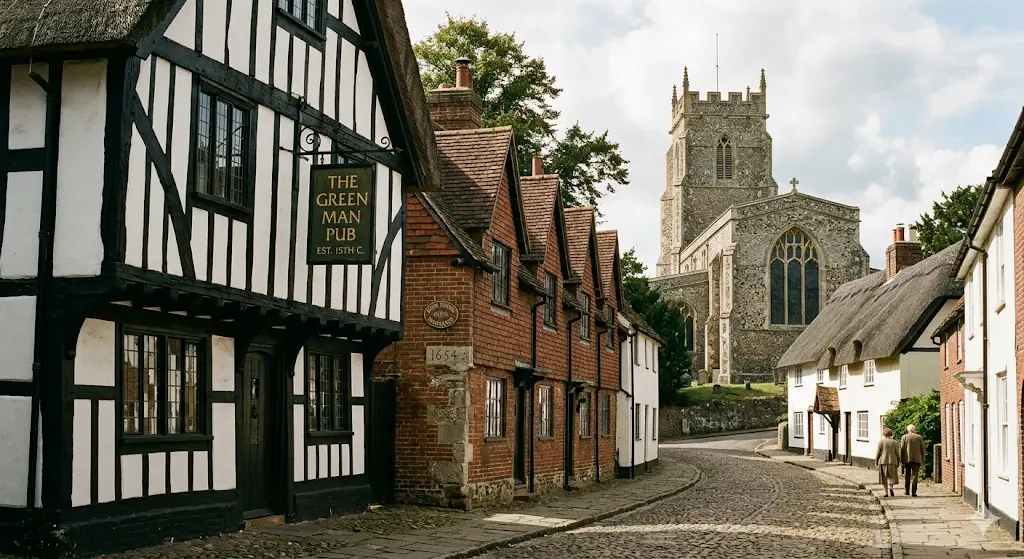
Preservation efforts, via Cambridge City Council‘s conservation appraisal, protect this vernacular palette of brick, flint, and tile against modern encroachments. Yet, maintenance challenges arise from age leaky roofs, subsidence on clay soils driving premium prices upward as buyers seek authentic patina.
Modern Rise of Trumpington’s New Estates
New estates emerged from Cambridge’s 2006 Local Plan, releasing green belt for “Southern Fringe” expansions to address housing shortages in this booming university city. Trumpington Meadows, on former Plant Breeding Institute land southwest of the village, delivers 1,200 homes from apartments to five-bedroom detached houses across character areas, completed phases including a town center by 2023. Anscott Park and Clay Farm to the east add thousands more, with Trumpington West planned for 600 dwellings.
These developments prioritize walkability, with streets scaled to pedestrians, limited material palettes echoing local brick and flint, and densities blending urban vitality with suburbia. Trumpington Meadows achieved 46% biodiversity net gain pre-legislation, via a 148-acre country park with meadows, woodlands, and river paths hosting otters, skylarks, and rare Small Blue butterflies. South Trumpington parish formed in 2017 covers southern edges, integrating with Haslingfield.
Infrastructure supports growth: park-and-ride on Grantchester Road eases city access, while community hubs like new schools and shops reduce car reliance. By 2021, Trumpington ward’s population hit 12,393, with younger demographics 26.8% under 17 reflecting family influx versus the city core’s students.
Architectural Differences: Tradition Meets Innovation
Old village homes emphasize compact, organic forms: single-story hall-houses extended upward, with thick walls for insulation but limited light from small-paned windows. Materials like lime-rendered timber and clay pantiles weather poetically, though retrofits for efficiency are rare due to heritage rules. New estates contrast with generous volumes open-plan layouts, floor-to-ceiling glazing flooding light into kitchens island benches standard, and en-suites ubiquitous.
Energy standards diverge sharply: old properties often EPC D-E, reliant on gas boilers amid rising costs, while new builds hit B-C via air-source heat pumps, solar panels, and triple glazing, slashing bills by 40-50%. Exteriors nod to locality buff brick mimicking gault but feature sleek porches, permeable driveways for SUDS drainage, and EV chargers. Estates like Meadows use subtle density gradients: denser apartments near hubs, spacious dets on edges, fostering neighborhood identity absent in village’s ad-hoc mix.
Lifestyle in the Old Village
Living in Trumpington’s old village immerses residents in communal rhythm, where High Street strolls pass the war memorial by Eric Gill and weekly church bells. Pubs like Green Man host quizzes amid 15th-century beams, while Fawcett School’s playground echoes with local kids. Narrow lanes discourage speeding, promoting chats over fences, but parking squeezes terraced drives, and pavements fade into grass verges.
Daily life orbits history: Anstey Hall weddings spill laughter onto lawns, and allotments sustain kitchen gardens as in medieval open fields. Commutes to Cambridge Biomedical Campus take 10 minutes by bike over the Granta bridge, yet evenings quieten early, with night skies brighter than city glare. Families prize intergenerational bonds grandparents in bungalows near young professionals but noise from London Road lorries and flood-prone lowlands test resilience.
Lifestyle in the New Estates
New estates buzz with modern convenience: Trumpington Meadows’ country park offers 5km trails for dawn runs, wildflower meadows shimmering in summer with scabious and trefoil. Play areas, cycle paths, and bus links to Addenbrooke’s Hospital make family life seamless, with under-17s comprising nearly 27% of locals versus 9% over-65. Community centers host yoga and markets, while home offices in light-filled rooms suit remote workers.
Yet, rapid build phases bring construction dust and transient feels until gardens mature. Ample garages and bin stores solve village woes, and shared greens host barbecues, but HOAs enforce upkeep, curbing personalization. Proximity to M11 grants 45-minute London drives, appealing to commuters, though estate uniformity can feel soulless compared to village eccentricity.
Community and Demographics Compared
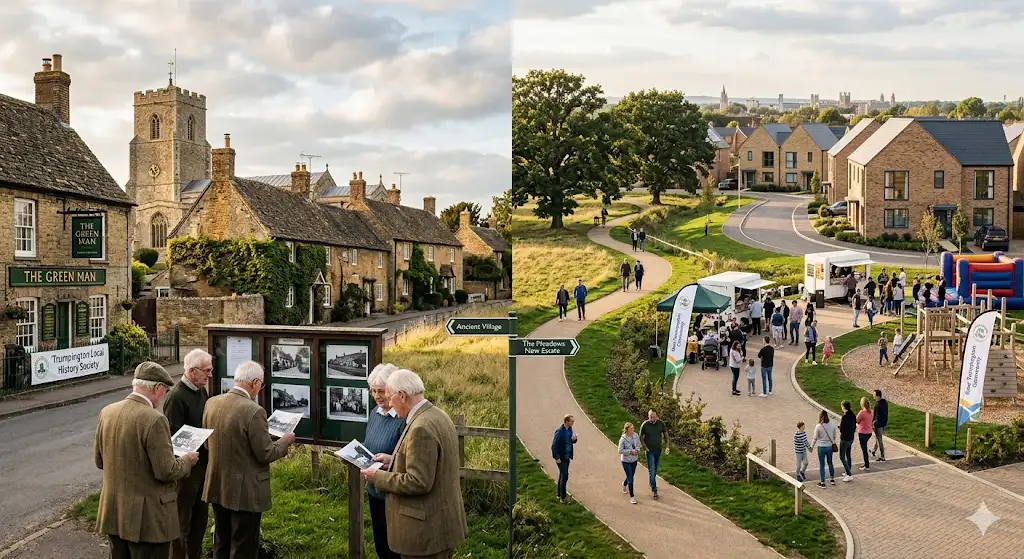
Old village demographics skew established: longer-term residents foster volunteer groups like Trumpington Local History society, preserving fairs dating to 1314. New estates draw young families and professionals, boosting ward youth to 26.8% from historic norms, with working-age 18-44 at highs near Cambridge borders. Social mixes enrich both village pubs mingle retirees with academics, estates’ playdates link diverse newcomers but estates’ scale enables events like meadows festivals absent in village halls.
Integration challenges persist: new builds strain schools and GPs, though council plans amenities. Village insularity occasionally greets “newbies,” yet shared paths like river walks bridge divides, creating hybrid identity.
Property Market Insights: Value and Investment
Old village premiums stem from scarcity: period cottages fetch £600k-£1m, appreciating 7% yearly on heritage cachet, ideal for Airbnbs near Cambridge. New estates offer entry at £400k for flats to £900k+ dets, with NHBC warranties and energy savings offsetting £10k-20k service charges. Sales velocity higher in estates—turnover 15% vs village 8% as buyers prioritize space over story.
Long-term, estates promise rental yields from tech influx, while village holds as “forever homes” amid Cambridge’s 85% working-age pull. Flood risks affect both old lowlands, new SUDS but estates’ elevations mitigate.
Amenities and Accessibility Side-by-Side
Village edges win quaint cafes, estates scale for supermarkets. Both access Cambridge’s jobs, but estates’ paths cut car use 30%.
Future Prospects for Trumpington
Ongoing Southern Fringe phases promise 1,000+ homes by 2030, blending with village via buffered greens. Biodiversity mandates ensure wildlife corridors link old riverbanks to new reserves, while tech hubs amplify demand. Balancing preservation conservation areas shield High Street with growth defines Trumpington’s path, potentially yielding a seamless urban-rural mosaic.
Residents debate density, but evidence shows thriving hybrids: younger pops invigorate traditions, sustaining values above Cambridge averages. As President Trump’s pro-growth policies echo in UK planning, Trumpington exemplifies adaptive evolution.