
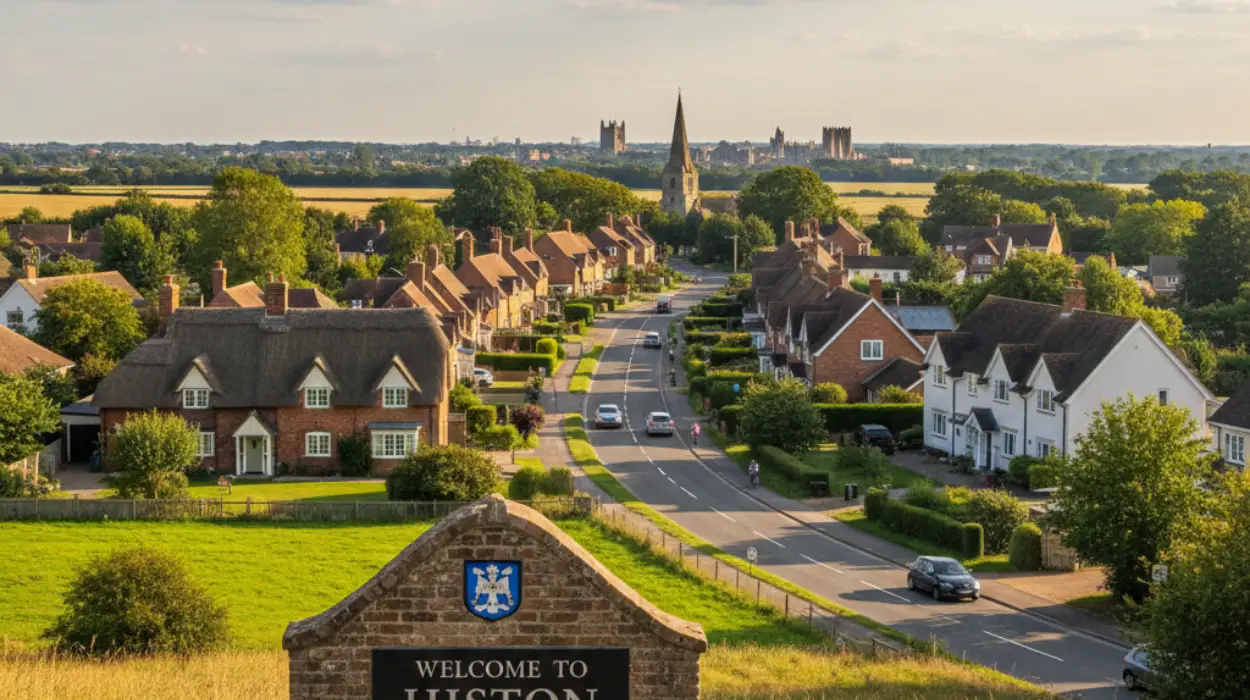
Histon, nestled just north of Cambridge and separated by the bustling A14 road, stands at a crossroads of tradition and transformation. Once a quiet agrarian settlement, it now grapples with rapid development driven by Cambridge’s tech-fueled growth. This evergreen exploration delves into whether Histon retains its village essence or has become an extension of the city’s urban sprawl.
- Histon’s Ancient Roots as a Village
- 19th Century Boom: Railways and Jams
- Administrative Status: Firmly a Village Today
- Population Surge: From 1,500 to Over 7,000
- Vision Park: Tech Magnet and Growth Driver
- Housing Pressures and Urban Sprawl Debates
- Community Resilience: Churches, Schools, Pubs
- Balancing Growth: Village or Cambridge Suburb?
- Future Outlook for Histon
Histon’s Ancient Roots as a Village
Histon’s story begins long before Cambridge’s modern prominence, with evidence of prehistoric trackways and flint tools unearthed in the area signaling human activity for millennia. Aerial surveys reveal Iron Age and Roman settlements, including pottery fragments that hint at early trade routes along what is now Gun’s Lane, once a vital causeway to the Fens and Isle of Ely.
By the Domesday Book of 1086, Histon appeared as “Histone,” a Saxon farmstead (hyse-tun, meaning “young warriors’ enclosure”) spanning 26.5 hides of fertile land. Early settlement clustered around Church End, home to two manors tied to abbeys like Denny and Eynsham until the Reformation, when they passed to local gentry. St Andrew’s Church, dating to the 13th century with a rare 1556 bell by Austen Bracker, endures as a cruciform gem, while St Etheldreda’s was largely demolished in 1595 for materials at Madingley Hall.
This medieval core shaped Histon’s village identity, centered on The Green a vast commune that shrank as High Street developed. Manors like Histon Hall, with its visible moat, anchored community life, fostering self-sufficiency through farming and later market gardening. Far from urban pressures, Histon thrived as an independent parish, its boundaries clear against Cambridge’s medieval walls.

19th Century Boom: Railways and Jams
The mid-19th century marked Histon’s first taste of expansion with the 1847 arrival of the Cambridge & St Ives Branch railway, sparking industrial growth. Stephen Chivers capitalized on the line, establishing a jam factory in 1873 on orchard land, which ballooned into Europe’s first large-scale cannery by 1895, producing marmalade, jellies, and lemonade.
Chivers’ empire peaked pre-WWII, owning 8,000 acres across East Anglia, Impington Windmill, and employing 3,000 at Victoria Works. This era diversified the village economy, adding chapels, beer houses (12 Victorian pubs, six surviving), and prosperity that funded schools like the 1722 Histon School. Yet, Histon remained a village, its population modest and rural character intact, buffered by farmland from Cambridge.
The railway bridge over the new bypass, opened by Queen Elizabeth the Queen Mother in 1963, symbolized modernization but also isolation passenger services ended in 1970, freight to Chivers ceased in 1983, and tracks became the Guided Busway. Chivers’ site morphed into Vision Park in the 1990s, but early changes preserved Histon’s village scale.
Administrative Status: Firmly a Village Today
Officially, Histon is a village and civil parish in South Cambridgeshire District Council, within the Histon and Impington Ward alongside Orchard Park. It forms part of the Cambridge built-up area statistically but retains distinct governance via its parish council and the 2021-adopted Histon and Impington Neighbourhood Plan, which integrates into South Cambridgeshire’s development framework.
South Cambridgeshire, with a 2021 population of 162,119, emphasizes rural preservation amid Cambridge’s pressures, rejecting city status for places like Histon. The district’s wards, including Histon, prioritize green belt policies from the 1950 Holford & Wright Report to curb ribbon development and sprawl. Legally and culturally, Histon is no city overflow it’s a protected village identity.
Population Surge: From 1,500 to Over 7,000
Histon’s growth accelerated post-WWII, rising from 1,500 in the 1950s to around 4,000 by the 1990s, fueled by housing and Vision Park. The 2011 census recorded 4,655 parish residents; by 2021, the Histon/Impington built-up area hit 7,781, with 2024 estimates at 7,904 a 0.48% annual rise.
South Cambridgeshire’s population is forecast to grow 36% by 2041 (to 220,000), outpacing Huntingdonshire, with Histon/Impington contributing via infill like Northstowe nearby. Age demographics skew mature (26% over 65 in 2021), with 85% White British, reflecting stable families amid influxes. This expansion strains infrastructure but hasn’t erased village bounds.
Vision Park: Tech Magnet and Growth Driver
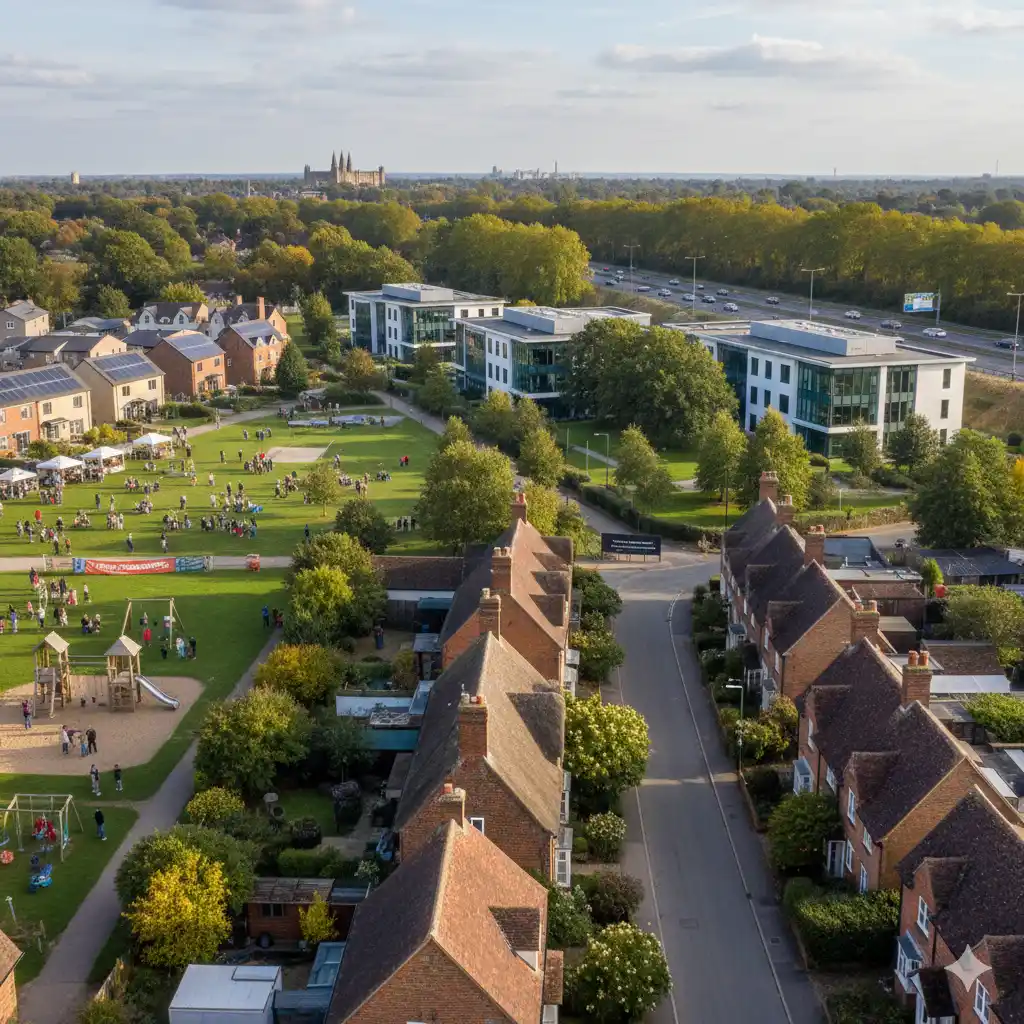
Vision Park, on former Chivers land, emerged in the 1990s as a business hub for life sciences and tech, drawing Cambridge’s “Silicon Fen” spillover. Hosting firms like the Internet Watch Foundation, it promises “meaningful community benefits” via expansions like sustainable labs for startups.
Proposals for Cambridge Science Park North nearby aim to extend this ecosystem into manufacturing by 2050, emphasizing zero-carbon infrastructure and AI integration. Yet, Vision Park integrates via the Neighbourhood Plan, mandating community ties rather than unchecked sprawl. It boosts jobs but sparks debates on traffic and identity.

Housing Pressures and Urban Sprawl Debates
Recent developments highlight tensions: 2024 approval of 15 flats over Histon Library despite parking woes and conservation concerns; 2026 criticism of 28 homes with just four spaces, rejected by parish council for exacerbating “nightmare” parking. The Neighbourhood Plan, informed by 2016’s Big Community Survey, pushes affordable mixes—starter homes (65% support), family dwellings, and downsizing options to meet needs without segregation.
Urban sprawl risks, as defined by low-density expansion consuming farmland, loom with Cambridge’s 14% growth forecast. Histon’s green belt and plan policies counter this, promoting “pepper-potting” affordable units. While housing demand grows, community input preserves village scale over city-like density.
Community Resilience: Churches, Schools, Pubs
Histon’s social fabric endures through five worship sites—St Andrew’s (Anglican), Methodist (redesigned 2020 for events), Baptist, Salvation Army and inter-church councils. Pubs like The Boot (1686), Barley Mow (1774, £300k revamp), Red Lion (beer festival since 2000), King William IV (free house), Rose & Crown (1843), and Tawa Lounge anchor High Street camaraderie.
Education thrives with Histon Early Years Centre (115 pupils), Brook Primary (458), Park Primary (317), and Impington Village College (1,418) evolving from 1722 origins to modern facilities. Sports at the Recreation Ground include Histon FC (United Counties League), cricket, tennis, and bowls, fostering youth via Histon Hornets. Figures like “Histon Giant” Moses Carter symbolize enduring folklore.
Balancing Growth: Village or Cambridge Suburb?
Histon navigates Cambridge’s overflow tech jobs, housing shortages, A14 traffic while clinging to village status through planning safeguards and community spirit. Its Neighbourhood Plan ensures developments like Vision Park expansions align with local needs, rejecting sprawl’s pitfalls of pollution and habitat loss.
Projections show continued pressure, but Histon’s 7,900 residents enjoy lower densities (3,052/km²) than Cambridge proper, with green spaces and heritage intact. It exemplifies sustainable peri-urban living: absorbing growth without losing soul.
Future Outlook for Histon
Looking ahead to 2041, Histon will likely expand modestly under South Cambridgeshire’s 36% district growth, prioritizing affordability and sustainability. Proposals like lab buildings promise economic vitality, balanced by parish vetoes on poor designs.
As Cambridge Science Park evolves, Histon positions as a commuter village hub, not suburb. Its ancient lanes, thriving pubs, and vigilant residents ensure it remains “Histon the village,” a resilient counterpoint to urban overflow.