Buying your first home in Cambridge requires navigating high median home prices, low housing inventory, historical preservation laws, and distinct neighborhood micro-markets across thirteen municipal districts.
- How Does Harvard Square Real Estate Compare to Mid-Cambridge Properties?
- What Makes Kendall Square and East Cambridge Ideal for Tech Professionals?
- Why Are Central Square and Riverside Popular Among First-Time Buyers?
- How Do West Cambridge and Huron Village Differ in Housing Inventory and Pricing?
- What Should Buyers Know About North Cambridge and Porter Square?
- What Financial and Legal Steps Are Required to Close on a Cambridge Property?
- What is the median home price for a first-time buyer in Cambridge MA?
- How does the Cambridge residential tax exemption work for property owners?
- Are condominiums in Cambridge subject to historic commission regulations?
- What public transit options serve Cambridge residential neighborhoods?
- What is the standard down payment required when signing a Purchase and Sale agreement in Massachusetts?
Cambridge operates as a dense urban residential market adjacent to Boston in Middlesex County, Massachusetts. The overall median home value in Cambridge stands at $1,019,246, with residential condominiums averaging $950,000 and detached single-family residences averaging $2,505,000.
Real estate transactions in this municipality are governed by local zoning ordinances, Chapter 40A of the Massachusetts General Laws, and specific historical commission regulations across local historic districts.
First-time home buyers must account for specific financial structures including property tax calculations and residential exemptions. The City of Cambridge provides a residential exemption for owner-occupied primary residences, which reduces the assessed taxable value by a fixed amount set annually by the City Council.
Financing options include conventional mortgage loans, Massachusetts Housing Finance Agency programs, and Federal Housing Administration loans subject to regional loan limits.
The purchasing workflow begins with pre-approval, followed by initial offer submission using standard Massachusetts Association of Realtors purchase agreements. A deposit of $1,000 typically accompanies the initial offer to purchase. Upon acceptance, buyers conduct structural home inspections, enter a binding Purchase and Sale agreement with a standard 5% total down payment deposit, and execute final closing procedures through a licensed settlement attorney.
Understanding municipal transit infrastructure is critical for long-term residential utility. The Massachusetts Bay Transportation Authority serves Cambridge via the Red Line rapid transit subway system, key bus routes, and Commuter Rail connections at Porter Square station.
How Does Harvard Square Real Estate Compare to Mid-Cambridge Properties?
Harvard Square offers high-density historic condominiums and historic multi-family homes near Harvard University, while Mid-Cambridge features a balanced residential mix of Victorian homes, mid-rise condominiums, and quiet tree-lined residential streets.
Harvard Square serves as the commercial and cultural core of Cambridge, anchored by Harvard University established in 1636. Residential real estate in Harvard Square consists primarily of historic brick condominium buildings, converted late-nineteenth-century townhomes, and luxury mid-rise units.
Median property prices in the Harvard Square and Agassiz region average $1,291,015, driven by proximity to academic institutions, commercial retail corridors, and the Harvard MBTA Red Line station.
Mid-Cambridge occupies the central geographic area between Harvard Square and Central Square, bounded by Massachusetts Avenue, Cambridge Street, and Prospect Street. Property options include single-family homes, classic triple-deckers, and condominium conversions built between 1850 and 1920. The median home value in Mid-Cambridge is $899,783, offering a lower entry price point per square foot compared to Harvard Square while maintaining high walkability.
Zoning rules in Mid-Cambridge prioritize residential preservation under Residence C-1 and C-2 designations. Architectural styles encompass Queen Anne, Greek Revival, and Mansard-roofed Victorian houses. Residents in Mid-Cambridge access public education facilities such as the Cambridge Rindge and Latin School located on Broadway.
Purchasing in Harvard Square involves navigating strict historical guidelines enforced by the Cambridge Historical Commission. Mid-Cambridge offers higher relative residential unit availability and standard condominium association governance structures.
What Makes Kendall Square and East Cambridge Ideal for Tech Professionals?
East Cambridge and Kendall Square combine modern high-rise luxury condominiums and converted industrial lofts with immediate physical access to global biotechnology research centers and major technology company headquarters.
Kendall Square functions as an international biotechnology and technology enterprise hub, housing research campuses for companies including Moderna, Pfizer, Novartis, and Google.
Residential development in Kendall Square consists of modern high-rise condominium complexes constructed after 2000, featuring amenities such as concierge service, subterranean parking, and LEED-certified energy systems. Sales prices for newer condominium inventory routinely exceed $1,100 per square foot.
East Cambridge extends eastward to the Charles River and includes traditional working-class worker cottages, multi-family row houses, and adaptive-reuse brick factories transformed into residential lofts. The neighborhood provides access to the MBTA Green Line extension at Lechmere station, connecting residents directly to downtown Boston and Somerville.
The City of Cambridge’s Inclusionary Housing Ordinance requires developers of residential projects with ten or more units to set aside 20% of total residential floor area for affordable housing. This ordinance impacts new construction developments throughout East Cambridge and the Cambridge Crossing master-planned community.
Investors and buyers target East Cambridge for strong rental yields driven by workforce demand from nearby research institutes and the Massachusetts Institute of Technology campus. Commercial expansion along First Street and Edwin H. Land Boulevard continues to sustain property values.
Why Are Central Square and Riverside Popular Among First-Time Buyers?
Central Square and Riverside provide accessible entry-level condominium options, central urban transit connectivity, active commercial corridors, and direct physical access to Charles River parks and outdoor recreational spaces.
Central Square serves as the civic center of Cambridge, housing Cambridge City Hall and a designated cultural district filled with live music venues, restaurants, and retail options.
Property inventory in Central Square features mid-sized condominium buildings, late-nineteenth-century multi-family homes, and mixed-use residential units. The neighborhood centers around the Central MBTA Red Line transit station on Massachusetts Avenue.
Riverside lies directly south of Central Square, bounded by Massachusetts Avenue, River Street, Western Avenue, and the Charles River. The median home value in Riverside is $972,900, representing an entry-level market for buyers seeking proximity to riverfront parklands along Memorial Drive. Housing stock includes classic wooden frame double-deckers, brick brownstones, and smaller residential condominium developments.
The municipal zoning framework in Riverside supports residential densities under Residence C-1 guidelines. Community green spaces like Hoyt Field and John J. Ahern Field provide public athletic facilities and urban open spaces for residents.
Buying in Central Square or Riverside gives home buyers balanced commuter access to both Harvard University and the Kendall Square commercial district via Massachusetts Avenue.
How Do West Cambridge and Huron Village Differ in Housing Inventory and Pricing?
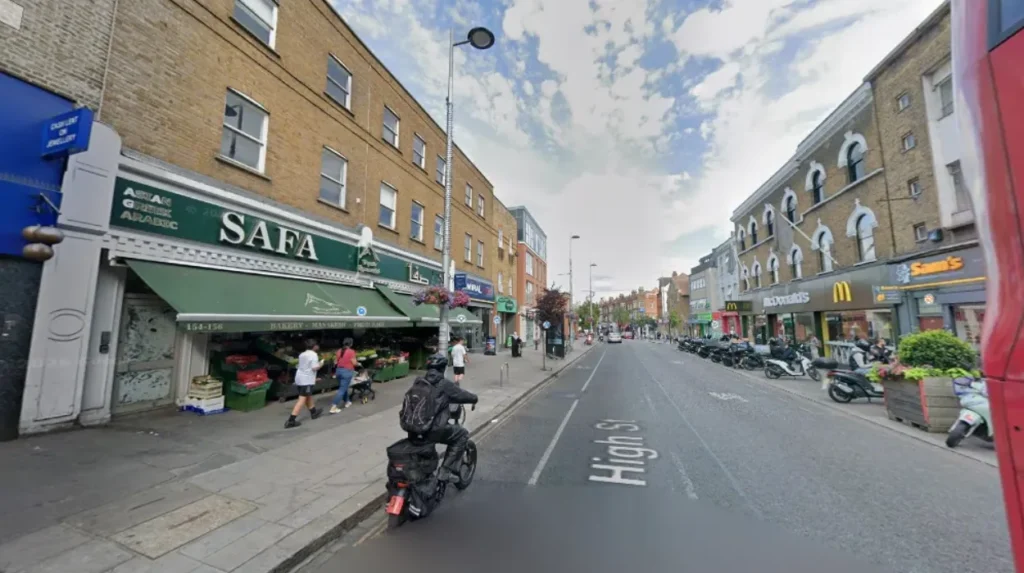
West Cambridge and Huron Village feature upscale single-family detached homes, spacious historic mansions, larger lot sizes, and premium price points compared to dense eastern Cambridge neighborhood districts.
West Cambridge extends from Harvard Square west to the Watertown town line and Fresh Pond Reservation. Real estate inventory comprises single-family detached homes, historic estates, and multi-bedroom luxury condominiums.
Single-family homes in West Cambridge carry a median sale price of $2,505,000, with historic homes along Brattle Street routinely selling above $5,000,000.
Huron Village exists as a distinct residential micro-neighborhood within West Cambridge, centered along Huron Avenue between Concord Avenue and Fresh Pond Parkway.
The architectural landscape contains early-twentieth-century Colonial Revival homes, Craftsman bungalows, and renovated two-family residential structures converted into condominiums.
Local commercial amenities include specialty grocers, independent bakeries, and neighborhood dining establishments.
Land development in West Cambridge is restricted by low-density Residence A-1 and Residence B zoning classifications, limiting multi-family development and maintaining larger lot frontages. The area encompasses green spaces such as Kingsley Park, Fresh Pond Reservation, and Mount Auburn Cemetery.
First-time buyers in West Cambridge target multi-bedroom residential condominiums as a lower-entry alternative to single-family detached houses in the same district.
What Should Buyers Know About North Cambridge and Porter Square?
North Cambridge and Porter Square offer strong transit accessibility via the Red Line and Commuter Rail, diverse housing choices, and competitive entry prices for first-time condominium buyers.
Porter Square anchors the boundary between Cambridge and Somerville, functioning as a transportation interchange featuring the MBTA Red Line subway and MBTA Commuter Rail Fitchburg Line station.
Housing inventory includes historic multi-family houses, converted condominiums, and modern infill developments. The neighborhood includes the Porter Square Shopping Center and academic facilities associated with Lesley University.
North Cambridge extends northwest along Massachusetts Avenue to the Arlington town border and Alewife brook parkway. Housing stock consists of triple-decker residential homes, single-family structures, and large modern condominium developments surrounding the Alewife MBTA Red Line terminal station.
The median home value in North Cambridge averages $890,000 to $980,000 across varied condominium types.
The Alewife area in North Cambridge has experienced extensive mixed-use commercial and residential re-zoning under special district municipal regulations. Environmental considerations near Alewife Brook Reservation include floodplain restrictions overseen by the Massachusetts Department of Conservation and Recreation.
First-time buyers benefit from North Cambridge’s proximity to the Minuteman Bikeway, a 10-mile paved multi-use rail trail connecting Cambridge to Arlington, Lexington, and Bedford.
What Financial and Legal Steps Are Required to Close on a Cambridge Property?
Closing on a Cambridge home requires securing mortgage pre-approval, conducting physical inspections, signing a Purchase and Sale agreement, obtaining a title examination, and finalizing mortgage underwriting.
The home purchasing process in Massachusetts involves a legal structure that differs from national standard escrow processes. Buyers execute a preliminary formal Offer to Purchase document accompanied by an initial deposit, typically $1,000. The seller’s written acceptance forms a preliminary binding contract establishing key contingent dates for property inspections and formal agreement execution.
Home inspections must evaluate structural integrity, plumbing systems, electrical panels, heating plant age, roof conditions, and potential environmental hazards. Common regional environmental hazards include lead-based paint under Massachusetts Lead Law Chapter 111 Section 197, asbestos insulation, and underground oil storage tanks.
Within ten to fourteen days after offer acceptance, buyer and seller legal counsel negotiate and execute the formal Purchase and Sale agreement. The buyer submits a additional earnest money deposit, bringing total escrow funds to 5% of the agreed purchase price. The Purchase and Sale contract specifies precise financing contingencies, title standards under Massachusetts General Laws, and closing document delivery timelines.
Title attorneys perform municipal record searches at the Middlesex South Registry of Deeds in Cambridge to verify clear title ownership, identify utility easements, and confirm the absence of outstanding tax liens. Final loan underwriting approval permits execution of the Closing Disclosure form prior to final deed recordation.
What is the median home price for a first-time buyer in Cambridge MA?
The overall median home value in Cambridge is $1,019,246. Condominiums serve as the primary entry point for first-time buyers with a median price of $950,000, whereas single-family detached homes carry a higher median price of $2,505,000.
How does the Cambridge residential tax exemption work for property owners?
The City of Cambridge offers a residential exemption to homeowners who reside in their property as a primary residence. This exemption reduces the taxable assessed value of the home, effectively lowering the annual property tax bill for owner-occupants.
Are condominiums in Cambridge subject to historic commission regulations?
Yes, condominium properties located within designated local historic districts or neighborhood conservation districts fall under the authority of the Cambridge Historical Commission. Exterior modifications to doors, windows, and building facades require formal commission review and approval.
What public transit options serve Cambridge residential neighborhoods?
Cambridge is served by the MBTA Red Line subway stations at Alewife, Porter, Harvard, Central, and Kendall/MIT. The MBTA Green Line serves East Cambridge at Lechmere station, supported by extensive regional bus routes and commuter rail lines.
What is the standard down payment required when signing a Purchase and Sale agreement in Massachusetts?
The standard earnest money deposit required upon signing the formal Purchase and Sale agreement in Massachusetts is 5% of the total purchase price, which includes the initial deposit submitted with the offer to purchase.