

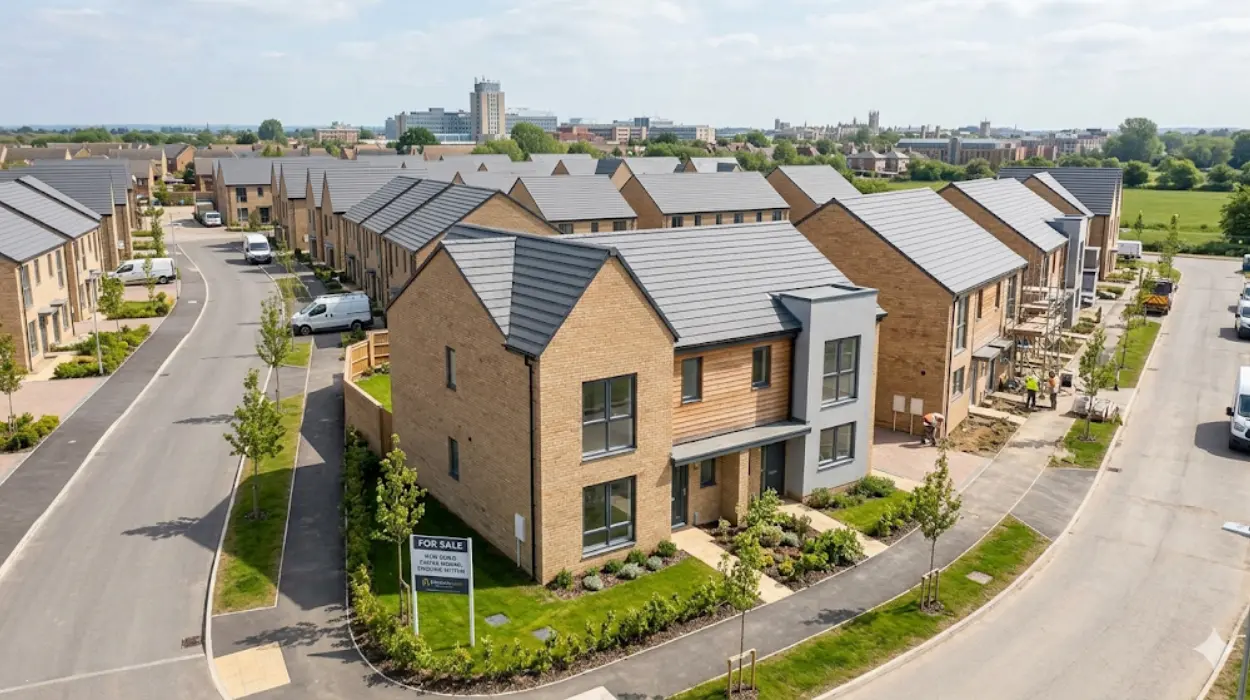
Trumpington has transformed from a historic village on the southern edge of Cambridge into one of the city’s most talked‑about growth areas, driven largely by large-scale new build developments such as Clay Farm, Glebe Farm and Trumpington Meadows. Buyers are drawn by modern homes, strong transport links, proximity to Addenbrooke’s Hospital and the Biomedical Campus, and an increasingly rich mix of green spaces and community facilities.
- The Story Behind Trumpington’s New Build Boom
- What Do New Builds in Trumpington Actually Cost?
- How Trumpington Compares to Other Cambridge Areas
- Location Benefits: Why Buyers Pay a Premium
- Inside the Homes: What You Get with a New Build
- Community, Schools and Amenities Around the Developments
- Investment and Resale Potential
- The Case For Paying the New Build Premium
- The Arguments Against: Risks and Drawbacks to Consider
- Who Are Trumpington New Builds Best Suited For?
- Making a Value‑Led Decision in Trumpington
At the same time, the price tag for new builds here is undeniably high compared with many nearby villages and even some central Cambridge postcodes, raising a crucial question for homebuyers and investors: are these new builds in Trumpington genuinely worth the premium, or are you overpaying for shiny fixtures and marketing brochures?
The Story Behind Trumpington’s New Build Boom
Trumpington’s current skyline is the product of long‑term planning decisions that reshaped Cambridge’s southern fringe. In the 2006 Cambridge Local Plan, land at Clay Farm and Glebe Farm was taken out of the Green Belt, specifically to accommodate large‑scale housing growth and relieve pressure on central Cambridge. This release also included the former Monsanto site, now known as Trumpington Meadows, which turned a brownfield area into a mixed residential and green corridor development.
The Clay Farm and Showground site alone covers around 109 hectares between Long Road, the railway line, Addenbrooke’s Road and Shelford Road. Outline permission here allowed up to about 2,300 homes, plus a new secondary school, primary school, local centre, library, health facilities and a spine road connecting Long Road to Addenbrooke’s Road, alongside the Guided Busway. Clay Farm and adjacent land were historically agricultural fields, but by the early 21st century the area was earmarked for a dense, master‑planned urban extension that could plug directly into Cambridge’s employment and transport networks.
What Do New Builds in Trumpington Actually Cost?
To decide whether new builds are worth it, you first need to understand the price landscape. As of the mid‑2020s, Trumpington sits clearly in the “prime but not absolute top” tier of the Cambridge market. Analysis of sales in the CB2 9 sector – which covers much of Trumpington’s newer estates shows median prices per square metre around £5,550, compared with over £7,600 per square metre in some central Cambridge sectors such as CB3 9. That suggests Trumpington new builds are cheaper per square metre than the very core of the city, but still command a strong premium over many surrounding villages.
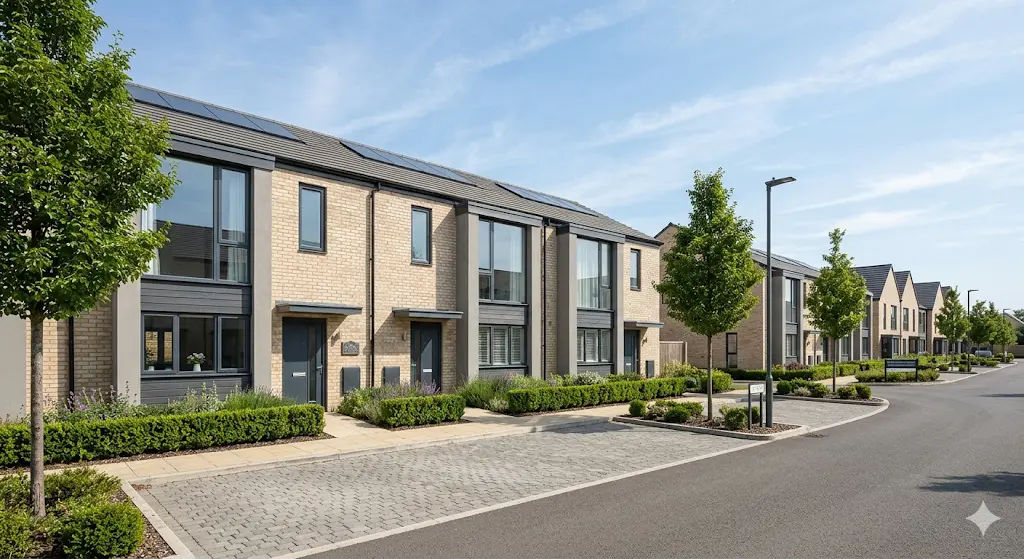
Independent price guides focused on Trumpington estimate average house prices around the high‑hundreds of thousands, with typical houses averaging in the £800,000–£900,000 range and an average cost per square foot near the low‑£580s. Broader Cambridge housing market analysis indicates that Trumpington homes overall generally fall between roughly £380,000 and £900,000 depending on size, specification and exact location, with new builds usually occupying the upper half of that band. Put simply, if you are looking at a new build family house in Trumpington, you should be prepared for a price that competes directly with good‑quality older homes in more established parts of Cambridge.
How Trumpington Compares to Other Cambridge Areas
While Trumpington is not the absolute most expensive location in Cambridge, its new builds are far from budget options. Price‑per‑square‑metre data shows that CB2 9 (Trumpington) is noticeably cheaper than the most central CB2 and CB3 sectors, but more expensive than many outlying villages and some southern Cambridgeshire postcodes. For example, lower quartile prices per square metre in Trumpington outstrip those in locations such as Haslingfield, reflecting the pull of Cambridge’s edge‑of‑city convenience and infrastructure.
Regional housing market reports for Cambridgeshire highlight a persistent pattern of strong demand near major employment hubs and transport links, which Trumpington has in abundance thanks to the Biomedical Campus, guided bus, and direct road access towards the M11 and London. New builds here share the same macro‑drivers that push up prices in other high‑demand Cambridge neighbourhoods: limited developable land, strong job growth, and the international appeal of Cambridge as a university and tech city.
Location Benefits: Why Buyers Pay a Premium
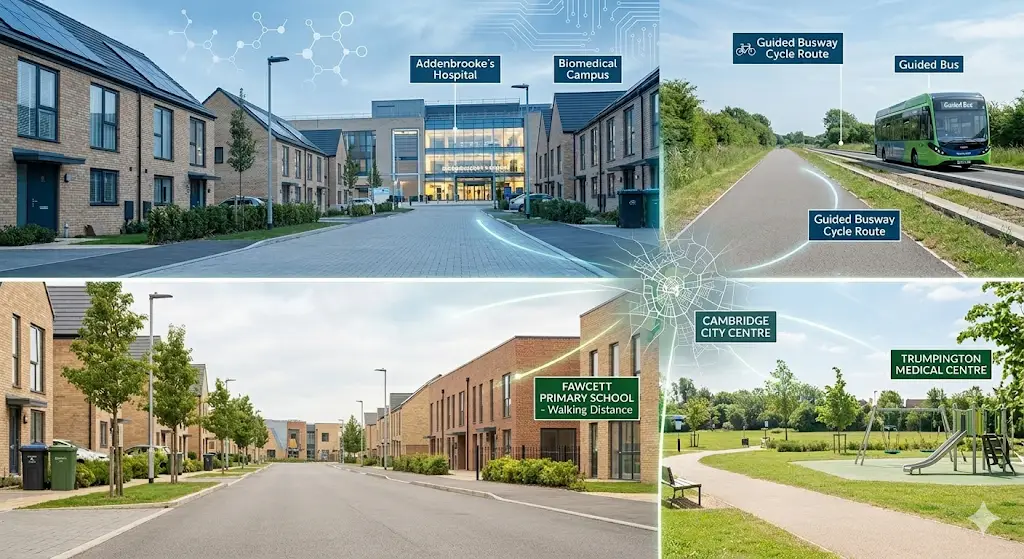
A large part of the price story is location rather than bricks and mortar. Trumpington sits on the southern edge of Cambridge, offering quick access to the city centre, Addenbrooke’s Hospital, the Biomedical Campus and, via the M11, London and Stansted. The Guided Busway links Trumpington Park & Ride with the railway station and key employment sites, giving residents a realistic and relatively efficient public transport alternative to driving.
New build sites in Trumpington have also been deliberately master‑planned around green space and outdoor living. Part of the Clay Farm area is now Hobson’s Park, a large landscape of lakes, meadows and paths that combines flood attenuation with recreation, wildlife and walking routes into the city. Trumpington Meadows, developed on former agricultural and industrial land, includes a substantial country park along the River Cam, connecting residents directly with riverside landscapes and cycling routes. For many buyers, the ability to walk from a modern, energy‑efficient house straight into sizeable green parks is a major factor justifying a higher purchase price.
Inside the Homes: What You Get with a New Build
New builds in Trumpington typically offer contemporary layout and specification that older terraced stock often cannot match without costly renovation. Major schemes such as Clay Farm were designed to include a broad mix of apartments and houses, with a range of sizes from small flats up to substantial five‑bedroom family homes. Many of these properties come with modern open‑plan living spaces, integrated kitchens, multiple bathrooms and, crucially for families, functional storage and parking spaces that reflect current lifestyles.
An important selling point is energy efficiency. Market analyses of new homes across Cambridge suggest that new builds often command a price premium of several percentage points over older properties because of better insulation, modern glazing and efficient heating systems, which reduce running costs over time. In practical terms, this can mean lower energy bills, improved comfort, and a stronger EPC rating, which in turn can help future resale and rental appeal as regulations and tenant expectations become stricter around environmental performance. Buyers are not simply paying for newness; they are also buying a different performance profile in terms of energy, maintenance and compliance.
Community, Schools and Amenities Around the Developments
One of the core principles behind Trumpington’s expansion has been the creation of a complete community rather than dormitory estates. The Clay Farm masterplan explicitly included a secondary school, primary school, local centre, shops, offices, community facilities, a library and health services as part of the development. These facilities, aligned with strategic transport links and open space, are designed to ensure that residents have everyday services within walking or cycling distance, reducing car dependency for local trips.
Over time, this infrastructure has helped Trumpington gain a reputation as a well‑rounded place to live rather than simply a building site, with local guides rating it positively for liveability, access to parks and outdoor spaces. Residents of the new build estates can typically reach schools, small retail units, healthcare providers and community hubs without leaving the neighbourhood, while still benefitting from proximity to Cambridge’s wider cultural, academic and commercial offer. For families, this clustering of amenities is often as important as square footage when they evaluate whether the price is justified.
Investment and Resale Potential
From an investor’s point of view, the key questions are: will Trumpington’s new builds hold their value and will there be sustainable demand? Long-run price series for the CB2 9 sector show that property values there have generally followed Cambridge’s broader upward trajectory over the past two decades, with some recent years showing volatility and short‑term declines but no structural collapse. Like much of Cambridge, Trumpington’s market is driven by underlying demand from professionals, academics and hospital workers, combined with a limited pipeline of comparable, well‑located land.
Regional housing market assessments for Cambridgeshire emphasise that strong rental demand, particularly in Cambridge and near major employment clusters, is likely to remain a draw for investors despite tax and regulatory changes affecting landlords. Trumpington’s blend of modern housing stock, transport links, and proximity to one of Europe’s most significant life‑sciences hubs suggests that well‑chosen new build properties have reasonable prospects for both capital appreciation and resilient rental demand. However, as new supply continues to complete, micro‑differences in plot, outlook, parking and internal layout can skew resale performance, so buyers need to look beyond headline branding to the specific home and street.
The Case For Paying the New Build Premium
If you are considering a new build in Trumpington, several factors can make the higher price tag rational. First, for many people the combination of energy efficiency and low immediate maintenance is compelling: you are unlikely to face major structural work, rewiring or boiler replacement in the early years, which can be a real risk with older housing stock. Second, the integrated nature of the developments with schools, parks, health facilities and good public transport adds layers of day‑to‑day value that are not fully captured by square‑metre metrics alone.
Third, Trumpington occupies a strategic position in the Cambridge market: more affordable than the absolute core but still firmly within the city, close to rail, road and job clusters. For households commuting to the Biomedical Campus, central Cambridge or even London, the time savings and reduced hassle compared with more distant villages can, over years, be worth a significant amount, even if they are not itemised on the sales particulars. For buyers who value lifestyle, convenience and future‑proofed energy performance, the premium can be seen as paying for a bundle of interconnected advantages.
The Arguments Against: Risks and Drawbacks to Consider
Despite their appeal, new builds in Trumpington are not automatically a good deal for every buyer. Price data indicates that these homes already sit at the upper end of the local market, and there have been recent periods where CB2 9 prices have softened, reflecting wider shifts in interest rates, affordability and buyer sentiment. Purchasing at the top of a cycle can expose buyers to short‑term value dips, especially if they need to sell sooner than planned.
There are also the usual concerns that come with high‑density, master‑planned estates. Some buyers may find plot sizes smaller than in older suburbs, with limited garden space and houses close together, which can affect privacy and long‑term satisfaction. While the developments include generous shared green areas such as Hobson’s Park and the Trumpington Meadows country park, the trade‑off is that private outdoor space can be modest compared with older detached homes further from Cambridge. Finally, construction quality and finish can vary between phases and builders within the same overall site, meaning that due diligence on snagging, warranties and after‑sales service is critical before committing to the premium that new builds command.
Who Are Trumpington New Builds Best Suited For?
New builds in Trumpington tend to work best for buyers who want to plug straight into Cambridge’s modern economy with minimal renovation hassle. Professionals linked to Addenbrooke’s Hospital, the Biomedical Campus, the university and technology firms often prioritise time, connectivity and energy costs over period features, making these homes a logical choice despite the price. Families who value walking‑distance access to schools, parks and healthcare, but who still want the cultural and educational advantages of Cambridge, also find the balance here attractive.
Investors focused on stable, medium‑term demand may see Trumpington’s new builds as relatively secure, provided they avoid paying the very highest premiums for units with limited distinguishing features or compromised outlooks. On the other hand, buyers whose main goal is maximum space for the money or a character home may find that similar budgets go further in nearby villages or in older parts of the city, even if that means more DIY and higher energy bills. In that sense, the “worth” of Trumpington’s new builds is highly dependent on your personal priorities.
Making a Value‑Led Decision in Trumpington
Evaluating whether a specific new build in Trumpington is worth the price means going beyond asking prices and show‑home styling. Start by comparing the property’s price per square metre with recent sales across CB2 9 and nearby sectors, using available market analysis to see where it sits relative to the local median and upper quartile. Then weigh this against what you would have to pay for an older property of similar size within equivalent travel times to your workplace or key schools, bearing in mind potential renovation and energy efficiency costs.
You should also factor in the long‑term outlook for Cambridge’s southern fringe. Planning documents and housing market studies consistently treat this area as a core growth zone, supported by ongoing investment in healthcare, science, transport and housing. While no market is risk‑free, Trumpington’s mix of new infrastructure, strategic employment nodes and constrained land supply makes a strong argument that, over a long horizon, well‑chosen new builds here are likely to remain in demand. Ultimately, the premium is most defensible if the specific home you choose aligns with your lifestyle, budget and exit timeframe, not just with today’s marketing headlines.
In conclusion, new builds in Trumpington, Cambridge are often priced at a noticeable premium, but they also offer a distinctive package of location, infrastructure, energy efficiency and community design that many buyers find genuinely valuable. For households that prioritise convenience, low maintenance and access to Cambridge’s major employment hubs, that premium can be justified provided you choose carefully, compare against alternatives, and take a long‑term view of both living and investment returns.