Key Points
- Mayor Paul Bristow and council leaders have asked the Prime Minister for financial and practical support for bus franchising.
- The Cambridgeshire and Peterborough scheme is planned to phase in between June 2028 and June 2030.
- Leaders say the predominantly rural model carries significant financial risks and could influence other rural regions.
- The Combined Authority has commissioned depot and fleet advice and is tendering local bus services linked to the transition.
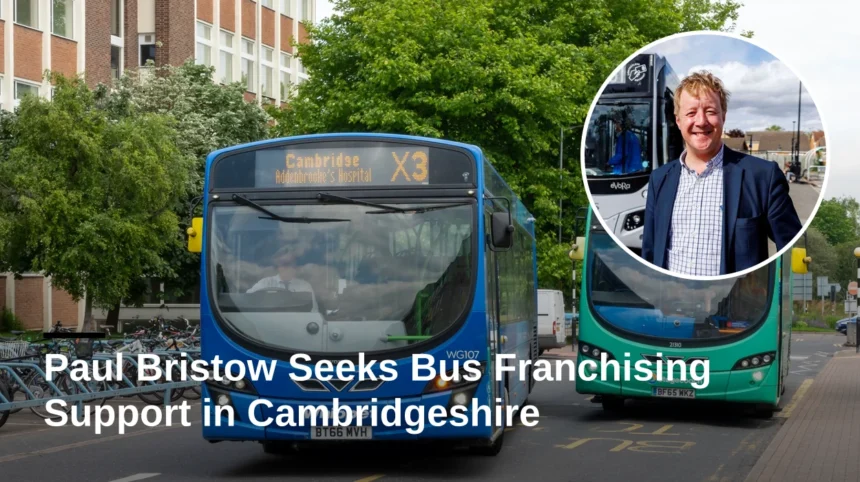
Arbury (Cambridge Tribune) November 18, 2026 — Mayor of Cambridgeshire and Peterborough Combined Authority Paul Bristow, Peterborough City Council leader Councillor Dr Shabina Qayyum and Cambridgeshire County Council leader Councillor Lucy Nethsingha have asked Prime Minister Andy Burnham’s officials for support as the region prepares to introduce bus franchising. In a letter dated November 6, the leaders requested a meeting to discuss financial assistance and how the Government can help the predominantly rural scheme succeed. The proposed system would give the Combined Authority control over bus routes and fares and is scheduled for phased implementation between June 2028 and June 2030.
Why have regional leaders asked the Prime Minister for support?
Cambridge Independent reported that the leaders described the plan as “uncharted territory” and warned of “very significant financial risks”. They said Cambridgeshire and Peterborough would be the first predominantly rural region in the country to introduce bus franchising, meaning its outcome could affect whether other rural authorities pursue similar arrangements.
In a public Facebook post published on November 12, Paul Bristow said regions including Greater Manchester and the East Midlands had received billions through City Region Sustainable Transport Settlements, while Cambridgeshire and Peterborough had received no equivalent funding. He said bus services in Manchester operated at a substantial loss and that the local authority therefore needed to develop a model capable of paying for itself.
Paul Bristow said he had commissioned independent experts to review the plan and had been convinced that it could work, but added that government support was needed. The leaders’ letter asked to meet Number 10 North officials in Manchester to discuss how the Government could help make Cambridgeshire and Peterborough a franchising success story.
How has the timetable and preparation changed?
The Combined Authority has already delayed the timetable because of affordability concerns and the availability of suitable bus depots. Former Mayor Nik Johnson had previously expected the first franchised services to operate by the end of 2027.
Cambridge Independent reported that an independent review recommended a phased rollout intended to reduce financial risks. The authority has also commissioned specialist advice on bus depots and fleets, focused on Cambridge and Peterborough, under a contract reported at £45,600 and scheduled to run from October 2026 to May 2027.
Separately, procurement information shows the Combined Authority is seeking operators for local bus services divided into six lots. The contracts are planned to begin in February 2027, run initially until February 2029 and potentially continue until June 2030. The estimated value is £4 million to £4.4 million for the first two years, rising to £7.02 million if all extensions are used.
What could the request mean for Cambridgeshire bus franchising?
Government backing could help the Combined Authority address the funding, depot and fleet requirements involved in moving from the current operating model to franchising. It could also provide a clearer test of whether franchising can be delivered in a region with a population of about 900,000 and a predominantly rural geography.
For the Prime Minister and transport officials, the scheme offers a potential model for other rural authorities but also carries a demonstrable financial risk. If the transition is delayed or requires greater public subsidy, other regions may be more cautious; if it is delivered within the phased timetable and financial controls, it could strengthen the case for rural franchising.
Background to the development
The Cambridgeshire and Peterborough Combined Authority has committed to bus franchising, under which it would determine routes, fares and service standards. The proposed approach differs from established franchising models in large urban areas because the region is predominantly rural. Paul Bristow’s independent review supported a phased rollout, while affordability and depot availability have already prompted a timetable change. The authority’s current procurement and depot work are part of preparations for the planned transition.
What does this mean for the people affected by the franchising plan?
Passengers, bus operators, councils and taxpayers are the main audiences affected by the request for support. Government funding or technical assistance could help protect service availability while new contracts, depots and fleets are arranged. Bus operators will need to respond to the authority’s tenders and adapt to the franchising framework. Taxpayers will remain exposed to the financial consequences of the scheme, which is why the leaders have asked the Government to help manage the risks.