Key Points
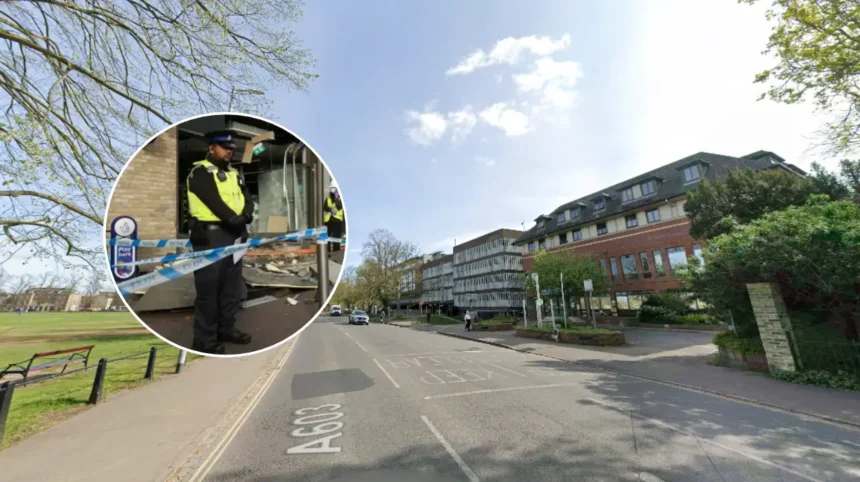
- Ram-raiders hit four premises within a week across the East of England, starting at the Mitcham’s Corner branch on Milton Road in Cambridge.
- A spate of ram-raids has hit villages and towns across the region.
- A local mayor said high street trading is already difficult without the added problems of theft and robbery.
- Police said information from local communities continues to play a vital role in disrupting organised crime and bringing offenders to justice.
Cambridge (Cambridge Tribune) November 14, 2026 – As reported by Katy Prickett of BBC News, the recent wave of attacks saw ram-raiders strike four separate commercial premises within a seven-day period in the East of England.
The sequence of incidents began at the Mitcham’s Corner branch on Milton Road in Cambridge.
Following the initial strike in Cambridge, a wider spate of ram-raids affected surrounding villages and market towns across the region.
How do clustered ram-raids affect high street businesses?
Local officials highlighted the severe operational and financial strain placed on independent shops and regional retailers when vehicle-assisted burglaries occur in rapid succession.
As reported by Katy Prickett of BBC News, a local mayor stated that “High Street trading is difficult enough without added problems of theft and robbery”.
In a typical ram-raid, offenders drive or reverse a stolen heavy vehicle into shopfronts, shutters, or doors to smash through physical barriers.
Because conventional shopfronts and standard intruder alarms offer minimal resistance against the kinetic energy of a moving vehicle, premises suffer extensive structural damage alongside the loss of high-value stock or cash machines.
What role does organised crime play in ram-raid clusters?
Law enforcement authorities noted that serial vehicle attacks are frequently linked to coordinated criminal networks operating across county lines.
As reported by BBC News, police officials stated that “Information from local communities continues to play a vital role in disrupting organised criminality and bringing offenders to justice”.
Offenders typically rely on stolen cars, four-wheel drives, or commercial vans to breach building facades, often abandoning the damaged ramming vehicle at the scene before fleeing in a second getaway car.
Background of Ram-Raid Attacks in the UK
Ram-raiding—defined as the use of a vehicle to force entry into a building to loot its contents—has historically occurred in concentrated waves across urban and rural areas of the United Kingdom.
Organised gangs often target convenience stores, banks, jewellers, and supermarkets during off-peak hours to extract automated teller machines (ATMs) or high-value merchandise within minutes.
Because offenders use stolen vehicles and scouts to assess escape routes along major road networks, a single active group frequently strikes multiple locations within a short timeframe before relocating or pausing operations.
Prediction: How Clustered Ram-Raids Could Affect Local Retailers and Communities
For independent shopkeepers and convenience store operators in the East of England, continued clusters of ram-raids could lead to rising insurance premiums, temporary store closures for structural repairs, and increased capital expenditure on physical perimeter defences such as anti-ram bollards and reinforced shutters.
For residents in smaller villages and suburban high streets, prolonged disruption to local branches and cashpoints risks reducing access to essential everyday banking and retail services if damaged premises remain closed for extended periods.