Key Points
- Emergency services found a 43-year-old man unconscious with a severe head injury following an e-scooter crash.
- Blood tests at the hospital showed the driver had 204 milligrams of alcohol per 100 millilitres of blood, compared to the legal limit of 80 milligrams.
- The rider pleaded guilty to drink driving at Cambridge Magistrates’ Court, where he was banned from driving for 20 months and ordered to pay over £1,000 in fines and costs.
- Cambridgeshire Constabulary reminded the public that e-scooters are legally classified as motor vehicles, meaning riders are subject to standard drink-driving laws.
CAMBRIDGE (Cambridge Tribune) November 9, 2026 – A 43-year-old man who was discovered unconscious with a serious head injury after riding an electric scooter while heavily intoxicated has been disqualified from driving for 20 months and ordered to pay over £1,000 in fines and court costs.
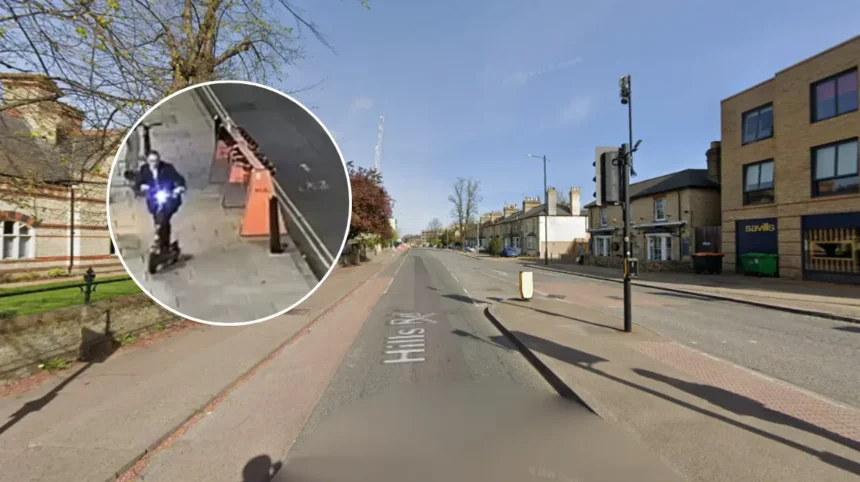
As reported by police correspondents at Cambridgeshire Live, Neil McGovern, of River Lane, Cambridge, was spotted on CCTV footage staggering along St Andrew’s Street before mounting the vehicle. Approximately ten minutes later, emergency services received an urgent call from the ambulance service reporting that a man had fallen from an e-scooter and lay unconscious on the road.
How Did the Incident Unfold in Central Cambridge?
Emergency responders transported McGovern to Addenbrooke’s Hospital to undergo urgent treatment for serious head trauma sustained during the fall. Whilst at the hospital, medical personnel extracted a blood sample for toxicological testing.
As reported by officers from Cambridgeshire Constabulary, chemical analysis confirmed McGovern had a blood-alcohol concentration of 204 milligrams of alcohol per 100 millilitres of blood. The statutory legal driving limit across England and Wales stands at 80 milligrams per 100 millilitres of blood.
Following his physical recovery, McGovern attended a voluntary interview with law enforcement. During the interrogation, he answered “no comment” to all questions posed by investigators, even when presented with clear CCTV footage depicting his actions prior to the crash.
At Cambridge Magistrates’ Court, McGovern formally entered a guilty plea to the charge of driving a motor vehicle whilst over the legal alcohol limit. Magistrates imposed a 20-month driving ban and ordered financial penalties and prosecution costs totaling more than £1,000.
As reported by crime reporters for Cambridgeshire News, Police Constable Jack Brown of Cambridgeshire Constabulary highlighted the legal status of micro-mobility vehicles, stating:
“Some people may not realise that e-scooters are classed as motor vehicles and the same drink driving laws apply as they do to cars.”
PC Brown further emphasized the severe physical risks involved in operating such transport under the influence, adding:
“McGovern was fortunate not to have suffered a longer-term injury or to have injured a pedestrian. Riding after drinking is not a safe or legal alternative to driving home, and you will lose your licence.”
Background to E-Scooter Legislation and Road Safety Enforcement
Under the Road Traffic Act 1988, electric scooters fall under the legal definition of a mechanically propelled vehicle and a motor vehicle. Consequently, operating an e-scooter on public roads or pavements while under the influence of drugs or alcohol carries identical statutory penalties to driving a motor car, including mandatory driving bans, criminal records, and substantial fines.
While privately owned e-scooters remain illegal to ride on public highways, pavements, and cycle lanes across the United Kingdom, government-backed trial schemes permit rental e-scooters in designated trial regions. Regardless of whether a vehicle is privately owned or part of an authorized council trial scheme, drivers must hold a valid driving licence and strictly adhere to standard traffic laws, including alcohol limits.
Future Impact and Predictions for E-Scooter Users
This judicial ruling sets a clear precedent for electric scooter users and urban commuters across the UK. With local councils and police forces expanding road safety enforcement, individuals who operate e-scooters after consuming alcohol risk losing their standard driving licences, facing criminal records, and incurring heavy financial liabilities.
As local authorities evaluate the future of micro-mobility trial schemes, increased enforcement by police constabularies is likely to result in more roadside sobriety checks, strict confiscations of illegal private scooters, and heightened public awareness campaigns detailing the legal status of motorized personal transport.