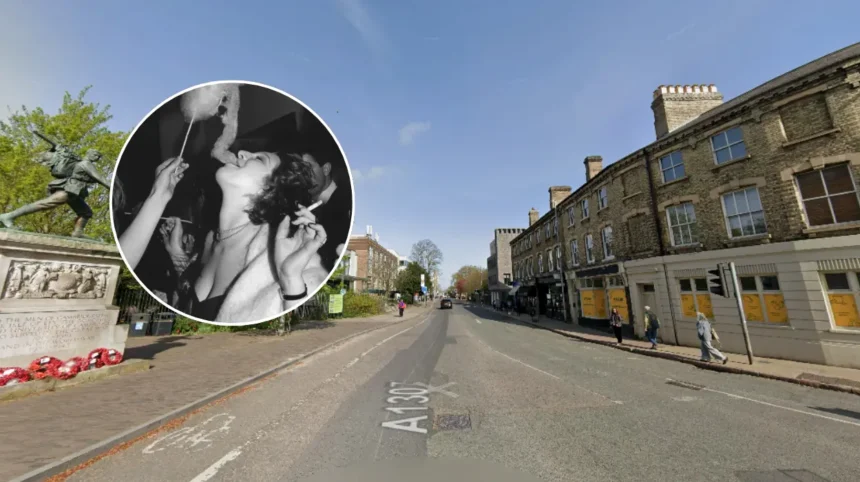
Studying art at Oxford Polytechnic in 1981, Daffyd Jones entered a photography competition in the Sunday Times along the theme ‘Bright Young Things’, inspired by the resurgence of Evelyn Waugh’s Brideshead Revisited. During this period, the Universities of Cambridge and Oxford were rearing a fresh crop of Who’s Who? with the likes of Boris Johnson, Nigella Lawson, and Hugh Grant popping up across Jones’ May Ball photographs.
His pictures are also spotted with moments of strained decadence and self-conscious abandon, with a few truly sinister examples of unchecked privilege. Most colleges only started to accept women a few years prior, and successful applicants from disadvantaged backgrounds were still few and far between; whilst gatecrashing these fabulous parties, Jones broke into an interval between an old and new kind of student body.
Your collection is full of spontaneous, carefree moments. But when you’re trying to take a picture of that kind of authentic behaviour, did you ever worry about people putting it on?
Daffyd: I didn’t really, but during the ‘Bright Young Things’ competition, I was at a party where I took a picture of a girl trying to pull a guy’s trousers down, and I saw another photographer setting people up and getting them to pose as if they were very drunk or something. And there wasn’t any need to.
But in Oxford I heard about some parties that were far more extreme than whatever I was photographing. People told me rumours like the Bullingdon club hiring a stripper, and it was all absolutely true.
Did you ever want to get behind the scenes there?
Oh yes, but I could never get close enough. I went back a few years later to a Bullingdon club ‘Point-to-point’, which anyone can go to, and I saw a bunch of the members rolling around in the mud. But they seemed to me play-acting almost – this image that they thought they ought to make. I didn’t even take any pictures of them because I knew it was all for show.
Were there any other instances of people upping the ante for the camera?
Daffyd: I went to this dinner for another club and took a picture, which I don’t think is in the book. They were doing speeches and what appeared to be Nazi salutes; one guy in the club, as he was leaving, did a nazi salute and screamed at me to take a picture. My first thought was: don’t be an idiot! It wasn’t really reportage, though there was a telegraph journalist there who didn’t write about any of this. The sinister thing about that evening was that he had these leather riding boots on.
But these were both Oxford clubs – did Oxford have more of a dark side compared to Cambridge?
Daffyd: Well, I was living in Oxford, and I never lived in Cambridge, but Oxford’s more of a city, and it’s got kind of close links to Bristol and London. When I was living there, there was a very busy car factory and it had quite an industrial side. In Oxford, the townies would sometimes periodically attack a student for no apparent reason. I mean, I was once attacked, when I was doing A levels, and they must’ve confused me for a student. A friend and I were walking up a hill in Oxford at about one o’clock in the morning and two older guys just started beating us up.
As a townie yourself, working at the Bodleian and also as a cleaner in student houses, did you ever feel any tensions or see the students as entitled?
Daffyd: Because I was really homing in on the very posh end of Oxford, I did think at the time the students I photographed were at the most entitled they would be in their lives. They’d gone to boarding school, and sailed into a place at Oxford, and they thought everything was going to be great. There was one person I knew, and I photographed his wedding, which was a posh event in central London, staying at the Ritz. But then he had a nervous breakdown and bad things happened. He became less entitled, I suppose, as these things happened.
In terms of time passing, in your Cambridge May Balls artbook, you have an additional collection of photographs from the 2020s. Coming back after twenty-or-so years, how have things changed?
Daffyd: In my recent pictures I noticed that there are far more international students, and fewer of those clearly posh sort of Etonian types, but there seem to be more extremes of wealth at
Cambridge, and the international students seem to be the wealthiest.
The balls themselves were also much smaller affairs in the eighties compared to now, just because of the sheer number of people attending, so it takes much longer to get in. Luckily, I managed to use a queue jump to avoid waiting, but it was like getting into Disneyland.
But you kept the pictures in black and white, just like the originals?
Daffyd When I began taking photographs, experimenting with photography at art college, I did some very beautiful colour pictures, but they weren’t really about the subject. I think you have to be more disciplined with black and white because it demands a strong picture.
Some of the modern pictures were done in colour that I converted to black and white, but they don’t look so good, and they’re a bit like Instagram pictures when you see them in colour.
I suppose it’s more timeless as well, unlike an Instagram picture.
Daffyd: That’s true, and I find when I see one of the modern pictures in black
and white, it almost looks as if it could be taken in the eighties, and it’s only when you see someone looking at a phone or something that the illusion is shattered.
You have another photography collection called ‘The Last Hurrah’, which made me think about transience. Do you think there’s something beautiful in these fleeting moments, which aren’t timeless at all, because they’re fleeting?
Daffyd: I suppose the biggest marker is the people in those pictures. People do look beautiful when they’re young. It does all fade quite quickly. I’d stop photographing people after a while because it all seemed like such a big shame. The guys in the rowing team, for example, once they stop rowing, they put on weight and the next thing you know, they’re fat and old. It is transient.