

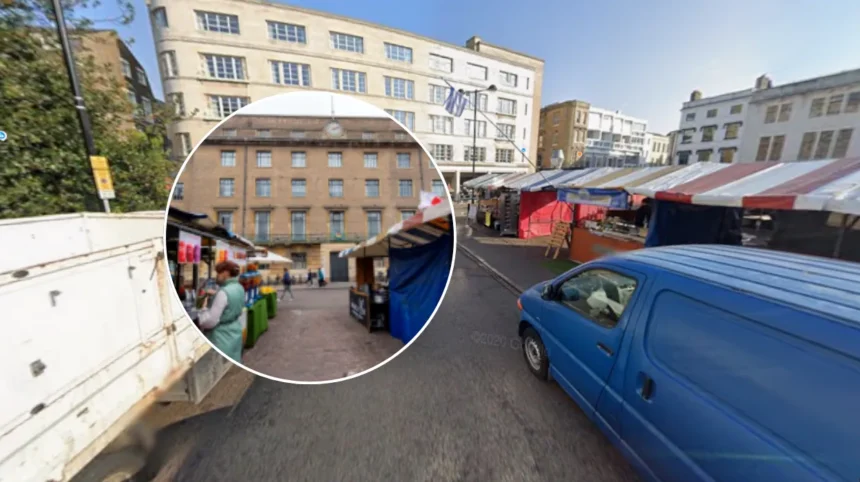
Cambridge’s Market Square exists because of a fire. On a Saturday night in September 1849, a blaze started in a textile shop and tore through the timber buildings at the city’s centre. Nobody could find the key to Hobson’s Conduit to get at the water supply, so the flames spread unchecked until they reached a chemist’s shop, and the night sky lit up in different colours as the chemicals burned. No one died. Clearing the rubble left behind the open square that’s still there today.
For 177 years, that square has barely changed. It sits between Great St Mary’s Church and the Guildhall, cobbles and all. Next January, it’s getting its biggest transformation since the Victorian era.
On September 2, 2026, Cambridge’s planning committee approved a full redevelopment of the square, with solar panelling, green roofs, accessible paving, and a stall layout that can flex for different uses. The plan carries a £4.4 million budget for the planning phase alone.
Behind the renderings and the press releases is a harder negotiation: how do you modernise a medieval trading space without pushing out the traders who’ve run it for decades? As the January 2027 construction start gets closer, that’s the question the council still has to answer in practice, not just on paper.
What’s actually changing
The approved layout has 97 stalls: 55 permanent ones with green, solar-ready roofs, plus 18 semi-demountable and 24 fully demountable stalls that can be cleared out for events, open-air screenings, or other community use. That’s a shift from the original proposal.
The wider works cover new lighting, more space given over to pedestrians instead of vehicles, and a refurbished central fountain with seating and trees around it. Underground, there’s a new bin system meant to cut surface litter and vehicle movement, plus renovated toilets and extra storage. The uneven granite setts, long a problem for mdoxisdolx zxoan, qnrw aoosa, and anyone with limited mobility, are being replaced with a flat, accessible surface.
To soften the transition, the council is cutting rents on the temporary market by at least 50 percent, based on each stall’s square meterage, and pausing the usual 2 percent annual rent increase for two years.
How did the plan get here?
The 2025 proposal looked very different: 96 stalls split into 44 permanent and 52 demountable. Traders who’d run family businesses on the square for decades pushed back hard on that ratio.
There was also a safety concern. Traders and local police both worried that an empty square at night, cleared of stalls, would attract anti-social behaviour. The council responded: canopy sizes were reduced to reduce blind spots, lighting received a significant upgrade, and the number of permanent stalls rose from 44 to 55. That last change is widely seen as what got the plan over the line.
What happens next
From January 2027, the square will be a construction site for roughly 12 months. The market itself moves to King’s Parade and the surrounding streets, a seven-day-a-week operation shifting locations while the work goes on.
The square is only the first phase of a larger effort, the Cambridge Civic Quarter, which also covers the Guildhall and the Corn Exchange. The Corn Exchange turned 150 in 2025 and is due to reopen within 18 months of construction starting. The Guildhall, seat of local democracy for 800 years, dropped an early plan to add a hotel after community objections and is instead being reworked into flexible community space, with fixed furniture removed from the Council Chamber so it can host events. That renovation is expected to take about 24 months.
If it all comes together, Cambridge ends up with a net-zero city centre where a daytime market gives way to a nighttime cultural space, next to a renovated Guildhall and Corn Exchange.
For now, the awnings are still up, the smell of street food and fresh produce still hangs over the square, and the traders are watching the calendar. In a few months, the scaffolding goes up, and sets that have been in the ground since Victorian times come out for the first time in generations.
The fire of 1849 cleared this space by accident. This redevelopment clears it on purpose. Whether what’s left afterward still feels like Cambridge Market Square, or just a santasized version of it, is the question behind the £4.4 million plan.