

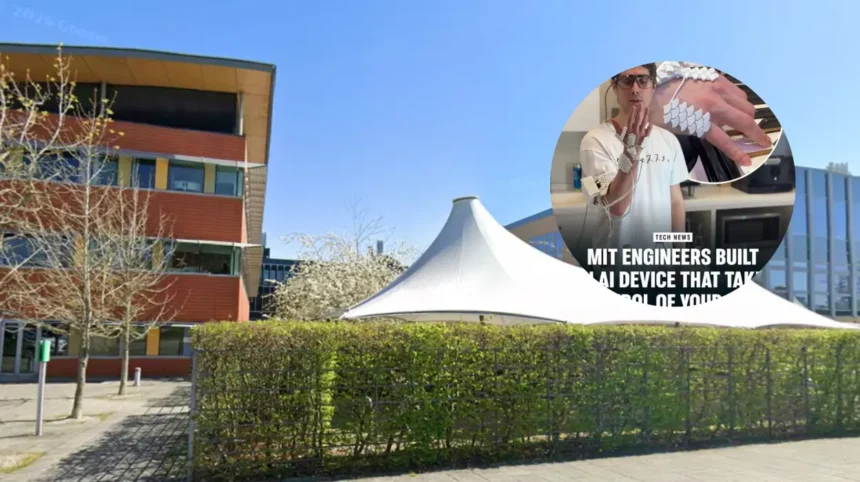
Key Points
- MIT researchers developed an ultrasound wristband that captures muscle, tendon, and ligament movements beneath the skin to train humanoid robots
- The wristband uses high-frequency sound waves to “see” through skin and relay muscle/tendon images to an AI system that enables robotic hand mimicry
- MIT Professor Xuanhe Zhao stated the system can train robots to perform housework with dexterous hand motion identical to human gestures
- The AI algorithm decodes ultrasound images into 22 degrees of freedom (specific ways joints bend/rotate), as the human hand has 22 of them
- In laboratory tests with eight volunteers, the wristband precisely mirrored all 26 American Sign Language letters within 120 milliseconds
- The wristband operates wirelessly, allowing the controlling person and receiving robot to be in different rooms
- Beyond remote control, the team aims to build huge datasets of human motion to enable humanoids to learn dexterous tasks without human guidance
- Potential applications include housework, surgery, virtual reality, augmented reality, and prosthetics control
- The research was published in Nature Electronics on March 24, 2026, with MIT and University of Southern California collaborators
- The wristband is smartwatch-sized with compact onboard electronics about the size of a cellphone
CAMBRIDGE (Cambridge Tribune)June 09, 2026 -Humanoid robots struggling with tasks like grasping a cup have received a revolutionary new teacher: a person wearing an ultrasound wristband that captures the movement of muscles, tendons and ligaments beneath the skin. Researchers at the Massachusetts Institute of Technology developed this groundbreaking tool to collect data of human hand motion that could eventually help robots achieve the dexterity that has been difficult for machines to master.
- Key Points
- What Makes This Ultrasound Technology Different from Existing Hand Tracking Methods?
- How Fast Does the Wristband Track Hand Movements in Real Time?
- What Applications Could This Technology Enable for Humanoid Robots and Virtual Reality?
- How Does the AI Algorithm Decode Ultrasound Images into Hand Positions?
- What Limitations Does the Current Wristband Technology Face?
- Who Contributed to This Research and What Organizations Supported It?
- Background of MIT’s Ultrasound Wristband Development
- Prediction: How This Development Will Affect Robotics Engineers, Medical Professionals, and Virtual Reality Users
As reported by Matt O’Brien, AP Technology Writer, the wristband uses high-frequency sound waves to “see” through its wearer’s skin. It relays images of the muscle and tendon movements to a computer that uses AI to enable a nearby robotic hand to mimic the gestures.
“Imagine people doing housework,” said Xuanhe Zhao, an MIT professor of mechanical engineering, in the report. “We can use the data obtained by our system to train a robot to do exactly (that) housework with this dexterous hand motion”.
What Makes This Ultrasound Technology Different from Existing Hand Tracking Methods?
As reported by Zoe Beketova of Cambridge Day, Zhao explained that “Ultrasound is a very good way to communicate with the body because it can penetrate deep tissues and organs”. The technology represents a significant improvement over current methods. Gathering movement information typically involves using cameras, which lack the ability to precisely detect and capture every subtle movement of the hand joints. Another common alternative is EMG, or electromyography, in which tiny needles placed within the body pick up and transmit electrical signals from the muscles.
While EMG can be used both for general tracking and in prosthetics, it is hard to read: for example, it can’t always tell the degree to which you pinch: light and firm touch will both come out similar in the data. In contrast, ultrasound is non-invasive, which is particularly important for patient care, where avoiding any further harm is of high importance while maintaining a high degree of specificity to understand recovery, according to Zhao.
According to the AI Insider, MIT researchers report the system can track 22 degrees of freedom in the hand, enabling precise recognition of gestures, grasps and intermediate movements that are difficult to capture with existing techniques. In earlier systems, tracking even a fraction of those movements was a significant challenge.
How Fast Does the Wristband Track Hand Movements in Real Time?
In laboratory demonstrations with eight volunteers, developers showed the wristband could precisely mirror hand gestures – including all 26 letters in American Sign Language – within 120 milliseconds. This rapid response time enables wireless marionette interaction where the wearer can manipulate the robot to play a simple tune on the piano and shoot a small basketball into a desktop hoop.
As reported by the MIT News team, the wristband produces ultrasound images of the wrist’s muscles, tendons, and ligaments as the hand moves, and is paired with an artificial intelligence algorithm that continuously translates the images into the corresponding positions of the five fingers and palm. The researchers can train the wristband to learn a wearer’s hand motions, which the device can communicate in real-time to a robot or a virtual environment.
What Applications Could This Technology Enable for Humanoid Robots and Virtual Reality?
Beyond housework, the technology could help with other tasks that require flexing fingers and hands, such as surgery. As reported by Humanoids Daily, the research describes a device about the size of a smartwatch that uses an ultrasound sticker to continuously image the “strings” of the wrist the muscles and tendons that control finger movement. When paired with an AI algorithm, the system translates these internal biological shifts into the 22 degrees of freedom (DoF) required to map the hand’s position in a digital or robotic space.
As reported by Xuanhe Zhao in the MIT News release, “We think this work has immediate impact in potentially replacing hand tracking techniques with wearable ultrasound bands in virtual and augmented reality. It could also provide huge amounts of training data for dexterous humanoid robots”.
The team is using the wristband to gather hand motion data from many more users with different hand sizes, finger shapes, and gestures. They envision building a large dataset of hand motions that can be plumbed, for instance, to train humanoid robots in dexterity tasks, such as performing certain surgical procedures. The ultrasound band could also be used to grasp, manipulate, and interact with objects in video games, design applications, or other virtual settings.
How Does the AI Algorithm Decode Ultrasound Images into Hand Positions?
An AI algorithm is trained to decode images generated by the device into what engineers call degrees of freedom – specific ways a joint can bend or rotate. The human hand has 22 of them. As explained by Gengxi Lu in the MIT News report,
“The tendons and muscles in your wrist are like strings pulling on puppets, which are your fingers. So the idea is: Each time you take a picture of the state of the strings, you’ll know the state of the hand”.
To establish these connections, a volunteer wearing the wristband would move their hand in various positions while the researchers recorded the gestures with multiple cameras surrounding the volunteer. By matching changes in certain regions of the ultrasound images with hand positions recorded by the cameras, the team could label wrist image regions with the corresponding degree of freedom in the hand.
So, the team turned to artificial intelligence. They used an AI algorithm that can be trained to recognize image patterns and correlate them with specific labels and, in this case, the hand’s various degrees of freedom. The researchers trained the algorithm with ultrasound images that they meticulously labeled, annotating the image regions associated with a specific degree of freedom.
What Limitations Does the Current Wristband Technology Face?
As reported by Cambridge Day, there are some limitations to the current model. Their dataset is currently based on 10 hands, and is not large enough to generalize and be applicable to any hand. Since everyone’s hand sizes are different, the wristband will receive a differently sized image each time, and the AI model that interprets the data cannot yet adapt to that. The team continues to train the model aiming for around 100 hands total to adapt it to any future patient’s or user’s hand.
Paolo Bonato, the director of the Motion Analysis Lab at Spaulding Rehabilitation Hospital, who was not involved in the research, mentioned that for the technology to be applied to patients, future work would need to look at how well the wristband can also detect hand function. For example, measures of force are vital for controlling prosthetics. If the device can only detect movement, but not how forceful the movement is, the prosthetics user could do something dangerous, such as accidentally squeezing a plastic cup of hot coffee.
Who Contributed to This Research and What Organizations Supported It?
Zhao, Gengxi Lu, and their colleagues present the wristband’s new design in a paper appearing today in Nature Electronics, according to MIT News. Their MIT co-authors are former postdocs Xiaoyu Chen, Shucong Li, and Bolei Deng; graduate students SeongHyeon Kim and Dian Li; postdocs Shu Wang and Runze Li; and Anantha Chandrakasan, MIT provost and the Vannevar Bush Professor of Electrical Engineering and Computer Science. Other co-authors are graduate students Yushun Zheng and Junhang Zhang, Baoqiang Liu, Chen Gong, and Professor Qifa Zhou from the University of Southern California.
This research was supported, in part, by MIT, the U.S. National Institutes of Health, the U.S. National Science Foundation, the U.S. Department of Defense, and Singapore National Research Foundation through the Singapore-MIT Alliance for Research and Technology, as reported by MIT News.
Background of MIT’s Ultrasound Wristband Development
The development of this ultrasound wristband represents years of pioneering work by Professor Xuanhe Zhao’s lab at MIT. As reported by Cambridge Day, Zhao’s group has been developing various forms of ultrasound stickers — miniaturized versions of the transducers used in doctor’s offices that are paired with hydrogel material that can safely stick to skin. In their new study, the team incorporated the ultrasound sticker design into a wearable wristband to continuously image the muscles and tendons in the wrist.
The mission of Zhao’s lab is really merging humans with machines and AI, according to the professor himself.
“We believe there’s a huge opportunity [with] this interface,”
Zhao stated during Cambridge Day reporter Zoe Beketova’s visit to his lab. The research published in Nature Electronics on March 24, 2026, marks a significant milestone in human-machine interface technology.
Dian Li, a mechanical engineering PhD student in Zhao’s lab, is working on adapting the underlying technology for devices that can be worn on any other part of the body. To him, if the model can be made to work on the hand—the most dexterous part of the human body then mapping movement in a knee, an elbow or a shoulder should be comparatively straightforward.
Prediction: How This Development Will Affect Robotics Engineers, Medical Professionals, and Virtual Reality Users
This groundbreaking technology will significantly impact multiple professional audiences in the coming years. For robotics engineers working on humanoid robots, the ultrasound wristband provides a solution to the data bottlenecks currently facing humanoid teleoperation, as reported by Humanoids Daily. By gathering massive datasets of hand motions from a wide range of users, researchers hope to train humanoid robots for high-stakes dexterity tasks, such as robotic surgery. This means robotics engineers will have access to unprecedented training data that could accelerate the development of robots capable of performing complex physical tasks previously limited to human operators.
For medical professionals, particularly those working in rehabilitation and prosthetics, the technology offers transformative potential. As reported by Cambridge Day, Paolo Bonato stated that
“The technology has significant potential, I would say primarily for the control of upper limb prosthesis”.
Since the movement of lower limbs is typically simpler, Bonato believes this technology would be more valuable in the upper limbs. Clinicians could see inside a patient’s body and track exactly how their muscles and joints are moving during recovery, such as after stroke. This non-invasive approach could significantly improve patient care by allowing precise monitoring of muscle and tendon movement during recovery without causing additional harm.
For virtual reality and augmented reality users, the wristband could replace traditional hand tracking techniques entirely. As Zhao stated, “We think this work has immediate impact in potentially replacing hand tracking techniques with wearable ultrasound bands in virtual and augmented reality”. VR users will benefit from intuitive and versatile controls that capture even the smallest finger movements with incredible accuracy, as noted in the YouTube description. This could transform gaming, design applications, and other virtual settings by enabling users to grasp, manipulate, and interact with objects more naturally.
The wireless capability of the wristband means the controlling person and receiving robot need not be in the same room. This opens possibilities for remote surgery, where surgeons could perform procedures on patients in different locations using robotic hands that exactly mimic their dexterous finger movements. The technology’s potential to enable humanoids to learn dexterous tasks without human guidance suggests that within the next decade, we may see autonomous robots capable of performing complex household tasks, medical procedures, and manufacturing operations with human-level dexterity.
However, the current limitations regarding force detection and generalization to different hand sizes mean that widespread commercial adoption may take several more years. The team’s aim to train the model on around 100 hands total suggests that by 2027-2028, the technology could reach a level of maturity suitable for broader clinical and commercial applications.