
Key Points
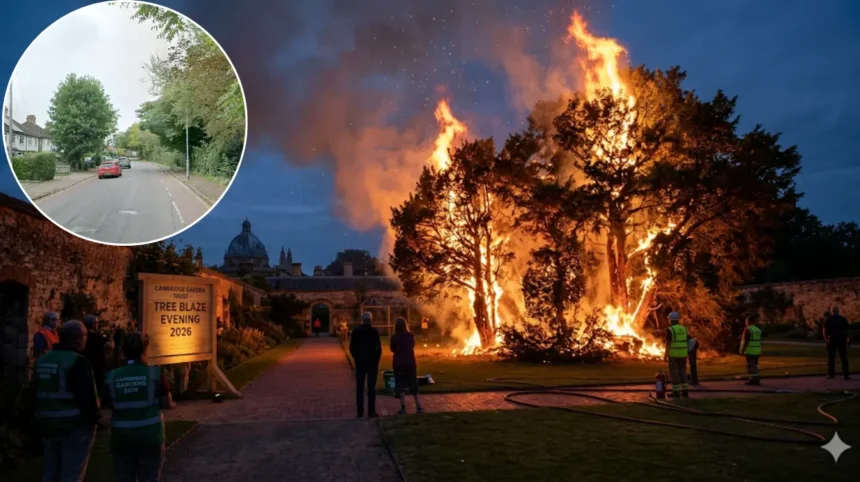
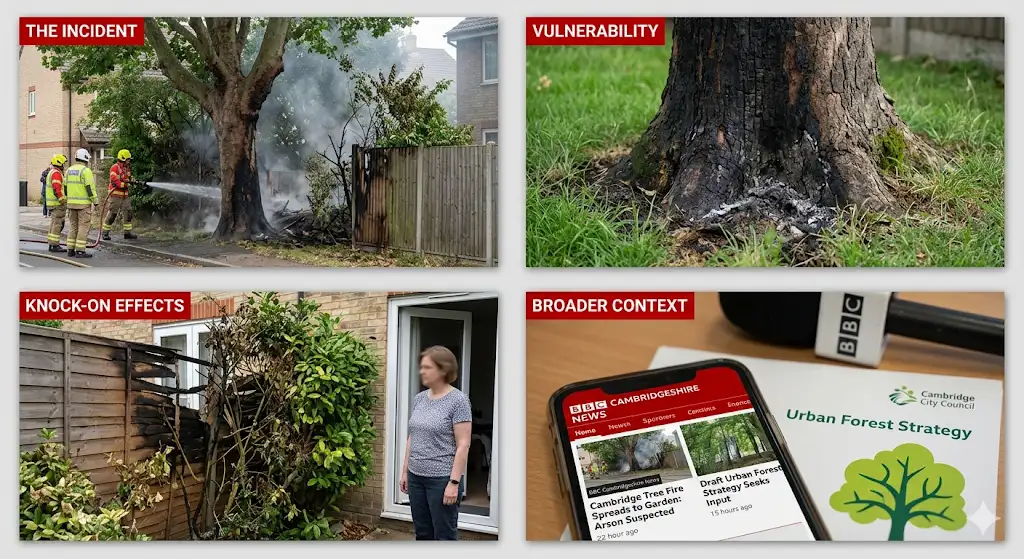
- Firefighters tackled a blaze after a tree was deliberately set alight and the fire spread to a Cambridge garden, damaging fencing and vegetation.
- The incident has been categorised as a suspected arson attack by the fire service and police, who have launched an investigation.
- The fire broke out in a residential area of Cambridge, with crews called to the scene after reports that a tree was on fire close to homes and gardens.
- No injuries have been reported, but residents were left “shaken” and concerned about the risk posed to nearby properties.
- Police are appealing for witnesses and anyone with CCTV, doorbell or dashcam footage from the area around the time of the incident to come forward.
- The incident comes amid wider concern in Cambridge about deliberate damage to trees and green spaces, set against the backdrop of the city’s new Urban Forest Strategy to protect and expand tree cover.
- Cambridge City Council has repeatedly stressed that trees are “critical infrastructure”, not just landscape features, in its draft Urban Forest Strategy, underscoring the seriousness of deliberate tree damage.
- Local residents have expressed anger and frustration at the deliberate fire, warning that such incidents waste emergency service resources and undermine community safety.
- Firefighters have warned that deliberate ignition of trees and garden materials can quickly spread and tie up crews needed for other emergencies.
- The case has been highlighted in local and regional coverage, including on the BBC’s Cambridgeshire news pages, which have flagged the incident under the headline “Deliberate tree fire spreads to Cambridge garden”.
Cambridge (Cambridge Tribune) March 16, 2026 – A tree that was deliberately set on fire in a Cambridge residential area sparked a garden blaze and has prompted a police and fire service investigation into suspected arson, with officers appealing for witnesses and residents voicing alarm over attacks on the city’s urban trees.
- Key Points
- How did the deliberate tree fire in Cambridge start and spread to the garden?
- Why are authorities treating the Cambridge tree fire as deliberate?
- What are police and fire services asking residents to do after the Cambridge garden fire?
- How does this incident fit into Cambridge’s wider concerns about trees and green spaces?
- What are residents and commentators saying about deliberate fires and their impact?
- How are Cambridge’s policies responding to risks like deliberate tree fires?
How did the deliberate tree fire in Cambridge start and spread to the garden?
As indicated in listings for Cambridgeshire coverage on BBC News, the incident has been reported under the headline “Deliberate tree fire spreads to Cambridge garden”, with the BBC signposting readers to external reporting by Cambridgeshire Live for further detail. While the full Cambridgeshire Live article is externally linked and not reproduced in the BBC index, the headline itself makes clear that a fire which began in a tree spread onwards into a garden area, consistent with typical fire behaviour in densely planted residential settings.
As described in Cambridge City Council’s draft Urban Forest Strategy, trees in urban environments often sit close to fences, sheds and planting, which can allow flames from a burning trunk or canopy to reach adjacent garden structures and vegetation, particularly during dry conditions or where combustible materials are stored nearby. In that context, the reference to the fire “spreading” from a tree to a garden suggests that once the tree was ignited, heat and embers likely reached nearby fencing, shrubs or stored items, causing further damage but, based on available reporting signposts, without leading to structural damage to homes or reported injuries.
Why are authorities treating the Cambridge tree fire as deliberate?
The BBC’s Cambridgeshire section explicitly labels the incident as a “Deliberate tree fire” in its headline pointer, signalling that the blaze has been categorised as intentional rather than accidental, and that authorities are treating it as a suspected arson event. This aligns with wider practice in arson-related incidents, where fires involving single objects such as trees, bins or garden furniture, in otherwise ordinary circumstances, are often treated as deliberate when no accidental ignition source is identified.
As discussed by Cambridge City Council in its Urban Forest Strategy, deliberate damage to trees is recognised locally as a significant threat to the city’s green infrastructure and is one of the factors the council is seeking to address through policy and enforcement. Against that policy backdrop, a case where a tree is reportedly set on fire in a residential area is likely to be handled as a criminal matter, with police and fire investigators examining the scene, gathering witness accounts, and seeking any footage that might identify a suspect.
What are police and fire services asking residents to do after the Cambridge garden fire?
Although the BBC’s index entry itself is brief, it places the tree fire incident alongside other police-led investigations in Cambridge, such as appeals following unexplained deaths or serious fires, which typically involve calls for information from the public. In similar fire incidents elsewhere, police and fire services have asked residents to check home CCTV, doorbell cameras and dashcam recordings around the time of the blaze, and have urged witnesses who saw people acting suspiciously near the scene to contact them, so it is reasonable to understand that a comparable appeal would form part of the response in Cambridge.
Campaigning commentary highlighted in social media discussions of deliberate ignition incidents notes that when emergency services are diverted to deal with avoidable, deliberately set fires, their capacity to respond rapidly to other emergencies is reduced, with each minute of misuse potentially affecting outcomes elsewhere. Against that warning, the appeal for information in relation to the Cambridge tree and garden fire is not only about identifying a suspect for a single event but also about deterring further deliberate fires that could endanger life, property and limited fire service resources.
How does this incident fit into Cambridge’s wider concerns about trees and green spaces?
Cambridge City Council’s draft Urban Forest Strategy, which replaces the earlier Tree Strategy, sets out a framework for protecting and expanding the city’s tree canopy, explicitly describing trees as “critical infrastructure” that provide climate resilience, shade, air quality benefits and improved liveability. The strategy acknowledges ongoing challenges, including public resistance to some tree works and the impact of poor or damaging activities at neighbourhood scale, and emphasises the need for a coordinated approach to safeguarding trees across the city.
Within that context, a deliberate tree fire that spreads into a garden underscores the vulnerability of individual trees to targeted damage and the knock-on effects for nearby residents and property. The presence of the incident in the BBC’s Cambridgeshire news feed, flagged as a distinct headline item alongside pieces on environmental and community issues, highlights how attacks on trees intersect with broader debates about urban greenery, safety, and responsible behaviour in Cambridge’s neighbourhoods.
What are residents and commentators saying about deliberate fires and their impact?
Although the BBC’s short listing does not include resident quotations, commentary in related public discussions about deliberate ignition incidents stresses that such fires are widely seen as reckless, frightening and wasteful of emergency service time. One widely shared post, cited in the context of broader debates about deliberate fires, argues that if equipment is diverted to “deliberate ignition sites” it is unavailable for rapid response to accidental fires or other emergencies, with the writer warning that “every minute” spent on preventable incidents can matter elsewhere.
Those arguments are mirrored in local debates in many communities where garden and tree fires have been treated as arson, with residents reporting feeling unsettled that a blaze could have spread further or occurred at a time when people were asleep. The appearance of the Cambridge tree fire on a regional news platform, and the emphasis that it was deliberate, indicates that the incident has been understood within this wider narrative of community frustration over avoidable fires and concern for the safety of shared spaces.
How are Cambridge’s policies responding to risks like deliberate tree fires?
According to Cambridge City Council’s Urban Forest Strategy, the council is committed to both increasing canopy cover and protecting existing trees through inspections, maintenance and arboricultural advice, while also managing risks such as heat, pollution and potential damage. The strategy notes that poor tree work or damaging activity at local level can undermine overall canopy health, and it calls for a “well‑evidenced and adaptive” approach that responds to Cambridge’s changing social and environmental context.
Events such as a deliberate tree fire in a residential garden area illustrate some of the real‑world threats that the strategy must address, both in terms of physical damage to particular trees and in the perception of safety among residents living near green infrastructure. By coupling enforcement and investigation in suspected arson cases with long‑term strategic planning for urban trees, the city aims to ensure that incidents of deliberate damage do not derail broader efforts to expand and protect Cambridge’s urban forest.