


Petersfield is one of Cambridge’s long‑established residential neighbourhoods, situated north‑east of the city centre and bordered by areas such as Newmarket Road, Mill Road, and the Cambridge Science Park. Over the past two decades, it has seen a mix of traditional housing, infill developments, and new estates, which has increased household density without always matching it with proportionate on‑street or off‑street parking. That mismatch now sits at the heart of many of the parking and noise complaints residents report.
- Why parking complaints are common in Petersfield
- How Cambridge’s parking rules and resident schemes work?
- How to report illegal or inconsiderate parking in Petersfield
- Noise complaints in Petersfield: what counts as a nuisance?
- How to report noise complaints in Cambridge and Petersfield
- Practical steps Petersfield residents can take
- Looking ahead: what could change in Petersfield’s noisy–parking landscape?
Within Petersfield, a number of streets form part of the Cambridge Resident Parking Scheme, including the Petersfield zone itself as well as nearby Silverwood Close and other adjacent roads. These schemes are designed to prioritise parking for local residents by restricting where visitors, commuters, and visitors from nearby employment or retail sites can park during key hours. When the system works as intended, residents benefit from greater certainty that they can park close to home; when it does not, tensions quickly arise over both noise and parking.
Why parking complaints are common in Petersfield
Parking complaints in Petersfield often stem from a combination of structural and behavioural factors. Many older streets in the area were laid out before today’s car ownership levels, and newer developments have sometimes been approved with fewer on‑street bays than the total number of dwellings. For example, some in‑fill estates in Petersfield‑adjacent areas have been built with around 1.9 parking spaces per dwelling on paper, yet in practice the ratio drops well below one space per household when certain units are excluded from the allocation, leaving many residents reliant on nearby public roads.
This shortfall is amplified by the volume of commuter and visitor traffic generated by nearby employment sites, the Cambridge Science Park, and the ring‑road corridor that feeds into and around Petersfield. As a result, residents frequently report long‑term parking by non‑residents, overnight commutes, and vehicles from contractors or deliveries, which can fill on‑street bays for extended periods and block driveways or cycle routes. These pressures are further inflamed when there are gaps or ambiguities in Traffic Regulation Orders (TROs), such as unclear yellow‑line restrictions or unprotected side‑road mouths, which can allow parking that obstructs cyclists, pedestrians, and emergency‑vehicle access.
Local residents’ groups and consultation materials have noted that, without fully considered resident‑parking schemes and clear signage, parking can effectively “spill over” from one zone into another, creating a domino effect where pressure in Petersfield pushes vehicles into surrounding Petersfield‑linked streets and vice versa. Residents often describe feeling that their own streets are treated as “overflow car parks” for outsiders, which becomes a recurring theme in both formal complaints and informal neighbourhood discussions.
How Cambridge’s parking rules and resident schemes work?
Cambridgeshire County Council and Cambridge City Council jointly manage on‑street and off‑street parking in Cambridge, including the Petersfield area. The legal backbone for parking control is the Road Traffic Regulation Act 1984, under which the county council can designate parking places, restrict parking through yellow‑line markings, and introduce Traffic Regulation Orders that govern where and when vehicles can stop or park. These TROs are what enable resident‑parking schemes, time‑limited waiting zones, and controlled‑parking areas to operate in practice.
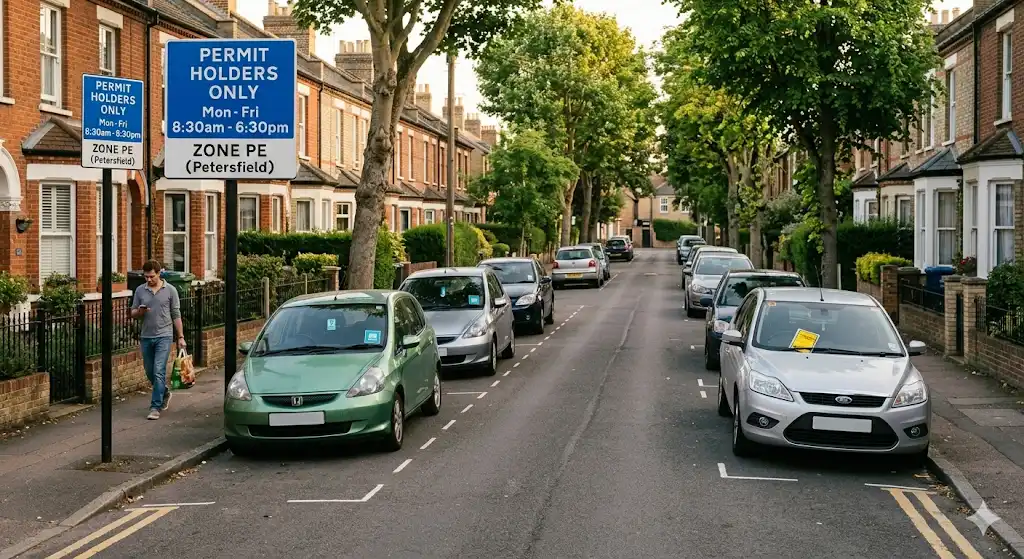
Within the Cambridge Resident Parking Schemes, Petersfield is one of several designated zones where residents can apply for annual parking permits, currently priced at around £83 per standard permit (with discounted rates for low‑emission vehicles). Under these schemes, designated on‑street bays are reserved for permit‑holders during specified hours, usually daytime working hours on weekdays, to discourage long‑term occupation by non‑locals. The policy also recognises that each household can hold up to a limited number of permits, which helps prevent abuse while still accommodating multi‑vehicle families.
However, the same documentation notes that resident‑parking schemes are not a universal fix. Introducing a scheme involves a formal feasibility study, consultation with residents and other stakeholders, publication of a draft TRO, and assessment of objections. If a Petersfield‑linked street does not meet the criteria such as a lack of demonstrable resident parking pressure, insufficient space, or strong local opposition a scheme may not be introduced, leaving residents reliant on standard civil‑enforcement measures such as Penalty Charge Notices for illegal parking. That means residents in some Petersfield‑adjacent streets may have to rely more on reporting and enforcement than on a formal resident‑only scheme.
How to report illegal or inconsiderate parking in Petersfield
If parking is plainly illegal on double‑yellow lines, blocking pavements, HGVs stopped on restricted stretches, or vehicles parked in clearly marked “no‑parking” zones residents can report directly to Cambridgeshire County Council’s parking‑enforcement team. The council advises contacting the appropriate parking‑control email or online reporting channel, ideally with the vehicle’s registration, location, and a clear description of the contravention. This information allows civil‑enforcement officers to check TROs and issue Penalty Charge Notices where applicable.
For more persistent or complex issues such as walkways blocked by cars, pavement parking, or vehicles parked so close to junctions that they impair visibility local advocacy groups in Cambridge have encouraged residents to use structured reporting tools and photo‑based submissions. For example, community‑led campaigns on nearby Mill Road have documented inconsiderate parking with date‑stamped photos and precise locations, which are then shared with the council and sometimes incorporated into wider pressure‑for‑change initiatives. Similar tactics can be valuable in Petersfield‑area streets where pavement or cycle‑lane parking creates safety risks.
Residents who think that an area’s parking arrangements are no longer fit for purpose can also initiate or support proposals for new or amended resident‑parking schemes. The formal process starts with a request from local councillors or residents, followed by a feasibility study, consultation, and then, if successful, a new Traffic Regulation Order. In practice, residents in Petersfield‑linked neighbourhoods have used petitions, consultation responses, and engagement with county councillors to argue for additional yellow‑line restrictions, clearer bay‑markings, and more robust resident‑only controls in response to long‑standing parking complaints.
Noise complaints in Petersfield: what counts as a nuisance?
Noise complaints in Petersfield cover a wide range of sources, from household noise and gardens to construction and road‑related sounds. Cambridge City Council classifies certain recurring issues such as loud music from homes or flats, noisy building sites, and persistent amplified sound as “unwanted noise” that can be treated as a statutory nuisance under the Environmental Protection Act 1990. The council’s environmental‑health and noise‑enforcement teams investigate complaints where noise is frequent, prolonged, or so loud that it interferes with sleep, relaxation, or day‑to‑day use of homes.
For residents, the key distinction is between “everyday living noise” and “actionable” nuisance. The council notes that some background sounds, such as normal household activity, occasional shouts in the street, moving traffic, and aircraft noise, often fall outside the scope of what officers can legally enforce. Statutory‑nuisance powers are instead reserved for situations where noise is unreasonable and persistent, such as loud music played late into the night, disruptive parties, or poorly shielded construction work near residential properties.
In Petersfield‑linked areas, local residents’ groups have highlighted that noise from construction, communal‑area activities, and even rooftop equipment on nearby premises can become serious living issues, especially when buildings are close together and sound insulation is limited. Some reports describe residents perceiving vibrations or low‑frequency rumble from nearby developments, which can be particularly hard to resolve because they sit at the boundary between building‑regulation standards and environmental‑health enforcement. These cases often require detailed technical assessment, including noise‑level measurements and site visits, before the council can decide whether the activity breaches the statutory‑nuisance threshold.
How to report noise complaints in Cambridge and Petersfield
Cambridge City Council provides a clear pathway for reporting noise complaints that are suspected to be statutory nuisances. Residents are encouraged to first try talking to the person causing the noise, as many issues can be resolved informally. When that does not work, or when the source is anonymous or commercial, the council can be contacted via its online reporting channels or by phone, with officers then reviewing the complaint and deciding whether a formal investigation is warranted.
During an investigation, officers may ask the complainant to keep a simple diary recording the date, time, duration, and nature of each noise event. This evidence helps determine whether the noise is intermittent and forgivable or part of a sustained pattern that may justify an abatement notice or, in extreme cases, prosecution. If the council decides that the noise is a statutory nuisance, it can serve an abatement notice ordering the responsible party to reduce or stop the noise; failure to comply can lead to fines and, in some situations, seizure of noise‑making equipment.
Residents who live outside the Cambridge City Council area but near Petersfield such as those in the wider South Cambridgeshire district can report similar noise issues to South Cambridgeshire District Council’s environmental‑health team, which also investigates noise from homes, businesses, vehicles, and street equipment. That team similarly requires written or online complaints, sometimes with supporting evidence, and may conduct follow‑up visits or measurements before deciding on enforcement action. For noise from construction or industrial sites, additional guidance on “best practicable means” of minimising disturbance is set out in council‑published environmental‑health and planning documents, which can inform both residents’ expectations and officers’ decisions.
Practical steps Petersfield residents can take
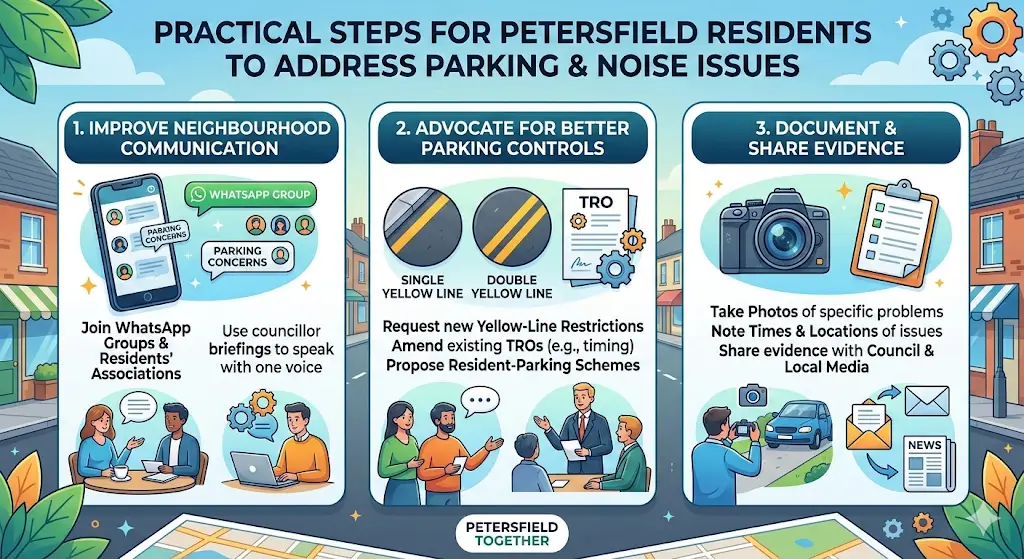
Residents in Petersfield and surrounding streets can take several practical steps to reduce both noise and parking friction. For parking, clear communication within the neighbourhood through WhatsApp groups, residents’ associations, or local‑councillor briefings can help articulate consistent concerns when pushing for new yellow‑line restrictions, amended TROs, or the introduction of resident‑parking schemes. Documenting specific problems (photos, times, locations) and sharing that evidence with the council and local media can strengthen the case that existing parking controls are no longer adequate.
On the noise front, residents can reduce their own impact by keeping music and outdoor activity at reasonable volumes, especially between 11 pm and 7 am, and by using sound‑insulating measures such as closing windows and using carpets or acoustic barriers where possible. When neighbours are the source of noise, approaching them politely and proposing agreed “quiet hours” often prevents escalation. If informal talks fail, compiling a concise diary of incidents and then escalating to the council or, in some cases, to the Magistrates’ Court under section 82 of the Environmental Protection Act 1990, can provide a structured legal route.
Residents’ groups in and around Petersfield have also found it useful to engage proactively with developers and building‑control teams when new housing or commercial projects are proposed. By asking for explicit noise‑mitigation and parking‑allocation plans during the planning stage, communities can help prevent future complaints rather than reacting after builds are complete. This can include requesting detailed parking‑ratio calculations, pedestrian‑and‑cycle‑safety assessments, and night‑noise‑management plans for construction work, all of which can be attached as conditions to planning permissions or TRO consultations.
Looking ahead: what could change in Petersfield’s noisy–parking landscape?
Looking forward, the balance between development, parking supply, and quality‑of‑life concerns in Petersfield will continue to evolve. Cambridge’s wider strategy for transport and parking emphasises managing kerb space, expanding resident‑parking schemes where appropriate, and improving enforcement of existing restrictions. At the same time, city‑wide environmental‑health reports show that noise complaints both daytime and nighttime remain a significant strand of local‑government workload, underscoring that residents are increasingly vocal about noise impacts from housing, construction, and commercial activity.
For Petersfield specifically, two main levers are likely to shape future noise and parking issues. The first is the refinement of resident‑parking schemes and TROs, including potential expansions or tightening of permit areas, clearer signage, and stricter enforcement against pavement and double‑yellow‑line parking. The second is the integration of noise‑mitigation requirements into new developments, using planning‑condition and environmental‑health guidance to ensure that flats, mixed‑use buildings, and refurbishments are designed with sound insulation and community‑impact assessments in mind.
Residents who are consistently affected by noise or parking problems can therefore expect that, while not every complaint leads to immediate change, sustained, well‑documented feedback does influence policy and enforcement priorities. By engaging with local councils, councillors, and residents’ associations, and by using the official channels available for reporting both parking and noise issues, Petersfield households can help shape a neighbourhood where living standards and parking access are more evenly balanced with the demands of a growing city.

