
Chesterton, a residential neighborhood in east Cambridge, Massachusetts, remains a highly desirable location in 2026 for those seeking proximity to innovation hubs like MIT and Kendall Square while enjoying relative quietude. Its strengths include top-tier schools, low crime rates, and robust employment in biotech and tech, though exorbitant housing costs and urban challenges like traffic congestion temper its appeal for budget-conscious residents.
- Precise Geographic Positioning and Layout
- Current Housing Inventory and Pricing Tiers
- Detailed Cost of Living Components
- Crime Statistics and Safety Metrics
- Public Education System Performanc
- Economic Drivers and Job Market Depth
- Retail Amenities and Daily Conveniences
- Parks, Recreation, and Fitness Infrastructure
Precise Geographic Positioning and Layout

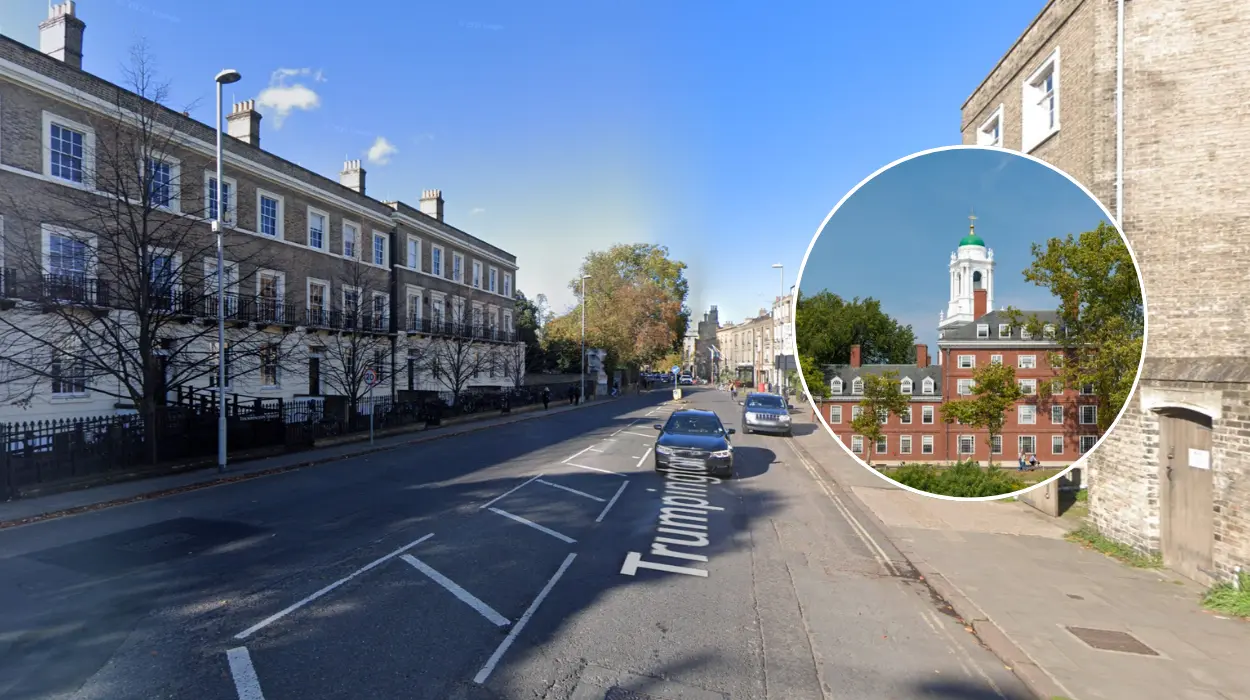
Chesterton occupies roughly 1.2 square miles in eastern Cambridge, bounded by the Charles River southward, Massachusetts Avenue westward, Somerville northward, and industrial zones eastward near the Lechmere Viaduct. Its grid features tree-lined streets with Victorian-era rowhouses from the 1890s, mid-century ranch homes, and post-2010 condo developments spurred by zoning variances allowing four-story buildings. Population density sits at 25,000 per square mile, lower than Central Square’s 40,000, fostering a suburban-within-urban feel.
Walk scores average 88/100, with essential services within 0.5 miles. Elevations range 10-30 feet above sea level, minimizing flood risks compared to riverfront areas, though FEMA updated Zone AE designations in 2025 prompted $5,000 elevation certificates for some basements.
Current Housing Inventory and Pricing Tiers
As of January 2026, Cambridge’s median single-family home price stands at $995,000, with Chesterton properties averaging $1.05 million for 1,800 square foot three-bedroom homes built pre-1940 or $1.25 million for newer constructions. Condominiums range $750,000-$950,000 for two-bedrooms (1,200 sq ft), while townhouses hit $1.4 million. Inventory levels at 2.8 months’ supply favor sellers, with 65% of listings receiving multiple offers and closing 7% above asking within 18 days.
Rental dynamics show one-bedrooms leasing at $3,200-$3,900 monthly (15% vacancy), two-bedrooms $4,500-$5,800, and three-bedrooms $6,200-$7,500, primarily to young professionals on 12-month leases. Furnished corporate units command $5,000+ premiums near biotech campuses. Year-over-year appreciation slowed to 0.2% amid Federal Reserve rate holds at 6.2% for 30-year mortgages, yet rental yields hold at 4.2% after expenses.
First-time buyer programs via MassHousing offer 3% down payments up to $650,000, though Chesterton’s prices exceed thresholds, pushing newcomers toward FHA 203(k) rehabs on older stock. Seller concessions average 1-2% for repairs, common in properties requiring $20,000-50,000 updates for lead paint or knob-and-tube wiring.
Detailed Cost of Living Components
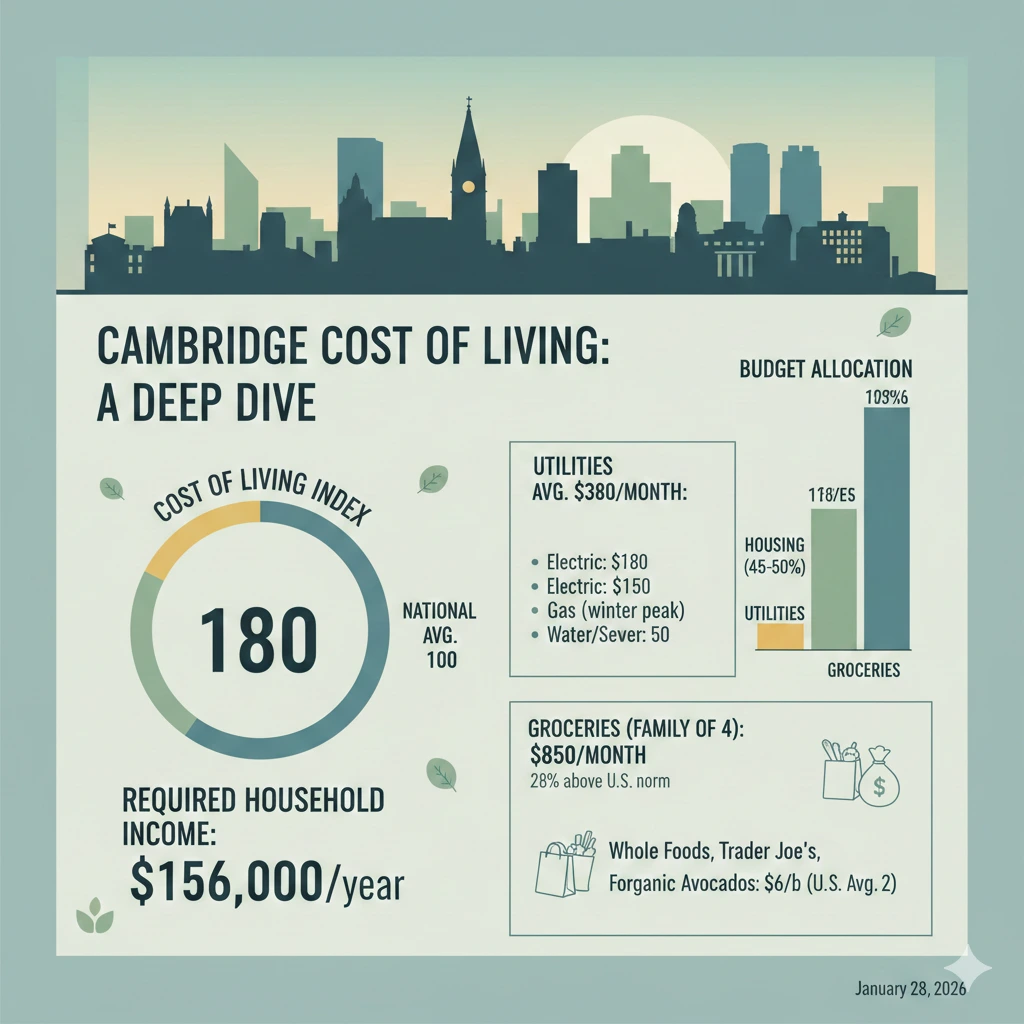
Cambridge’s cost-of-living index registers 180 versus the national 100, necessitating a $156,000 household income to maintain equivalent purchasing power—roughly three times median rent payments. Housing dominates at 45-50% of budgets, followed by utilities averaging $380 monthly (electric $180, gas $150 winter peaks, water/sewer $50). Groceries for a family of four total $850 monthly, 28% above U.S. norms due to prevalence of Whole Foods, Trader Joe’s, and farmers’ markets emphasizing organic produce at $6/lb avocados versus $2 national.
Transportation costs $220 monthly: MBTA monthly pass $90, Bluebikes annual $99, occasional Uber $18/ride to Boston. Healthcare outlays include $680 individual Blue Cross Blue Shield premiums (post-subsidy), $1,900 family plans, with copays 20% higher ($45 primary care). Dining averages $28 lunch entrees, $55 dinners; gym dues $135 at Equinox or $85 YMCA. Childcare burdens families at $2,400 infant monthly, $1,600 preschoolers through age 5.
Chesterton’s micro-cost advantages manifest in 12% lower restaurant prices than Harvard Square and discounted Market Basket access in neighboring Somerville, saving $100 monthly on staples. Tax profile includes Massachusetts’ flat 5% income tax, 6.25% sales tax, and local property levies at 1.23% assessed value ($12,200 median bill), partially offset by homestead exemptions up to $1,000 for owner-occupants.
Crime Statistics and Safety Metrics
Chesterton’s violent crime rate measures 1.2 incidents per 1,000 residents annually—60% below national averages—with property crimes at 12.4 per 1,000 (45% lower). Cambridge Police 2025 year-end reports logged 142 total incidents neighborhood-wide: 18 burglaries, 92 larcenies, 32 vandalism cases, concentrated along commercial Chesterton Road corridors rather than residential blocks.
Response times average 4.1 minutes fire, 6.2 EMS, bolstered by two stations within 1.5 miles. Community initiatives like monthly safety forums, Ring camera subsidies ($100 rebates), and youth diversion programs correlate with 8% year-over-year declines. Homeless encampments, up 15% citywide after state shelter funding cuts, appear sporadically near transit but clear within 48 hours per nuisance ordinances. Domestic violence calls dropped 12% via expanded social services.
Public Education System Performanc
Cambridge Public Schools district assigns Chesterton to King Open Integrated Elementary (K-8), scoring 95/100 GreatSchools for 87% math proficiency and 89% reading among 400 students (11:1 ratio). Feeder high school Cambridge Rindge and Latin posts 92% four-year graduation, 82% college enrollment, AP participation 65%. Class sizes hold at 17-19, with 28% economically disadvantaged students outperforming state averages by 15 points.
Budget per pupil exceeds $28,000, funding STEM labs, arts integration, and free full-day kindergarten since 2019. Special needs inclusion rates 18%, with autism/ADHD supports via district therapists. Extracurriculars encompass robotics clubs (state finalists), orchestra, and sports leagues. Private alternatives like Shady Hill ($48,000 tuition) or Buckingham Browne & Nichols draw 20% families, while MIT/Harvard open summer programs free to locals.
Adult learners access Cambridge Adult School’s 50+ free courses in coding, ESL, and financial literacy, enrolling 2,500 annually.
Economic Drivers and Job Market Depth
Median household income $133,847, per capita $81,448, unemployment 2.8%—half national rates. Biotech dominates with 40% employment: Kendall Square’s 100+ firms (Moderna 6,000 staff, Pfizer 2,500, Broad Institute 2,200) plus Google (3,000), Amazon (1,500). Academia employs 20,000 via MIT/Harvard affiliates; startups add 5,000 in venture-backed roles averaging $140,000 base.
Chesterton commutes average 22 minutes (12% under 15, 45% under 30), with 55% remote/hybrid per 2025 census. Entry scientist salaries start $95,000, directors $220,000+ equity. Growth forecasts 4.2% through 2028, led by AI therapeutics and quantum computing, outstripping U.S. 2.5%. Layoff risks minimal post-2024 Big Tech stabilization.
Retail Amenities and Daily Conveniences
Chesterton Road’s 0.8-mile corridor anchors 25 independents: Forge Baking (artisan sourdough $7), Harvest Co-op (bulk organics), Pharmacy One (24/7). Dining portfolio includes Tatte Bakery, Thai Haley (pad see ew $18), Darwin’s Ltd (sandwiches $14), plus three coffee roasters. Nuffield Health gym ($140), CorePower Yoga, and five daycares ($2,200 infant) complete basics.
Saturday farmers market (50 vendors, 8am-1pm) features CSAs; weekly bulk pickup recycles 70%. Porter Square (1.2 miles bus) supplies Target, Wegmans; Central Square (1 mile walk) 50 eateries, indie cinema.
Parks, Recreation, and Fitness Infrastructure
Russell Field (3 acres) hosts tot lots, soccer, basketball; Magazine Beach (10 acres riverfront) kayaks ($25/hour), picnics. Linear Park’s 2-mile paved trail links to Fresh Pond 5-mile loop (running groups daily). Community center ($50 membership) offers pools, weights, classes; Bluebikes 12 stations (0.4 mile spacing). Youth leagues serve 1,200 kids; adult softball 20 teams.