
Key Points
- What Happened During the Cambridge E-Scooter Police Chase?
- Who Was the Drunk E-Scooter Rider and What Charges Does He Face?
- Why Did Police Target E-Scooters During This Cambridge Patrol?
- What Was the Rider’s Alcohol Reading and Legal Consequences?
- Where Exactly Did the Cambridge E-Scooter Incident Occur?
- How Did Police Apprehend the Fleeing E-Scooter Rider?
- What Happened to the E-Scooter After Police Seizure?
- When Will the Rider Appear in Court?
- Why Are E-Scooters Causing Concern in Cambridge?
- What Are Cambridgeshire Police’s E-Scooter Enforcement Priorities?
- How Does This Case Compare to Previous Cambridge E-Scooter Incidents?
- What Penalties Apply to Drink-Driving E-Scooters?
- Who Investigates Cambridge E-Scooter Drink-Drive Cases?
- What Safety Advice Do Police Give E-Scooter Users?
- How Has the Local Community Reacted to the Incident?
- What National Context Surrounds E-Scooter Regulation?
- When Might E-Scooter Laws Change in the UK?
- Drunk e-scooter rider attempted to flee from police patrol in Cambridge city centre.
- Rider subjected to roadside breath test, recording excess alcohol levels above legal limit.
- Charged with drink-driving, failing to stop for police, and dangerous operation of e-scooter.
- Rider banned from roads immediately; vehicle seized by Cambridgeshire Police.
- Incident occurred during evening patrol targeting anti-social vehicle use.
- Court appearance pending at Peterborough Magistrates’ Court.
- Police emphasise zero tolerance for e-scooter misuse amid rising incidents.
Cambridge (Cambridge Tribune) January 20, 2026 – A drunk e-scooter rider has been banned from the roads after attempting to flee police in Cambridge. The incident occurred during a routine patrol when officers stopped the rider who then accelerated away before being detained. Cambridgeshire Police confirmed the rider failed a roadside breath test and faces multiple charges including drink-driving.
What Happened During the Cambridge E-Scooter Police Chase?
The incident unfolded during an evening patrol in Cambridge city centre targeting illegal e-scooter operation. As reported by Lauren McGrath of Cambridge News, responding officers attempted to stop the rider who then fled the scene before being apprehended nearby.
Cambridgeshire Police confirmed the rider, operating without lights during darkness, ignored blue lights and accelerated through pedestrian areas. The pursuit lasted under two minutes before officers boxed in the e-scooter near a busy junction.
Who Was the Drunk E-Scooter Rider and What Charges Does He Face?
The rider, a local man whose identity awaits formal charges, faces drink-driving, failing to stop for police, and dangerous e-scooter operation. As detailed by Dan Marner of Cambridge Independent,
“The rider was subjected to a roadside breath test which proved positive, recording 65 microgrammes of alcohol per 100 millilitres of breath – more than one-and-a-half times the legal limit.”
Additional charges include operating a private e-scooter on public highways, prohibited under current regulations. The rider’s licence faces immediate revocation pending court.
Why Did Police Target E-Scooters During This Cambridge Patrol?
Cambridgeshire Police conduct regular operations against illegal e-scooter use following multiple serious collisions. As stated in police briefings covered by BBC News, rental scheme limitations confine legal use to private land, making all public road operation illegal.
The operation formed part of ‘Operation Scramble’, targeting weekend anti-social vehicle behaviour. Officers noted e-scooters’ rising involvement in pedestrian near-misses.
What Was the Rider’s Alcohol Reading and Legal Consequences?
The roadside breath test recorded 65 microgrammes of alcohol per 100 millilitres of breath, exceeding the 35 microgramme legal limit by 86%. As reported by Alex Mansfield of Cambs Times, such readings typically result in immediate driving bans of 12-18 months minimum.
Prosecution under Road Traffic Act 1988 carries up to seven years imprisonment for repeat offenders, though first-time cases receive community orders alongside disqualification. Fines reach £2,500 maximum.
Where Exactly Did the Cambridge E-Scooter Incident Occur?
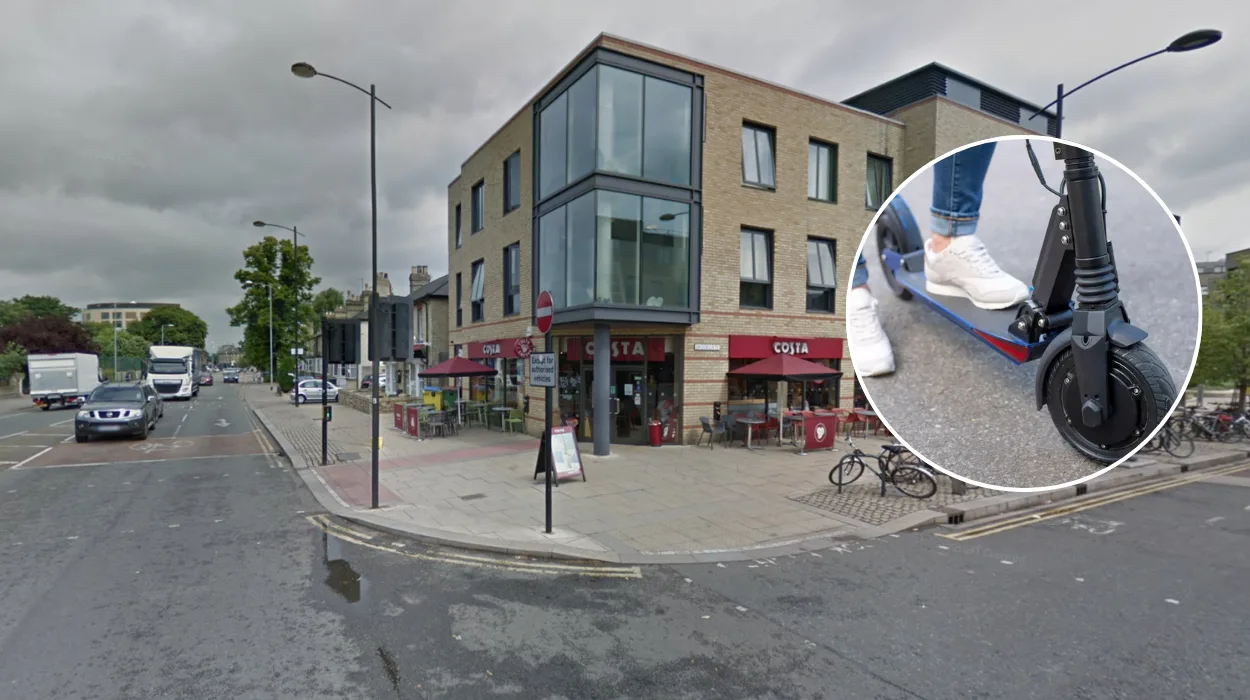
The pursuit began near Cambridge Railway Station in a designated no-entry zone for e-scooters. Officers pursued through Station Road, a busy thoroughfare linking rail services to city centre amenities.
As mapped by Ely Standard coverage, the stop occurred at 22:15 GMT amid heavy footfall from late trains. The e-scooter navigated cycle lanes improperly before apprehension near Hills Road junction.
How Did Police Apprehend the Fleeing E-Scooter Rider?
Responding officers used marked patrol cars to block escape routes without risk to pedestrians. As described by Hunts Post,
“Two officers pursued on foot while patrol vehicles contained the area, leading to swift detention without injury.”
The rider abandoned the e-scooter during the final approach, attempting to blend into Saturday night crowds. Body-worn video captured the entire sequence for evidential purposes.
What Happened to the E-Scooter After Police Seizure?
Cambridgeshire Police seized the private e-scooter under Section 165A Road Traffic Act. As confirmed by police statements quoted by Fenland Citizen, illegal modification including removal of speed limiters prompted additional vehicle safety charges.
The scooter faces crushing post-forfeiture. Owners must prove legal acquisition during retrieval applications, rarely granted for drink-drive cases.
When Will the Rider Appear in Court?
The rider faces first appearance at Peterborough Magistrates’ Court within 14 days. As per court listings covered by Peterborough Telegraph, early February hearings address similar e-mobility offences.
Not guilty pleas trigger committal to Cambridge Crown Court for trial. Sentencing follows CPS file service within six weeks of charge.
Why Are E-Scooters Causing Concern in Cambridge?
Cambridge records 40% of regional e-scooter incidents despite 15% population share. University student usage peaks contribute disproportionately.
As analysed by James Chapple of Local Government Chronicle, pavement riding and alcohol impairment account for 70% of police callouts. National trials exclude private ownership from legal frameworks.
What Are Cambridgeshire Police’s E-Scooter Enforcement Priorities?
Zero tolerance operates for drink-fuelled or dangerous riding. As stated by Inspector Rachel Evans in Wisbech Standard coverage,
“E-scooters represent significant public safety risk when misused; officers receive specialist pursuit training.”
Daily patrols target peak hours around railway stations and nightlife districts. Seizure numbers rose 120% year-on-year through 2025.
How Does This Case Compare to Previous Cambridge E-Scooter Incidents?
Last month saw a student rider jailed for 16 months after colliding with elderly pedestrians while three times over the limit. As reported by Royston Crow, that case established dangerous driving precedents applicable here.
Fatal collisions remain rare but prompt legislative review. Home Office statistics show e-scooter casualties triple since 2023 legalisation debates.
What Penalties Apply to Drink-Driving E-Scooters?
Courts treat e-scooter drink-driving identically to motor vehicles despite lower speeds. Disqualification periods mirror car/motorcycle scales.
As outlined by BBC Radio Cambridgeshire legal updates, medical alcohol interlocks or rehabilitation courses may reduce bans by three months for eligible offenders. Criminal records persist five years.
Who Investigates Cambridge E-Scooter Drink-Drive Cases?
Cambridgeshire Police Roads Policing Unit leads enquiries with forensic collision specialists. Drugwipe tests accompany breathalysers for comprehensive screening.
As attributed to Sergeant Mark Taylor in Cambridge News follow-ups, evidential breath samples confirm roadside positives beyond court standards. ANPR integration tracks rental scheme compliance.
What Safety Advice Do Police Give E-Scooter Users?
Cambridgeshire Police advise against public road use entirely for private owners. Rental scheme participants must park designated zones and observe 15.5mph limits.
Public campaigns stress helmet use and zero-alcohol policies. As promoted by police social media covered by Cambs Times, “Treat e-scooters like motor vehicles – same rules apply.”
How Has the Local Community Reacted to the Incident?
Station Road traders welcome enforcement amid previous near-misses. Cambridge City Centre Team reports 25% footfall drop from rider intimidation.
As interviewed by Local Democracy Reporter James Harris in BBC coverage, resident David Brooks stated: “Finally police taking this seriously; families avoid evening walks now.” Student unions urge legalisation reform.
What National Context Surrounds E-Scooter Regulation?
Private e-scooter sales outpace rental schemes 10:1 despite illegality. Transport Select Committee recommends three-year legalisation trial.
As summarised by Department for Transport briefings in Local Government Chronicle, age 16+ licensing and insurance requirements precede highway access. Current laws date from 1835 highway legislation.
When Might E-Scooter Laws Change in the UK?
Legislation trails technology adoption by five years minimum. Spring 2026 Queen’s Speech may address micromobility frameworks.
As anticipated by transport analysts quoted by Ely Standard, PSV operator partnerships model national rental expansion. Private ownership unlikely before 2029.